Commodifying life
THE ongoing tumult in the Middle East has generated varied notes of discourse. Pakistan and its armed forces deserve all plaudits extended to them for their incessant efforts towards peace.
But beneath these multiple narratives was one particular strand so conspicuous that it went nearly unnoticed. Almost every shifting tide in the conflict was measured in financial outcomes and the impact on global stock markets. The notion of peace itself — including numbers of lives lost — took a position of diminished significance in relation to the vagaries and movements of capital markets.
The preponderance today of global finance under the Washington Consensus is undisputed. What necessitates critical inquiry is how this sheer dominance emerged, and how the very concept of loss, violence and peace is reduced to financial calculations, predictions and number crunching.
Multiple writers have sought to engage with this query. Critics like David Harvey and Wendy Brown trace the financialisation of the everyday to neoliberalism and the writings of Friedrich Hayek and his disciple Milton Friedman. Michael Hudson, the author of The Bubble and Beyond, identifies the financial sector with ‘rentier overhead’ and the creation of ‘balance sheet wealth’ which has displaced industrial output.
A more rigorous intellectual pursuit, however, draws us to the works of Karl Polanyi, an Austro-Hungarian economic historian who perhaps wrote the most seminal work of his time. The Great Transformation, written in 1944, traces the emergence of the market economy in Western Europe and America and predicts the exact eclipse of the sociopolitical sphere by the economic as we witness almost everywhere today.
As per Polanyi, the market economy is built on fictitious commodities.
Polanyi’s thought requires far more than an op-ed to do it justice, but his fundamental tenets help address the question raised at the start of this piece. For Polanyi, the market economy is built on fictitious commodities — the morbid transformation of land, labour and money into commodities meant for consumption, trade and generating value. This change, according to Polanyi, commodifies and alters the very essence of human society.
Our individuality and relationship with the self is subsumed by our productivity as human capital. Land, which holds a far broader definition than merely the physical sites we occupy, and includes, instead, the entire environmental milieu, becomes an object to be exploited to extract surplus. Polanyi would explain the environmental crisis in these terms as well.
Taken together, this fundamental alteration of the essence of humanity is the ‘great transformation’ which heralds the establishment of the market economy and serves as the point of rupture between the past and the contemporary. We are now, according to Polanyi, in the throes of the market forces of capitalism.
The process remains yet incomplete. And this is where we are drawn to the present state of things. Polanyi contends that the forces of this transformation are inexorable in their magnitude. Human society is now subject to the whims and vagaries of these forces, and since the very elements that made us human now stand altered, ruin awaits civilisation.
While this dire prognosis is as yet elusive, it raises a fundamental question regarding our humanity and social relations. In Polanyi’s tracing of the erosion of the human essence, one begins to comprehend how war, death, peace and stability find traction, justification and valida-
tion in the ‘unhuman’ — spreadsheets, bull runs, and panic. That is the inevitability of the ‘great transformation’, triggered by the birth of fictitious commodities — land, labour and money.
A seemingly trivial narrative about markets panicking, or investors scrambling, is thus loaded with the burden of history and the seismic changes that have altered world society and how this society views itself. The framing of this narrative becomes of critical import as a result, since it gives us objectives and metrics by which we view progress, success and progress, even well-being.
Returning to the overpowering of the social and political by the economic also nudges us towards associated lines of inquiry: neo-colonialism, debt traps and political contestation subsumed by obscure technical jargon. These are all questions that deserve critical engagement on these pages. For now, we remind ourselves of the existential battle humanity fights. Not (as yet) with robots, but with the invisible matrix of finance, hot capital and the erosion of the very essence of what makes us human.
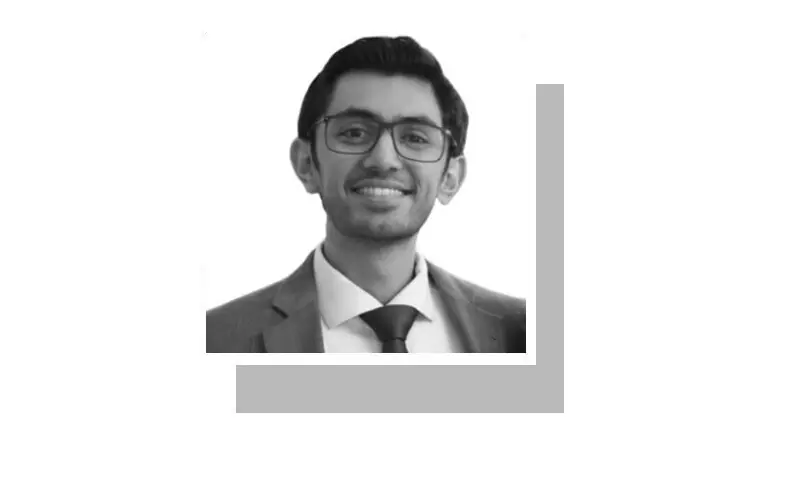
The writer is a civil servant and an alumnus of Cornell University and the University of Oxford.
Published in Dawn, August 11th, 2026