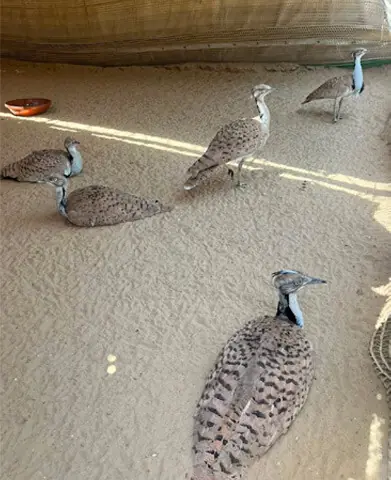
BAHAWALPUR: The Sheikh Mohamed bin Zayed Al-Nahyan Conservation, Breeding Centre at the Lal Sohanra National Park has integrated the modern scientific techniques and technology with wildlife conservation to ensure animal welfare and ecological sustainability.
This was stated by Houbara International Foundation chief retired Maj Tahir at the breeding centre during his briefing to a group of students of the departments of zoology and food sciences and technology of Government Sadiq College Women University, Bahawalpur, on Sunday.
The university students, led by their Vice Chancellor Prof Dr Shazia Anjum, visited the breeding centre.
According to a press release, the students visited the conservation centre to gain practical wildlife conservation experience. At the centre, the students gained practical exposure to wildlife conservation, biodiversity, environmental sustainability and scientific research.
The educational visit was organised with the aim of providing students with practical field experience beyond classroom learning.
Mr Tahir and his team of the Houbara International Foundation briefed the students on the centre.
The students were informed about the centre was using modern incubation technology, veterinary care, research laboratories, disease monitoring and wildlife management practices.
The students’ delegation also visited the blackbuck conservation area where they observed semi-natural habitats, feeding stations, natural ponds, shaded resting areas and modern environmental monitoring systems.
The visiting students particularly appreciated the centre’s zero plastic policy, cleanliness, biosecurity measures and environmentally responsible practices.
They observed how modern scientific techniques and technology were being integrated with wildlife conservation to ensure animal welfare and ecological sustainability.
VC Dr Shazia Anjum said education in the modern era was not limited to classroom and textbook learning but it also depended on practical exposure and field-based experiences for students’ academic and professional development.
She observed that such educational visits provided the students with opportunities to understand real-world applications of their academic knowledge, strengthen their research skills and develop deeper sense of responsibility towards environmental protection and wild life conservation.
She added that the university would continue to provide students with meaningful opportunities for experiential and research-based learning.
Published in Dawn, August 10th, 2026