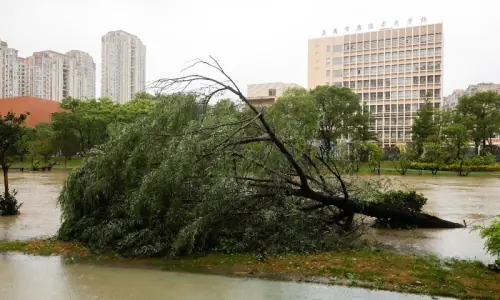
Typhoon Dolphin hits Japan's Okinawa, China shuts ports ahead of landfall
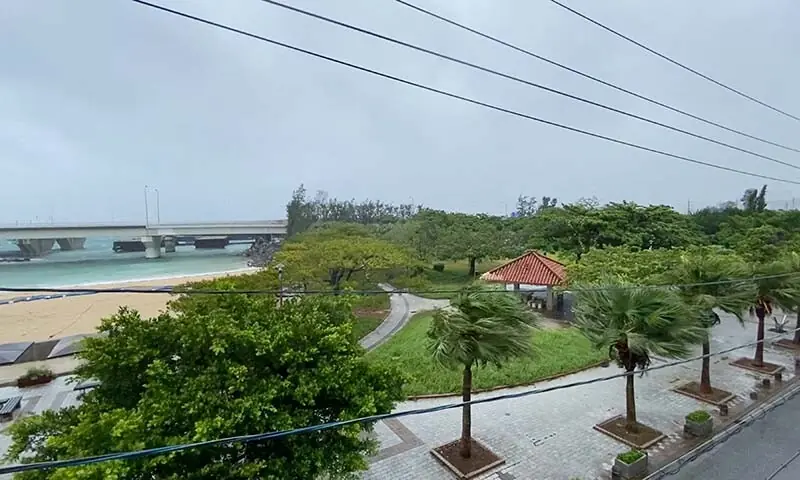
Typhoon Dolphin lashed Japan’s southern Okinawa prefecture on Saturday, injuring six people and cutting power to more than 50,000 buildings, while China shut ports and halted ferries ahead of the storm’s expected arrival on its east coast.
Five elderly people, three of whom fell due to strong winds, suffered non-life-threatening injuries in Okinawa while another person was injured in Kagoshima prefecture, authorities said.
Nearly 39,000 buildings were without power in Kagoshima while just over 12,000 were affected in Okinawa. Domestic airlines, ANA and Japan Airlines, cancelled flights to and from Okinawa.
The typhoon had maximum sustained winds of 162 kilometres per hour with gusts reaching 216 kph. Okinawa and Amami Island in Kagoshima prefecture are the main areas expected to be affected in Japan.
Typhoon expected to make landfall in China
In China, where the typhoon is expected to make landfall between late on Sunday and early on Monday, authorities have designated Dolphin as an orange-category typhoon, the second-highest level.
Worried about the risk of flooding and landslides, authorities also raised the emergency response level for Dolphin by one notch to level III, the second-lowest level.
The typhoon is most likely to make landfall between Zhoushan city in Zhejiang province and Fuding city in Fujian province and is expected to have winds of 38-45 metres per second near its centre, according to China’s National Meteorological Centre.

China’s National Marine Forecasting Centre on Saturday maintained its highest, red-level warning for waves, forecasting 5-to-8-metre (16-to-26-foot) waves in coastal waters off Zhejiang through Sunday afternoon.
Under an orange-level warning, waves in coastal waters off Shanghai and northern Fujian could be 3 to 5.5 metres.
On Saturday evening, Chinese authorities issued five weather and disaster warnings, including orange alerts for typhoon, heavy rain, and geological-disaster risks, along with a red alert for mountain torrents.
Ports and airports halt operations
Rain and strong winds are expected to affect eastern China through August 12, including parts of Shanghai and neighbouring provinces. Some areas could see short bursts of rainfall exceeding 80mm an hour, accompanied by thunderstorms and strong winds.
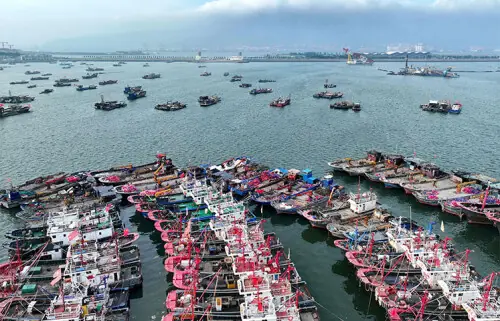
Zhejiang, one of China’s biggest provincial economies and a manufacturing and export hub, raised its coastal typhoon alert to its highest level and halted port operations. Authorities in eastern and southern China also suspended ferries, halted some construction work and ordered fishing boats back to port.
Ningbo Lishe International Airport in Zhejiang said it will suspend all flights on Sunday. Shanghai’s Yangshan port had been cleared of vessels by late on Friday, while some rail services in the Yangtze River Delta will be suspended from Sunday.
Beijing authorities have said they are monitoring the typhoon’s path and are preparing flood-control and evacuation plans for the capital.
In Taiwan, 78 flights, mostly international, were cancelled because of the typhoon, the government said. Heavy rain was expected in northern parts of the island over the weekend, though authorities had not ordered evacuations as of Saturday.
China has ordered that, due to the typhoon, ships passing through the Taiwan Strait must heed its traffic control instruction measures that Taipei denounced as “ridiculous”, saying that Beijing has no right to restrict access to international waters.
China views democratically governed Taiwan as its own territory and claims the strategic strait. Both Taipei and Washington reject that claim.