ARCHITECTURE: THE VANISHING APPRENTICE

Every profession depends on an apprenticeship. Architecture is beginning to lose its own.
There was a time when the life of an architectural office followed a rhythm that barely changed from one generation to the next. The youngest architect measured, drafted and revised. Someone more experienced checked the drawings. Partners met clients, negotiated with contractors and carried the weight of decisions that would eventually become buildings.
Knowledge moved quietly from desk to desk. It was rarely taught outright; mostly it got absorbed through repetition, correction and watching someone else work. That rhythm is starting to break down.
Artificial Intelligence (AI) has entered architectural practice at a pace few expected. Successive surveys by the Royal Institute of British Architects have tracked just how quickly the profession is adopting it.
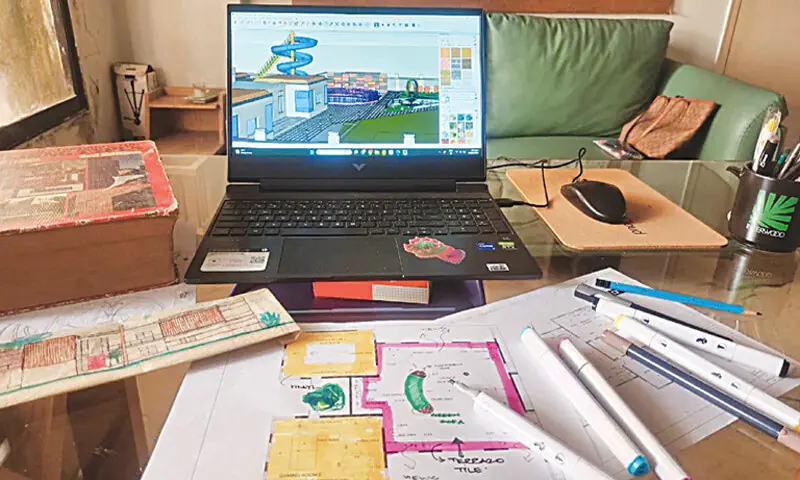
Tasks that once tied up junior architects for days can now be finished in hours. A client describes a project in a few sentences and walks away with several convincing design options before the meeting even ends. Renderings that once needed expensive hardware and an overnight wait now appear almost instantly.
AI hasn’t replaced architects — but it may be quietly dismantling the apprenticeship that once turned young drafters into experienced designers. What happens to a profession when its oldest training ground disappears?
Seen from inside a practice, none of this is easy to argue against. Firms move faster. Clients see more options. Smaller offices can now do things once reserved for practices with dedicated visualisation teams and deep pockets. From computer-aided drafting to software known as Building Information Modelling (BIM), every major shift in architectural tools has arrived carrying the same promise of efficiency.
AI is simply the latest — and the most dramatic — version of that story.
Most of the public conversation has settled on one question: will architects be replaced? That’s the wrong question. The better one is this: what happens when the work through which architects used to learn the profession starts disappearing?
A FOUNDATIONAL SHIFT
For generations, the repetitive tasks handed to young architects were treated as little more than grunt work: producing working drawings, fixing details, coordinating consultants, chasing down documentation. Nobody thought much of it. But it was exactly this kind of ordinary labour that built judgment.
One bad drawing taught you why another had failed. One site visit explained something no textbook ever could. Slowly, the profession stopped being just an academic qualification and became a way of seeing.
AI is now doing a good chunk of that work. And the evidence out of Britain and the US doesn’t point to mass layoffs because of it. The US Bureau of Labour Statistics projected that employment of architects will grow by four percent between 2024 and 2034, roughly in line with the average growth rate across all occupations.
What’s changing instead is the shape of the work itself. Architects are spending less time producing every drawing, and more time supervising, evaluating and refining what the machine generates.
In some ways, that might be healthier for the profession. Architects have long complained about spending more time documenting buildings than actually thinking about them. Strip away the repetitive part, and there’s more room left for design, research and genuine engagement with the places architecture is supposed to serve.
This shift is already visible in offices across Pakistan. In Karachi, Lahore, and Islamabad, work that used to take a junior architect several days now gets done before lunch. Clients have adjusted just as fast — expecting more options, faster revisions, tighter timelines. Many now assume that if images can appear in minutes, decisions should follow just as quickly.
So the technology has sped up design, and expectations have sped up with it. The architect’s job, more and more, is less about producing every drawing and more about judging which of the many possibilities is actually worth building.
But every efficiency drags a harder question behind it. If the apprenticeship disappears, where does experience come from?
THE HUMAN CODE
Architecture is unusual among professions because buildings are never the product of drawings alone. They come out of negotiation, among clients, engineers, contractors, suppliers, labourers, regulators and neighbours. A drawing can satisfy every line of the building code and still fall apart the moment it meets a construction site. Materials go out of stock. Costs jump without warning. A contractor suggests a workaround. A neighbourhood pushes back. A regulation read one way in the office gets interpreted completely differently on site.
No AI understands any of this, because none of it exists as data. It exists as experience.
This is especially true in Pakistan, where so much of building happens outside formal systems. An architect who actually spends time on site learns things no software will ever hand them: which materials hold up in the local climate, how much of a project’s fate rests on informal negotiation, why some buildings quietly fail years after the drawings are filed away and forgotten. This kind of knowledge resists automation for a simple reason. It belongs to a place, not to information.
All of this raises uncomfortable questions about how architects are trained in the first place.
THE CLASSROOM PROBLEM
Architecture schools, for their part, have spent years building curricula around software fluency. Many treat proficiency in industry-standard tools — including Revit, Rhino and parametric workflows — as evidence that a student is ready for the profession. But those exact skills are now being automated faster than a student can even finish a five-year degree.
Universities keep turning out graduates who are excellent with tools, while the profession is increasingly asking for something no tool can teach: judgement. Students pour thousands of hours into mastering software that may be obsolete by graduation day, while a deeper understanding of cities, construction, climate and society gets pushed to the margins.
Maybe the point of architectural education was never to produce software experts. Perhaps it was always meant to produce people who understand cities — including their planning, layout and architecture.
The architect of the future may spend less time drawing buildings and more time working out why one neighbourhood thrives while another falls apart next door. Climate before computation. Housing before visualisation. Construction before automation. Society before technology.
None of this is new, really. It’s closer to the profession’s oldest job description than anything invented recently.
AI can produce startlingly convincing images. What it can’t do is judge whether a settlement is equitable, sense the cultural memory folded into a street or explain why one public square feels alive while another feels abandoned, or take responsibility for the social consequences of a design choice. Those things stay stubbornly human.
WHO GETS THE BENEFIT
There’s another reason this matters beyond the profession itself. Most Pakistanis will never hire an architect. Their homes go up piece by piece, often over years, through conversations with masons, contractors and family, not through a design office. If AI only speeds up architectural services for people who could already afford them, its impact on the country will stay narrow.
But if it eventually makes thoughtful design available to ordinary households, helping families build homes that are safer, healthier and more efficient, then its significance reaches well past the profession. Whether that happens has less to do with the technology than with the choices universities, professional bodies and architects make from here.
Every generation inherits tools better than the ones before it. Few inherit tools capable of doing the very work through which they once learned their craft.
AI may soon draw better than any young architect ever could. Whether it can help produce better architects is a different question — and not one any algorithm can answer. That answer will depend, as it always has, on whether the profession still values the experience no machine can acquire, and the judgement no algorithm can automate.
The writer is an architect based in Karachi. He can
be reached at aliahmedqureshi2000@gmail.com
Published in Dawn, EOS, August 9th, 2026