Pakistan, 7 other Muslim countries once again condemn Israeli violations in Gaza Strip: FO

Eight Muslim countries, including Pakistan, have once again condemned Israeli violations in the Gaza Strip, terming them violations of international humanitarian law and relevant United Nations resolutions.
The Foreign Office (FO) said on Thursday that foreign ministries of Pakistan, Egypt, Turkiye, Indonesia, Jordan, Qatar, Saudi Arabia and the United Arab Emirates, in a joint statement, condemned the continued humanitarian crisis in the region, which they termed “a clear breach of Israel’s obligations under international law”, as well as the plan to end the conflict outlined by United States President Donald Trump in 2025.
The ministers expressed “their strongest condemnation and denunciation of the ongoing Israeli violations in the Gaza Strip, particularly the targeting of healthcare facilities and medical infrastructure, attacks on civilian infrastructure and the continued loss of civilian lives”. They said the continued violence undermined efforts to implement the second phase of the plan, especially after Palestinian factions had accepted the agreement.
The statement added that Israel’s actions threatened to derail the political process and “reignite the cycle of escalation”.
The eight foreign ministers stressed that the protection of civilians, medical facilities, humanitarian and health workers, as well as the immediate delivery of humanitarian aid, were legal obligations that must not be compromised.
They added that the ongoing violations could not be viewed in isolation from ongoing settler attacks in the Occupied West Bank, unlawful expansion of settlements, and the “unilateral measures aimed at altering the ‘status quo in Occupied Jerusalem’”, referring to frequent instances of Israeli settlers storming the Al-Aqsa Mosque — one of Islam’s holiest sites.
The Israeli government has publicly maintained that its policy on the status quo remains unchanged, even as incidents like last Thursday’s continue to inflame the Israeli-Palestinian conflict. However, since taking office, its far-right Security Minister Ben Gvir has stormed Al-Aqsa Mosque more than a dozen times.
“Taken together, these practices constitute a systematic policy aimed at imposing a fait accompli by force, undermining the foundations of the two-state solution, and marginalising the legitimate rights of the Palestinian people,” the statement said.
Reiterating that these actions violated international humanitarian law and relevant United Nations resolutions, the ministers once again called on the international community — particularly the UN Security Council — to compel Israel to fulfill its obligations under those laws while holding to account “those responsible for grave violations”. They added that this should be done in a way that contributes to civilian protection and achieving a permanent ceasefire.
They rejected attempts to annex or impose Israeli sovereignty over the occupied territory or to forcibly displace Palestinians, stressing that a “serious political process” leading to a two-state solution was the only path to a just and comprehensive peace.
This process, they added, should include the establishment of an independent and sovereign Palestinian state based on the pre-1967 borders, with East Jerusalem as its capital.
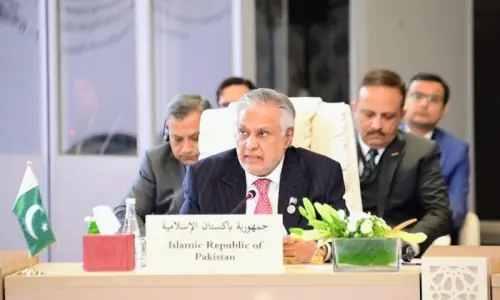
At a ministerial conference in Amman, Jordan on Wednesday, Deputy Prime Minister and Foreign Minister Ishaq Dar said that Israel has no sovereignty over East Jerusalem and its holy sites, condemning the incursions into Al-Aqsa Mosque by “extremist Israeli settlers”.
On the sidelines of the meeting, Dar also held one-on-one meetings with the foreign ministers of Turkiye, Algeria and Egypt, as well as his Jordanian counterpart, with the “deteriorating situation in the occupied West Bank” coming under discussion.