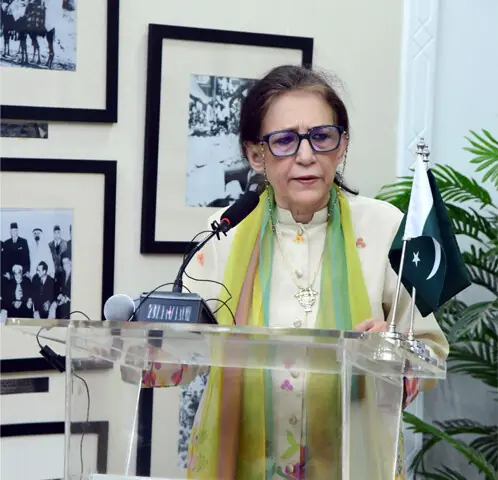
KARACHI: Eminent scholar and historian Prof Dr Ayesha Jalal has said Gaza’s open-air prison has long-served as a mirror to the fate awaiting Kashmiris after August 2019 when their status in the Indian union was unilaterally altered by the right-wing ruling party in New Delhi.
“Like the shocking genocidal violence was perpetrated against the people of Gaza, Kashmiris have been undergoing no less heartbreaking violence,” she said while delivering a talk on the current global scenario and its consequences at the Quaid-i-Azam House Museum on Tuesday evening.
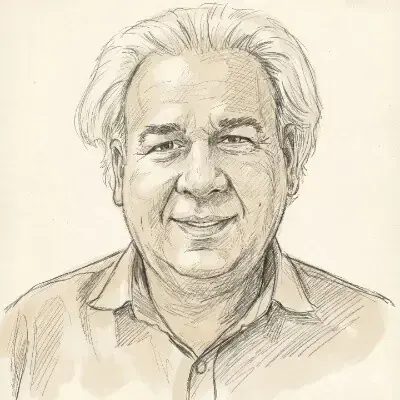
Prof Jalal, who is the Mary Richardson Professor of History/Director, Centre for South Asian and Indian Ocean Studies, Tufts University, began her lecture by saying that we’re witnessing seismic shifts in international politics with mind-boggling implications.
“A multitude of crises are emerging pushing the global economy to the precipice. We’re struggling with a global leadership deficit plunging countries into chaos. The consequences are detrimental for international organisations like the UN which for all practical purposes have become defunct,” she said.
Historian Ayesha Jalal says Jinnah took firm stance on Kashmir and Palestine
She said war clouds continue to hover menacingly over West Asia. She said: “International law is in a shambles. The mantra of neoliberalism and greed have bred despicable forms of human bestiality as we have seen to our distress in the killing fields of Gaza and Southern Lebanon.
“We have not seen one but two wars inflicted on Iran for the security of Israel backed by US and its European allies… There also signs of new possibilities that can shape the future.”
She then shifted her focus to what the Quaid-i-Azam Mohammad Ali Jinnah would have said about the situation. “Among the greatest dangers facing us today is the plague of ethno-nationalism… Palestine and India are two regions subjected to partition purportedly based on religion by the colonial masters.”
Prof Jalal said Gaza has long-served as a mirror to the fate awaiting Kashmiris after August 2019. She said Kashmiris have been undergoing no less heartbreaking violence.
The scholar said, “Jinnah took a firm stance on both Kashmir and Palestine. He took a resolute stand on Palestine and his views were shared not just by Indian Muslims but by the world because it was morally correct. The dispossession of land grants Palestine a different place in history than the partition of India and the creation of Pakistan.
“Jinnah’s demand for Pakistan was not intended to result in the partition of the subcontinent, but so much as to create the conditions for a power-sharing arrangement between the Muslim majority provinces and the Hindu majority provinces. This was entirely consistent with his opposition to the Balfour Declaration,” she said.
She said the Arab resistance had elicited a great deal of support in India at the time. Speaking at the historic All-India Muslim League session in Lucknow in October 1937, Jinnah slammed the British for betraying the Arabs. “Jinnah could see that a partition of Palestine would lead to a complete destruction of every legitimate aspiration of the Arabs in their homeland.”
Prof Jalal said the demand for Pakistan by the All-India Muslim League in 1940 was also an elaboration of federation aspirations articulated by Muslim leaders since the 1920s in response to the mainstream nationalism orchestrated by the Indian Congress.
This led Prof Jalal to talk about the issue of partition as a concept because the idea had been around since the 1920s when Ireland was partitioned — the concept had become irresistible for the departing colonial powers.
After the talk, the floor was opened for a question-answer session during which Prof Jalal received a good number of queries.
Answering the first, she said today the Pakistani position on Palestine is quite clear. “What’s not clear is its relationship with GCC countries.”
Responding to a question about the possible model of confederation for Palestine and Israel, she said, “This is a straightforward land grab going on. I don’t think they’re interested in confederation… I would go for a bilateral state. The idea of two states is quite popular, even though it’s a nonstarter. The problem at the moment is the current Zionist regime in Israel wants to rule the entire region. It has that capacity.”
Earlier, Liaquat Merchant, senior vice chairman of the Board of Management of Quaid-i-Azam House Museum, delivered the welcome address and spoke about the genesis of the museum.
Ameena Saiyid introduced the speaker to the guests.
After the lecture, Ikram Sehgal, in his closing remarks, disagreed with Prof Jalal’s comment that Israel was going for Greater Israel. He said it’s no more happening.
Published in Dawn, August 5th, 2026