ISLAMABAD: As Pakistan’s solar rush made headlines across the globe, experts said that turning this grassroots energy revolution into a lasting transition will require energy reforms, such as investments in storage systems and measures to ensure the clean energy transition is equitable and inclusive.
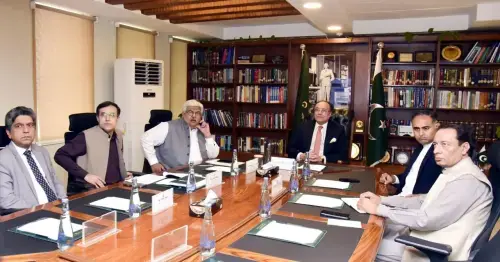
This was the highlight of multiple sessions at ‘Solar, Storage, Flexibility, 2026’, a two-day international energy conference held at a local hotel, which was attended by Power Minister Awais Leghari, Senator Sherry Rehman, and other local and global renewable energy experts.
Pakistan is powering through one of the most extraordinary people-led energy transitions of this time, a rooftop solar revolution, said Senator Sherry Rehman in her conversation with Sonia Dunlop of the Global Solar Council.
According to the senator, the solar boom was not led by international or national leaders, but ordinary households took control of their own power supply because of expensive and unreliable grid power.
Sherry calls for policies to be people-centric; Leghari seeks investment in storage systems
The falling prices of Chinese solar panels also played a key role in this transformation.
She said the government needed to move in tandem with the needs of communities if it did not want to cripple the benefits of this solar rush, adding that the government must become an enabler, not just a regulator, to achieve full solarisation potential.
Calling for a stable and predictable energy market, Senator Rehman said the era of fossil fuels was coming to an end. She maintained that effective public policy must be grounded in realities on the ground and place equity at the centre of energy planning.
Earlier, in his address, Federal Minister of Energy (Power Division) Awais Leghari framed solar and storage as complementary energy assets.
He noted that Pakistan’s energy mix was already 50 per cent clean, with a planned trajectory to reach 90 per cent by 2035, actively mapped across generation, transmission, and storage flexibility. Reaching a 90 per cent clean energy mix for Pakistan on renewables alone is not possible, he said, calling for investments in storage systems to convert renewable ambition into an operable plan.
‘Disconnect between policy and reality’
In a separate session, Fiza Farhan, a global expert on sustainable development, said there was a disconnect between policy and reality. She highlighted that access to solar in Pakistan has been inequitable and requires grassroots financing.
Ms Farhan said renewables have to be a business case, because without an economic advantage, it is not going to work. A transition without taking everyone along would not work, she added.
In response to a question about solar adoption, Dr Gabrielle Kuiper said, “The first thing we can do is invest in mindset change. That is the hardest part; technology is easier.” She highlighted that planning follows money, and if prosumers are incentivised to become part of it, revenue models and infrastructure will follow.
Xiaojun Tom Wang, founder of People of Asia for Climate Solutions, said China, with its focus on energy security, can support Pakistan in building its long-term plans for energy security.
Zain Moulvi of the Alternative Law Collective said current assumptions and systems were rooted in market supply and demand, rather than on-ground realities, like thedecommoditisationof energy. If the solar revolution was bottom-up, then the system needs to reciprocate.
Published in Dawn, August 5th, 2026