Pakistan says 'doing utmost' to bring US, Iran back to Islamabad MoU
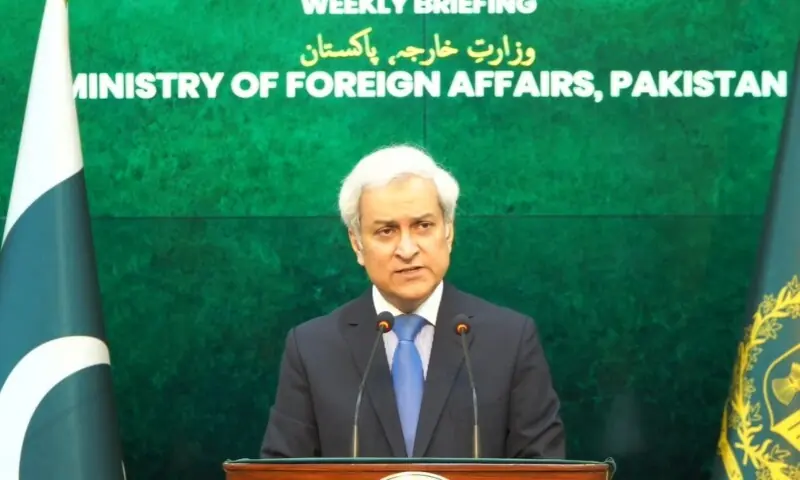


The Foreign Office (FO) said on Thursday that Pakistan was doing its “utmost” to bring the United States and Iran back to the negotiating table under the Islamabad memorandum of understanding (MoU) signed last month.
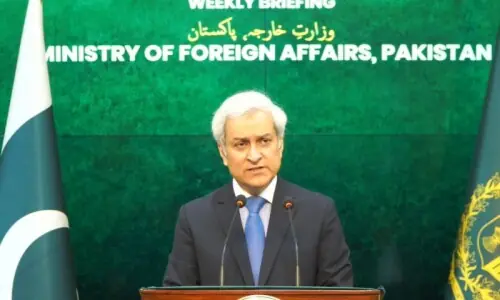
Addressing a weekly press briefing, FO spokesperson Tahir Andrabi said Pakistan noted with concern that the security situation in the Middle East “remains precarious despite the relative calm of the past few days, which had rekindled hopes that this positive development, this calm, would consolidate into a durable and fully respected ceasefire and pave the way for dialogue”.
Andrabi reiterated Pakistan’s support for dialogue and diplomacy, maintaining that it remained the “only viable path forward”.
“We welcome all efforts aimed at sustaining cessation of hostilities and resumption of dialogue between Iran and the US,” he said, adding that Pakistan remained engaged and will continue to do so.
“Let me add that the negotiations between parties are ongoing to normalise the situation, particularly the situation in the Strait of Hormuz, as well as to de-escalate,” he stated.
He added that Pakistan was doing its “utmost” to bring the two parties back to the Islamabad MoU “so that all irritants can be removed in the light of the spirit of the agreement and the Pakistan-Qatar joint statement on June 22”.
Andrabi urged both the US and Iran to exercise “maximum restraint and fully adhere to their commitment to resume technical-level talks” in line with the Islamabad MoU and the Pakistan-Qatar joint statement.
The MoU between the US and Iran was signed on June 18 after weeks of intensive diplomacy. It was aimed at reopening the Strait of Hormuz and ending the Middle East conflict — which began with US-Israeli strikes on Iran in February — after a further 60 days of negotiations.
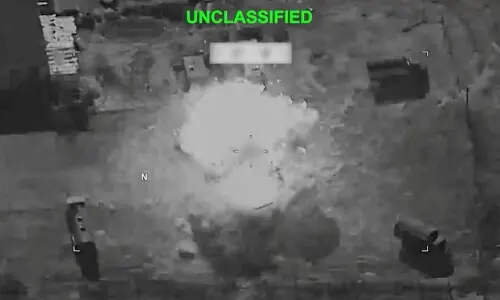
However, renewed hostilities erupted on July 7, when Iran attacked commercial shipping in the Strait of Hormuz, including a Qatari liquefied natural gas tanker, accusing the US of violating the understanding. The attack prompted multiple waves of US strikes on Iranian military targets.
The conflict has intensified with the Houthi rebels in Yemen imposing a naval blockade on Saudi Arabia, extending the war to a second major shipping chokepoint.
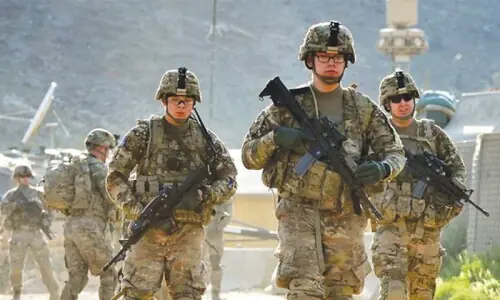
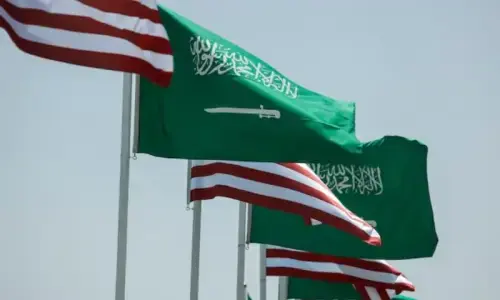
On Wednesday, the war spread across new fronts as explosions hit a natural gas loading port in Egypt and a US-owned floating storage tanker was reportedly struck by a drone, while the US and Saudi Arabia carried out joint strikes on Iran-backed paramilitary groups in Iraq in retaliation for attacks on US troops and Saudi oil targets.
On Thursday, after nearly a week-long pause, the US again struck Iran in retaliation for Tehran targeting American bases in Jordan.
Documentary aired by DW ‘nothing but speculative commentary’
The FO spokesperson also “rejected” a documentary about Pakistan’s nuclear programme uploaded by Germany-based Deutsche Welle (DW) recently on its YouTube channel, terming it “misleading”.
Responding to a query, Andrabi said the documentary was “nothing but a regurgitation of hackneyed and speculative commentary and biased sourcing”.
“The documentary reflects either a profound misunderstanding of, or a deliberate disregard of the history, evolution and rationale of Pakistan’s nuclear programme,” he said.
The FO spokesperson also commented on DW’s decision to air the documentary: “By lending a platform to such poorly-sourced and one-sided content, DW risks undermining its own credibility and reputation for professional fact-finding journalism.
“Responsible journalism demands rigorous verification, balanced context, not amplification of recycled conjecture and unfounded insinuations.”
Andrabi called on DW to “exercise greater editorial responsibility when reporting on issues with far-reaching implications for international peace and security”.
“Pakistan has full confidence in the robustness of its command and control architecture as well as comprehensive, technical, legal and institutional mechanisms governing the nuclear safety and security and our wider nuclear programme,” the FO spokesperson affirmed.
He asserted that “these arrangements meet the highest international standards and have been consistently acknowledged by independent international experts”.
FO highlights ‘India’s deep intolerance for independent voices’
Asked for a comment on India’s move to ban the social media accounts of state-run Pakistan TV for its residents, Andrabi quipped, “Does it surprise you?”
Since tensions between Islamabad and New Delhi intensified last April in the wake of the Pahalgam attack — which also resulted in a brief military escalation — India has blocked access to several Pakistani social media accounts and YouTube channels.
Andrabi said the Indian government’s decision to block access to social media accounts of Pakistan TV and others was “entirely in keeping with its established pattern of suppressing information and peddling an officially sanctioned and carefully sanitised version of so-called reality through pliant media that it has in its own country”.
“Factual reporting has no place in the captive ecosystem prevailing in India. The frequent lapse into escapism exposes India’s deep intolerance for independent voices and its increasing reliance on repressive and restrictive measures as instruments of state policy,” he said.
The FO spokesperson went on to urge the international community to take “full cognisance of the Indian government’s curbs on the media and the shrinking space for free [speech] in India”.