Sindh determined to remove barriers to investment: CM Murad
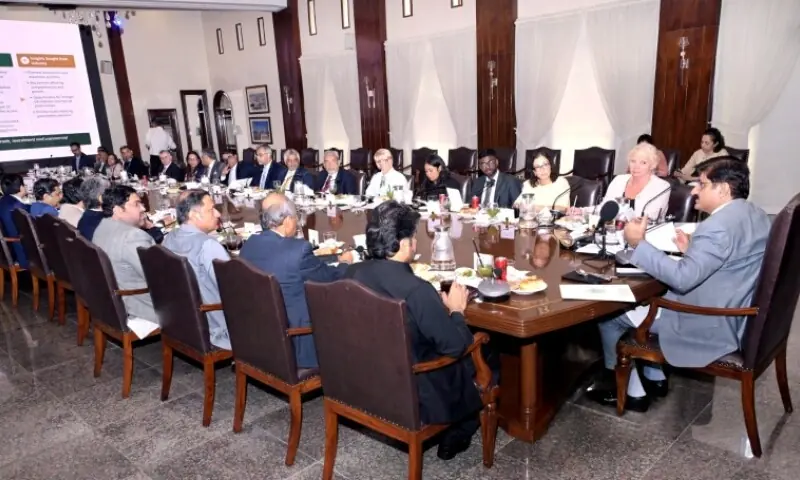


KARACHI: Sindh Chief Minister Syed Murad Ali Shah on Tuesday pledged immediate resolution of regulatory and operational issues facing British investors and their companies working in the province, assuring the international business community that the government would pursue investor-friendly reforms and policy consistency.
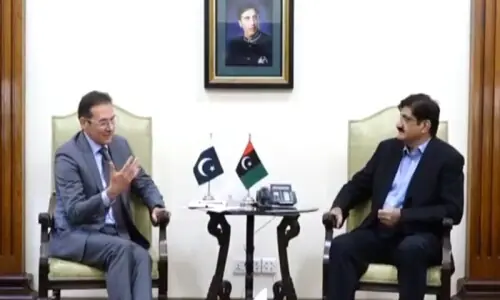
Chairing a high-level Pakistan-UK Roundtable of Multinational Corporations and UK-based firms operating in the province, organised with the British Deputy High Commission, the CM said the government was determined to remove barriers to investment, strengthen public-private engagement and position Sindh as the preferred destination for the foreign investors.
According to a press statement issued by the CM House, the meeting was attended by British Deputy High Commissioner Alison Blackburne, Director Trade Vanessa Montgomery, and representatives of Oxford University Press, Haleon, British International Investment, GSK, Reckitt, Unilever, Standard Chartered Bank, UBL, AstraZeneca and OICCI.
From the Sindh government, Local Government Minister Nasir Hussain Shah, Labour Minister Saeed Ghani, Food Minister Makhdoom Mehboob Zaman, Special Assistant to CM for Investment Syed Qasim Naveed, the chairman of the Sindh Revenue Board and Planning and Development Department, and senior secretaries were present.
“Today’s session was designed with a specific purpose: to listen. I have directed my team to treat these grievances as urgent matters requiring immediate and concrete action,” CM Murad said.
He acknowledged challenges relating to regulatory procedures, taxation, infrastructure, utilities and inter-agency coordination, and stressed that the government would work closely with businesses to remove impediments to growth.
The chief minister said that a government’s primary duty to its investors was to provide stability, transparency and consistency. “We are not only focused on attracting new investment; we are equally committed to ensuring that our existing investors thrive and expand their operations in Sindh,” he said.
CM Murad said the province was simplifying administrative procedures, digitising public services and improving institutional coordination. “We want investors to view us as partners, not merely regulators,” he added.
Special Assistant Syed Qasim Naveed said the government would develop an issue-wise action matrix assigning concerns to relevant departments, with designated focal persons and timelines. “Our objective is to ensure that it leads to clear actions, defined responsibilities and measurable progress,” he said.
Ms Blackburne welcomed the initiative and said the presence of the chief minister signalled Sindh’s commitment to supporting investors.
She said that over 500 reform measures introduced by the provincial government in recent years to reduce regulatory bottlenecks were encouraging for investor confidence.
A presentation by REMIT (Revenue Mobilisation Investment and Trade)/FCDO (Foreign, Commonwealth and Development Office) highlighted that while 74.1 per cent of investors would recommend Pakistan for new FDI (Foreign Direct Investment), 95.1 per cent still perceived business risks as medium to high. Pakistan’s competitiveness score stood at 49.3 out of 100, compared with Bangladesh at 63, Vietnam 71, Indonesia 78, UAE 81, Malaysia 83, India 92 and China 100.
It noted that only 25 of 48 multinational parent companies allocating investment within Asia include Pakistan in their pipeline. Policy predictability, taxation and cost of doing business were identified as the most pressing concerns.
It was informed that Pakistan had implemented 558 reform measures in the past 14 months, generating estimated savings of over Rs468.7 billion for businesses. Seven reform packages had been completed and three more were planned for 2026.
The presentation also noted Sindh’s central role, co-leading reforms in six of 10 major business-environment domains and being directly involved in 259 of 397 high-impact indicators under the World Bank’s B-READY framework.
Concluding the session, representatives of the British International Support Team outlined the evolving UK-Pakistan economic partnership as a journey from strategic priorities and delivery mechanism to measurable outcomes and industry feedback.
Published in Dawn, July 29th, 2026