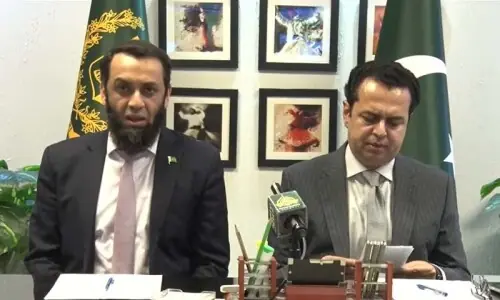
Information Minister Attaullah Tarar on Tuesday, while referring to the recent violence in Azad Jammu and Kashmir (AJK), said the protests by the proscribed Joint Awami Action Committee (JAAC) were not peaceful but violent, alleging the involvement of militant elements pursuing a foreign agenda and backed by Indian funding.
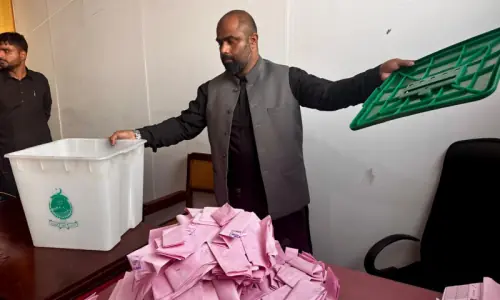
“Peaceful and transparent elections were held in AJK, with all the mainstream political parties participating fully. The people of Kashmir responded to the call of the election,” he stated, referring to the first phase of elections held in the region on Monday.
In Rawalakot alone, a total of 600,000 votes were cast, making it a massive success, he said, adding that political parties held public rallies and conducted their election campaigns as usual. “The response from the people was spectacular.”
However, he said, the banned outfit could not accept this political activity and the peaceful and transparent elections.
He also referred to the press conference held earlier in the day by senior AJK officials. “A violent group that does not accept progress, development and Kashmir’s unbreakable relationship with Pakistan resorted to violence and tried to sabotage peace,” the information minister said, adding, “The reason was that the people of Kashmir had rejected them and chosen the path of elections.”
Tarar added that arms had also been recovered from the violent elements, who had also resorted to firing at security forces earlier.
“From day one, we have been saying that they are not peaceful protesters. This is a violent group. They are militants working on a foreign agenda and receiving Indian funding,” he stated.
He said that these violent actors had now been “exposed”.
“The government of Pakistan supports the stance of the AJK government against these elements.”
‘Not a protest movement anymore’
During the same media address, State Minister for Interior Talal Chaudhry assured the AJK government of the federal government’s full support in maintaining law and order and restoring peace in the region.
Referring to the JAAC, he said that it was not a movement for securing rights but a movement for “snatching” the rights of the people of AJK.
“37 of 38 JAAC demands were accepted, and the government of Pakistan fully cooperated with them,” he said.
He also emphasised that the timing of the movement’s uprising was noteworthy.
“Initially, they tried to stop the election schedule in AJK so that they could give the impression that the government, which talks about a referendum in Kashmir, wanted to rob them of their right to vote,” Chaudhry said.
When they failed, Chaudhry said, JAAC members started long marches, sit-ins, strikes, blocked roads and disrupted activities across the region.
“Their last desire was that the people of Mirpur would not come out to vote and would support them, but when people came out, and turnout increased at polling stations, why then did the unrest occur?” he questioned.
He also shared details of the weapons recovered from JAAC protesters.
“M-4, an imported American gun, Kalashnikovs and sniper guns [were recovered]. One of our security personnel was martyred and five others were injured, including an official who was shot by a sniper,” he said.
“What kind of protest is this? This cannot be a protest. This is something else in the guise of a protest — this is militancy,” Chaudhry said.
The state minister reiterated that the government of Pakistan would protect the right of the people of AJK to vote.
“This is not a protest movement anymore. The AJK protest has decided that it will be tackled differently.”
He said that, from now on, the protesters would be considered perpetrators.
“The state of AJK will use powers granted by law against those perpetrators, and to avoid this, we urge ordinary people to stay away from them,” Chaudhry stated.
He said the “perpetrators” included snipers, armed individuals and those who created situations that forced security forces to use force in a “balanced” manner and in self-defence. “This use of force was avoided for the past one to two months,” he emphasised.
However, Chaudhry said that, in principle, individuals carrying snipers or guns would not be spared.
“An individual has been arrested who came to Pakistan two weeks ago from another country and is a specialist in long-range shooting. He was called and he arrived,” the state minister said.
The government of Pakistan would “crush” this mutiny, he said, adding that it needed to be dealt with in coordination with the AJK government.
‘Fitna Al Khawarij elements present among protesters’
Earlier today, AJK Information Secretary Muhammad Rashid Hanif claimed that a significant number of protesters participating in the proscribed JAAC demonstration in AJK were affiliated with Fitna Al Khawarij.
Fitna al Khawarij is a term the state uses for terrorists belonging to the banned Tehreek-i-Taliban Pakistan.
Addressing a press conference, Hanif said that illegal and violent activities had taken place in AJK aimed at disrupting the upcoming phases of elections in the region.
“The fundamental duty of the state is to maintain law and order, continue the democratic process and fulfil this responsibility. The state is capable of doing so,” he stressed.
The senior official reiterated that the JAAC protest included individuals linked to Fitna Al Khawarij rather than only ordinary citizens.
He also played a video as evidence, which showed masked gunmen on the roof of a building in the region.
“Common people are fewer in number; however, armed individuals, militants and Fitna Al Khawarij members are present, which falls under the definition of terrorism,” Hanif maintained.
“They have involved innocent people by misleading them. We appeal to the people to distance themselves from them. The government will also make some public announcements in this regard to fulfil its responsibility,” he stated.
The regional information secretary added that anti-state elements were using children and women as human shields.
“Several misleading videos have also been circulated on social media, indicating that it is a human rights movement; however, that is not the case.”
Hanif said that state institutions had adequate information regarding the presence of Fitna Al Khawarij elements and members of other militant organisations.
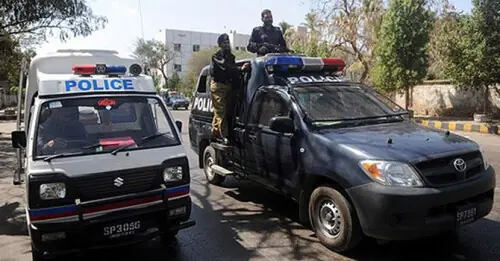
Addressing the media after the information secretary, AJK police spokesperson and Deputy Inspector General of Police (DIG) Irfan Kashfi said that such elements would be “handled in the same way that any terrorists or militants are handled”.
He said that their possession of modern weapons and resources — including automatic weapons, M-4 rifles, SMGs, AK-47s and, according to initial information, even sniper weapons — showed that they were “not peaceful protesters, but militants”.
The DIG said one police official had been martyred in the skirmishes, while five others were injured. He added that one suspect had been arrested in Rawalakot, from whose possession a military-grade weapon was recovered.
Citing initial information, Kashfi said the suspect was a foreign national who had been acting as a sniper.
“Security forces are answering [attacks] in self-defence and for the protection of the public,” Kashfi said, noting that law enforcement agencies have shown great endurance.
He added that facilitators of these militants were also being investigated.
The senior police official assured that there was no need to believe the “misconception” that these militants could capture Rawalakot or any other area, as LEAs would “persist at all costs”.
Earlier today, while sharing a video of several people carrying arms in AJK, the region’s Prime Minister Faisal Mumtaz Rathore said, “They planned this for weeks and now they have got what they wanted: the blood of innocent Kashmiris.”
“The rioters not only have sophisticated weapons, they also have the advantage of access to all vantage points from where they take aim at security forces, whose only objective has been to contain the situation and prevent escalation,” Rathore stated.
He added that the march to Muzaffarabad during the elections was a “conniving plan to trigger mass unrest”.
“I appeal to the people to stay away from these agitators who have a proven record of using civilians as human shields and creating a win-win situation for themselves once security personnel act in self-defence,” he said.
Over the past month, the regional administration and the Joint Awami Action Committee (JAAC) have been at odds over various issues, most notably the committee’s demand to abolish the 12 seats in the region’s Legislative Assembly, which has resulted in protests across the region.
On June 5, the JAAC was declared a proscribed organisation by the regional government and placed under the First Schedule of the region’s anti-terrorism act (ATA).
A day later, AJK authorities launched a crackdown on the JAAC, arresting scores of its leaders and later placing 147 of its activists on the Fourth Schedule of the ATA.