Monsoon toll tops 100, with more rain to come


• NDMA reports seven fatalities in Punjab, three in KP, 25 hurt in Balochistan in a day
• AI-based dashboard launched to monitor releases from Indian dams
• Ravi in high flood at Sidhnai; inundation persists in Punjab areas
ISLAMABAD / LAHORE: As monsoon showers continued to lash parts of the country, the National Disaster Management Authority (NDMA) on Sunday reported seven more deaths in Punjab and three in Khyber Pakhtunkhwa, taking the nationwide death toll since June 26 to over 100.
According to the NDMA’s daily situation report, covering a 24-hour period, Punjab’s Gujrat and Okara districts recorded two deaths each, while one death each was reported from Sargodha, Narowal and Sialkot.
In KP, Hangu recorded two deaths, while one person died in Shangla.
The NDMA specified that the causes behind the casualties were house collapses, electrocution and drowning.
Moreover, at least 47 people were injured in various districts of Punjab, while three people were injured in Hangu during the same 24-hour period.
According to NDMA data, the country has recorded 107 deaths since June 26 during monsoon rains.
KP has recorded the highest number of fatalities, with 55 deaths, followed by Punjab with 36, Azad Jammu and Kashmir (AJK) with seven, Balochistan with six, Sindh with two and Gilgit-Baltistan (GB) with one. The Punjab Provincial Disaster Management Authority director general said under the province’s compensation policy, the families of those killed in rain-related incidents would receive financial assistance ranging from Rs1m to Rs5m.
Meanwhile, the Emergency Response Committee held its fifth meeting at the National Emergencies Operation Centre (NEOC) at the NDMA headquarters in Islamabad to review the country’s preparedness and response to this year’s monsoon season. The meeting was chaired virtually by Planning Minister Ahsan Iqbal and attended by federal ministers, the NDMA chairman, provincial representatives and other stakeholders.
The committee reaffirmed its commitment to strengthening national coordination and preparedness to protect lives, livelihoods and infrastructure during the monsoon season.
Fresh wet spell
Separately, the Pakistan Meteorological Department’s (PMD) Flood Forecasting Division (FFD) said no flood-generating rainfall activity was expected until July 28. However, it forecast a fresh wet spell from July 29 in the upper catchments of all major rivers, Islamabad, upper Punjab, Kashmir, KP and Gilgit-Baltistan.
The Punjab irrigation department, in a bid to monitor rainfall, river flows and water storage and releases at Indian dams, has introduced an AI-based Dam Reservoir Analysis Dashboard, an intelligent decision-support platform developed to enhance reservoir monitoring and water resources management through the integration of satellite remote sensing, geospatial analytics and artificial intelligence.
“Since India is not sharing data on floods, river flows, rainfall and water releases from dams, we have made this system to at least check and get some information. It is a very efficient system to check the water situation in Indian dams through satellite imagery,” an irrigation department official said.
“Although through this way we cannot have confirmed information, we can get something to check and update our information as well as issue alerts for further arrangements,” he added.
High-flood
In a related development, the Ravi River on Sunday entered a high flood level at Sidhnai Headworks in Abdul Hakim, Khanewal, while water levels in the Chenab River subsided considerably, bringing it back to the low flood level at major gauging stations.
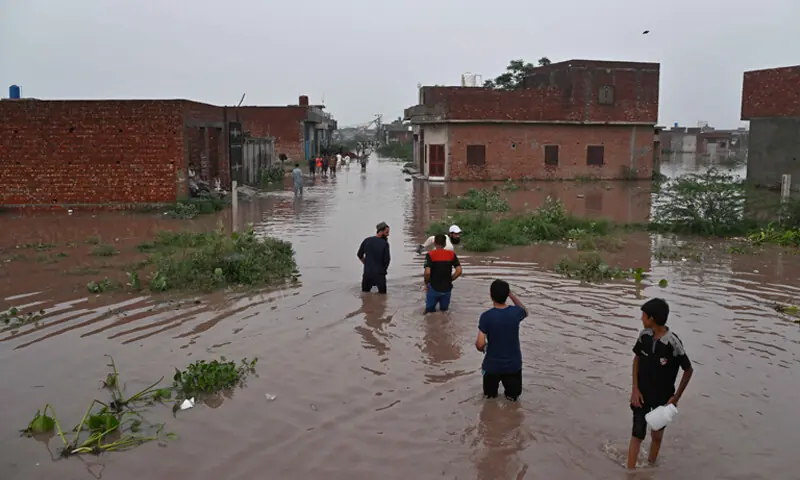
On the other hand, nearly 60 people have so far been evacuated from flood-affected areas of Nankana district in Lahore Division, while several areas of Sheikhupura, Nankana, Gujranwala, Sialkot and Narowal districts in Lahore and Gujranwala divisions remain inundated due to torrential rains, Dawn has learnt.
“Although there were no rains in some areas today, a number of chunks of land [nearly 400 square kilometres] are still remain under water. However, if there is no further rainfall, it will still take some time for these areas to dry out,” a senior official of the irrigation department told Dawn.
According to a report issued by the PMD’s FFD at 6pm on Sunday, the Chenab River at Marala, Khanki, Qadirabad and Trimmu was flowing at the low flood level, while the Ravi River was at the low flood level at Balloki and the high flood level at Sidhnai Headworks.
The Indus River’s flows at Tarbela, Kalabagh, Chashma, Taunsa and Guddu have been gauged as in low flood. “In the Indus River, a flash flood of 297,873 cusecs was passing near Chachran Sharif/Benazir Pul in Rajanpur district,” the report said.
25 hurt in Balochistan
Meanwhile, torrential rain and strong winds lashed several districts of central Balochistan overnight, leaving more than 25 people injured, damaging a large number of mud houses, disrupting power supplies and flooding link roads.
According to officials, the heavy downpour affected Dera Murad Jamali, Usta Muhammad, Gandakha, Jhal Magsi, Bhag, Nari and surrounding areas, where streets, markets and residential neighbourhoods were inundated, resembling flood-hit zones. Rainwater entered homes and shops, severely disrupting daily life and leaving residents stranded. Reports suggested that dozens of mud houses either collapsed or sustained extensive damage during the storm. More than 25 people were injured and shifted to nearby hospitals for treatment.
In the eastern and western parts of Dera Murad Jamali, floodwater entered residential areas, compounding the difficulties faced by residents. Fallen electricity poles caused widespread power outages, plunging several localities into darkness and disrupting essential services.
The heavy rainfall also blocked roads and hampered transport, leaving commuters and travellers facing significant difficulties. Authorities have yet to provide a detailed assessment of the damage.
Meanwhile, floodwater from the Chattar and Faleji streams entered the Rabi Canal, raising concerns about possible flooding in nearby settlements. Residents living close to the canal have been warned of the potential risk as water levels continue to rise.
Imran Gabol in Lahore, Saleem Shahid in Quetta and Ali Jan Mangi in Dera Murad Jamali also contributed to this report
Published in Dawn, July 27th, 2026