FOOTBALL: THE (NOT SO) GREATEST SHOW
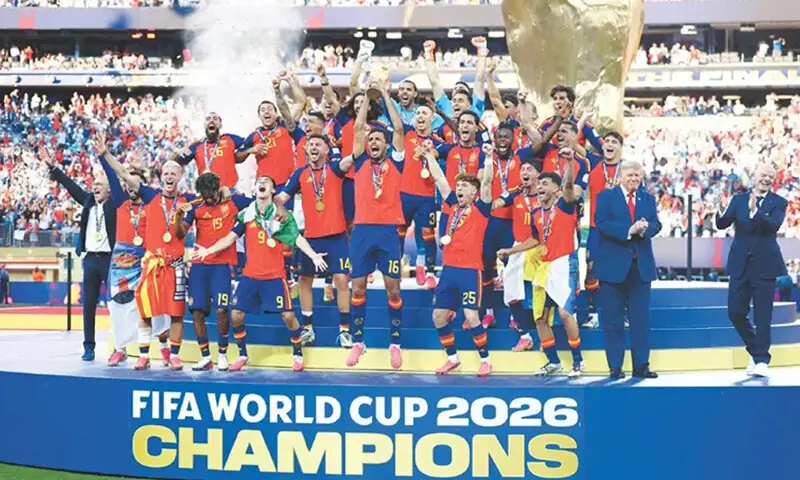


The 2026 World Cup came to a close on a bright afternoon last Sunday at the MetLife Stadium in New Jersey, in a match that seemed to be attended more by celebrities than actual supporters.
Watched on by Fifa president Gianni Infantino, who was present at his scarcely believable 47th match of the tournament, and the inaugural winner of the Fifa Peace Prize, Donald Trump, Spain and Argentina faced off amidst a storyline written in Hollywood itself. The greatest to ever kick a ball, Lionel Messi, still going strong at 39, against the kid he baptised in a Unicef calendar shoot 20 years ago, Lamine Yamal.
The proceedings commenced fairly ordinarily, a closing ceremony followed by the trophy paraded around the pitch. But while normally you would have the teams come out next, the 2026 World Cup went down a new path. And why wouldn’t it? It was only fitting that the World Cup riddled with controversies ended with one too.
For some reason, the organisers thought it would be a good idea to have the US national anthem sung before a match the US was not playing in. And somehow the organisers also thought it would be completely fine to omit the national anthems of the other two host nations, Canada and Mexico. American obnoxiousness at its peak.
The Fifa World Cup final, expected to be a chaotic, thrilling contest between a spirited Argentina and technically matchless Spain turned out to be a dour game with no fluency
Anyway, the teams march out. Spain’s national anthem is played out by a band; Argentina’s by a mix of a singer and their raucous fan base. And finally, seven minutes past the official kick-off time, the biggest game in the world of sports gets underway. Late kick-offs were another highly contentious point of discourse, especially during the first week of the tournament.
Immediately, there’s a new record: Messi becomes the first person to start in three World Cup finals. Coincidentally, he’s captained Argentina in all three. He also becomes the oldest ever outfield player in a World Cup final. And what a tournament the 39-year-old had had, scoring eight while breaking Miroslav Klose’s all-time record of most goals and assisting another four, to move miles ahead in the all-time playmakers’ list.
Partnered upfront by Julian Alvarez, who had scored the definitive best goal in the quarter-finals, and driven by the strongest of characters that had helped him wriggle Argentina out of the most precarious of situations, you would think the stage was set for an exciting, chaotic match.
Wrong! In a World Cup that had seen 307 goals over 103 matches at an average of almost three goals per game — the highest since 1958 — the team with the most goals up till the semi-finals decided to just sit back.
They were strong defensively: holding their shape, nullifying the threat carried by Spain’s extremely fluid possession-based attacks, the impregnable Emiliano Martinez snuffing out anything that managed to breach their defence, and deploying the dark arts when required.
Hydration break — let me have a quick drink.
The dark arts. One of the most talked about topics in Argentina’s run to the final. A conspiracy theory did rounds throughout the tournament that the Albiceleste were favoured by the officials. Late challenges by Argentina seemed to go unpunished, having committed the highest number of fouls but having received one of the lowest number of bookings.
Then came Egypt’s disallowed goal in the Round of 16, one of the most divisive decisions in football history. The deeper the tournament ran, Argentina’s approach turned more cynical — little fouls as attempts to slow down the pace, led by spoilers-in-chief Enzo Fernandez and Leandro Paredes.
Spain, on the other hand, were technically and tactically peerless. Their dismantling of France in the semi-finals, unlocked by the irrepressible Rodri finding his pre-ACL brilliance, was a sight to behold.
Their full backs, Marc Cucurella and Pedro Porro, were the standout pairing of the tournament. Their defence and goalkeeper Unai Simon had already set the record for the longest time at a World Cup without conceding — 650 minutes — and had only conceded once all tournament to Belgium’s Charles de Ketelaere.
Mikel Oyarzabal had stood up when Lamine Yamal hadn’t been at his sparkling best, tying David Villa for the most goals at a World Cup edition by a Spaniard, with five. Dani Olmo and Fabian Ruiz had been everywhere on the field, switching positions and bamboozling entire systems. And when they struggled, they could rely on the super-sub Mikel Merino to bail them out of it.
And in the final, the combination of the two led to a contest which could be called uneventful at best, especially after the fireworks of the 2022 final. The game had no fluency, partly due to the slow pitch and majorly due to Argentina trying to kill the spectacle.
The result was a dour game littered with interruptions, including the razzmatazz of the first-ever half-time show in a World Cup, featuring Shakira and BTS. The Americanisation of football completed.
All the one-way traffic led to two things: Argentina becoming the second-ever team not to register a single shot over 90 minutes in World Cup history and Spain forcing 11 saves out of Martinez, the most in a World Cup final.
Spain showed the utmost calm, racking up more than double the passes attempted by Argentina, as they recycled possession in the face of continuous roadblocks. Argentina weren’t helped by the fact they had to replace both their first-choice centre-backs, but the turning point came late in regulation time — Fernandez collecting two quick needless yellow cards, exhibiting brattishness, the first for dissent and the second for a challenge so spectacularly late and brutal it sent Pau Cubarsi somersaulting.
Argentina down to 10 men, but still somehow forced the match to extra time.
Spain, on their part, had been quite wasteful in their finishing. Multiple chances went begging, including a glorious headed opportunity for Merino. When they did score through Nico Williams, the goal was ruled out for a foul in the build-up.
But Spain kept coming, and they knew they only needed to find one moment of magic, which duly arrived when Ferran Torres controlled a Williams cutback header and smashed it in from close range, emulating Andres Iniesta in their 2010 victory by scoring the winner in the second half of extra time.
Argentina finally mustered a shot in the 117th minute, but Spain were comfortable. Control prevailed over chaos, Spain winning the World Cup for the second time after a thoroughly dominant display in which they outshot their opponents 20 to 2.
The full-time whistle brought about some ugly scenes, wherein Paredes squared up to Gavi and Pedri and was duly sent off for his machoism. Nahuel Molina attempted to throw a punch at Rodri, all while the great man stood alone with tears flowing down his cheeks.
Messi had been the nucleus of this Argentina side. His final appearance in the World Cup — surely, he won’t be playing at 43 — he merited a better send-off than the belligerence his teammates brought at the end.
Cubarsi was named the Best Young Player and Simon won the Golden Glove, both contributing to Spain’s seven clean sheets in the tournament. Their captain Rodri picked up the Golden Ball for being the tournament’s outstanding player ahead of Messi, while France’s Kylian Mbappe won the Golden Boot for being the highest goal scorer.
Trump awarded the trophy, then proceeded to remain on the stage during Spain’s celebrations despite the best efforts of Infantino to bring him off.
The writer is a sports enthusiast with a background in supply chain management. X: @tahagoheer
Published in Dawn, EOS, July 26th, 2026