Lahore infrastructure strained with heaviest rainfall of monsoon so far


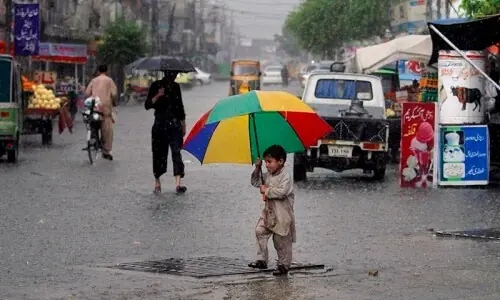
LAHORE: Heavy monsoon rain on the third consecutive day brought the routine life in Lahore to a grinding halt on Thursday, flooding several roads and streets.
The airport and surrounding areas received 263mm of rain — the highest so far in the ongoing monsoon, leaving motorists and pedestrians with no option but to bear the brunt of urban flooding.
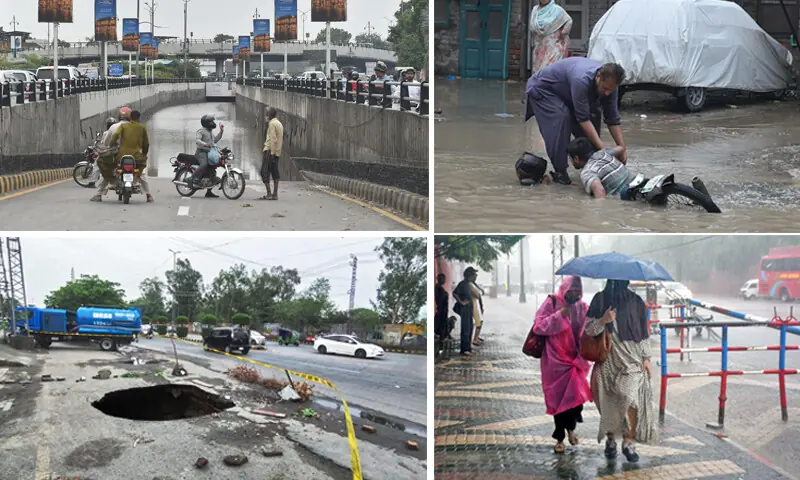
Water could not be drained from Tajpura underpass and it remained blocked for traffic through the day. The rainwater eroded the earth-filling (soil), creating large sinkholes at various spots and posing safety threats to the commuters.
Several deep sinkholes measuring around 10 square feet appeared on three to four roads, including Canal Road, Johar Town Main Boulevard and Bhekhaywala Mor, causing part of the roads to collapse. The traffic police cordoned off the areas and diverted traffic after Wasa teams reached the site. Another sinkhole reappeared on Khayaban-e-Firdousi, where barriers were placed as a precautionary measure and traffic was shifted to alternate routes.
Sinkholes appear on four roads; Tajpura, Harbanspura among the most affected areas; airport receives 263mm rain
“Khayaban-e-Firdasui is the road where sinkholes appeared several times — in some incidents, the motorists also received injuries after falling into them,” commented a resident of Johar Town.
According to experts, such road depressions occur either due to underground water seepage causing soil erosion caused by inadequate earth-filling and compaction. They say that sinkholes form when the ground surface is no longer supported by soil and factors like heavy rain, wastewater flow from broken sewer lines, or the weight of fast-moving vehicles weaken the asphalt, causing it to collapse. “I, after being trapped in the rainwater like others, found Lahore presenting the scenes of the city of Venice. The difference was that in Lahore, the motorists were trapped in the water everywhere,” a motorcyclist, whose bike broke down due to water on a road, said while talking to this reporter. There are reports that the rainwater in various localities in low-lying areas entered houses and residents were seen draining water out with buckets. The most affected areas in the city included the airport and surrounding localities, Tajpura, Mughalpura, Upper Mall, Johar Town, Shadipura, Kahna and Manawan.
The city received 343 millimetres of rain during the past 48 hours, according to the Provincial Disaster Management Authority (PDMA). According to a report issued by the Lahore Water and Sanitation Agency (Wasa), the maximum 263mm rain was recorded at the airport. Tajpura received 157.4mm, it was 143.4mm at Kahna, 136mm at Shadipura, 133mm at Mughalpura, 116mm at Upper Mall, 106mm at Manawan, 53mm rain at Wasa Head Office, Gulberg, 27mm at Lakshmi Chowk, 56.4mm at Nishtar Town, 64.6mm at Chowk Nakhuda, 28mm at Paniwala Talab, 23.4mm at Farrukhabad, 18.4mm at Gulshan-i-Ravi, 55mm at Iqbal Town, 33mm at Samanabad, 81mm at Johar Town, 45mm on Defence Road and 23mm at Saggian.
The residents of Ali View Society, Paragon City, Tajpura, Askari-10 and DHA also explained the miseries they faced on Thursday.
“Our society presented a view of the lake due to massive rain on Thursday. The water level in our street was over one foot or more for a long time and it receded gradually,” commented a resident of Paragon city. He added that the rainwater inundated the Barki Road completely, forcing the motorists to remain stuck due to incomplete construction work and massively accumulated rainwater there.
“As heavy monsoon rains lashed various parts on Thursday, it was, so far, the heaviest one since start of the monsoon. But we made all out efforts to drain out the accumulated rainwater within the shortest possible time,” Wasa Lahore Managing Director Ghufran Ahmad told Dawn when contacted.
According to him, the officers were continuously monitoring the rainwater drainage operation with more than 200 live cameras, surveillance of all major underpasses, to assess water accumulation and traffic flow.
Mr Ahmad said in fact the rain badly affected several parts of the city, especially those nearby the airport and other spots. According to him, since these areas (DHAs, Cantt, Airport, Tajpura, Upper Mall, Defence Road etc) received a record rain of 263mm on Thursday, the residents faced issues related to timely drainage of water.
“In fact in Cantonment areas, Cantt Board authorities are entrusted with the task related to drainage etc. Though we helped the Cantt Board in some parts, most responsibilities lie on their part,” he clarified.
Meanwhile, the senior officials led by Secretary Housing Noorul Amin Mengal visited Tajpura and other affected localities and reviewed the rainwater drainage.
“All available resources must be utilized for the prompt disposal of rainwater and that drainage from low-lying areas be ensured at the earliest,” the secretary sought.
The rain caused tripping of several electricity feeders of 11kV capacity across Lahore, disrupting power supply to various localities. Officials said the outages were reported in different parts of the city after the rain, with electricity supply suspended in a number of areas as a precautionary measure and due to technical faults triggered by the weather.
Published in Dawn, July 24th, 2026