0
0

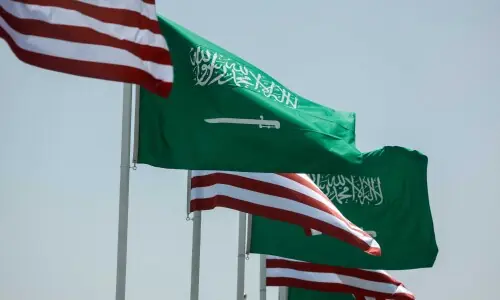
DUBAI/RIYADH: Top officials and ministers in Saudi Arabia and the United Arab Emirates have recently posted about friendship and unity on social media, signalling a rapprochement months after a public fallout between the two largest Arab economies.
On Tuesday evening, General Entertainment Authority chairman Turki Alalshikh posted a picture of Saudi Defence Minister Khaled bin Salman, alongside Emirati Vice President Mansour bin Zayed that he said was taken a few days ago. “Saudi Arabia and the UAE: A story of brotherly relations and a strong partnership,” he wrote in his post on X.
Anwar Gargash, the UAE presidential adviser, shared the picture, with the caption: “The biggest story in the Gulf is captured in a single photograph.”
For months, pundits from both sides had engaged in virulent debate online, with Saudi Arabia also launching earlier this year a media campaign against its smaller neighbour.
Both sides use social media to promote unity after months of tension
The two allies-turned-rivals had a public falling out in December when Riyadh accused Abu Dhabi of threatening its national security by supporting Yemeni separatists who orchestrated a brief offensive.
The pair have been at odds in their foreign policy from Yemen and Sudan to the Horn of Africa, where they have supported rival forces.
Their differences have spilled over into the Iran conflict, with the Saudis backing Pakistani mediation efforts, while the UAE initially took a more hawkish stance on Tehran, before the signing of a US-Iran MoU last month.
The apparent mending of ties came as US-Iran hostilities resumed this month, triggering renewed Iranian attacks across the Gulf, while Tehran’s Houthi allies in Yemen ramped up the pressure by threatening a naval blockade of Saudi Arabia.
Abdulla Alhamed, who heads the UAE’s media authority, and Saudi Media Minister Salman Aldosary posted very similar messages on X on Tuesday, lauding relations between the two countries and their leaders, while stating that “responsible media” must reflect this bond.
“The role of responsible media is to counter anyone attempting to portray a misleading image of the relationship between the two countries and to ensure accuracy in all published information,” Aldosary said in his post, praising the “wise leadership in both countries”.
“Emirati-Saudi relations are an extension of a shared history and deep-rooted fraternal ties between two brotherly peoples, united by a single destiny,” Alhamed wrote.
“The relationship between the Kingdom and the Emirates is a relationship between two peoples united by a shared history and heritage, and wise leadership in both countries,” Aldosary’s post said. Both posts said media should reflect those aspects of the relationship and avoid undermining them.
From oil quotas to geopolitics
The two Gulf heavyweights have seen their interests diverge for years on everything from oil quotas to geopolitics, with the disagreements coming into the open late last year over their support for opposing sides in the war in Yemen.
That culminated in a Saudi air strike on what it said was a shipment of UAE military equipment to the Yemeni faction Abu Dhabi backed. Since that time, influential Saudi and Emirati social media accounts, pundits and some media organisations have engaged in unusually open debate and criticism. In March, the UAE banned Saudi TV channel Al Arabiya’s X accounts.
Their divergence continued during the Iran war, which threatened Gulf security, with Saudi Arabia and the UAE often differing on what they saw as the right response to the conflict. In May, the UAE left OPEC, the oil producers’ group led by Riyadh.
“I think what we witnessed was a storm in a cup. We have seen worse before but it was never strategic,” said Mohammed Baharoon, director general of the Dubai Public Policy Research Centre.
“I am sure there has been adaptation from both parties, but the reality remains that what we have in common far outweighs our divergences,” he said of the Saudi-UAE relationship.
Gulf officials have in recent weeks called for unity among the six members of the Gulf Cooperation Council in the face of Iranian attacks and, most recently, threats by the Houthis against Red Sea shipping.
One hour ahead of the posts by senior media officials, Turki Alshikh, an adviser to the Saudi royal court and chairman of the General Entertainment Authority, shared a photo on X that he said had been taken days earlier.
It showed Saudi Defence Minister Khalid bin Salman, Crown Prince Mohamed’s brother, and United Arab Emirates Vice President Sheikh Mansour bin Zayed Al Nahyan, their arms over each other’s shoulders and smiles on their faces.
He captioned it: “Saudi Arabia and the UAE: a story of brotherly relations and a deeply rooted partnership.” Commenting on the post, Anwar Gargash, diplomatic adviser to the United Arab Emirates president, said: “Spears, when together, refuse to be broken... and break if they part.”
Published in Dawn, July 23rd, 2026