0
0

ISLAMABAD: Amid a raging controversy over a bill seeking blue passports for dependent children under the age of 28 of former members of parliament, the government has decided to enforce stricter rules for the issuance of official passports.
"It will be ensured that blue passports are used only for the performance of official duties abroad for a limited period," Minister of State for Interior Tallal Chaudhry told Dawn.
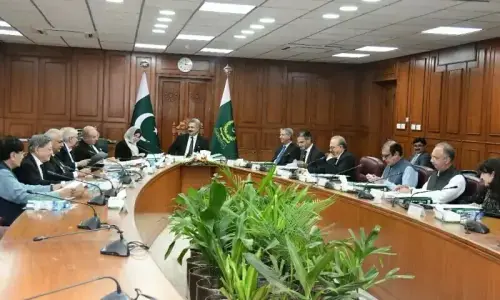
A Senate panel on July 10 unanimously approved the Members of Parliament Salaries and Allowances (Amendment) Bill.
The legislation seeks to allow the issuance of blue passports to dependent children under the age of 28 of former members of parliament, stirring debate over extending a facility meant purely for state functions to adult children of those who no longer hold public office.
Talal Chaudhry assures steps to ensure travel document used only for ‘official duties’ abroad; says large number of official passport holders ‘major impediment’ to visa abolition pacts
A statement released by the Senate Secretariat earlier this month said Mr Chaudhry had "also agreed to the passage of the bill".
However, he later said he had opposed it during the July 10 Senate committee meeting, arguing that it should first be discussed with the federal cabinet and other stakeholders. He claimed the committee passed the bill despite his objections.
He later told Dawn that each application for an official passport would be processed only after approval by the interior ministry.
Mr Chaudhry described the large number of blue passport holders in the country as a major impediment to signing visa abolition agreements with different countries.
"Our focus is on securing visa-free entry agreements with as many countries as possible," he said.
He said the number of blue passports had been reduced from around 70,000 to fewer than 50,000 in recent years and would be cut by a further 15 to 20pc.
He said discussions on a visa exemption agreement with Saudi Arabia were at an advanced stage, while negotiations with some other countries, including Italy, were also underway.
Answering a question about the bill seeking the issuance of blue passports to the children of former parliamentarians, he said the fate of the legislation would be decided by political parties. He, however, believed the bill ran contrary to the government's policy of reducing the number of blue passports.
Mr Chaudhry rejected the argument that the amendment would bring dependants of former parliamentarians at par with the entitlement available to dependent children of BPS-22 government officers.
Who gets blue passports?
Official blue passports are issued to key constitutional office-holders, senior government officials, judges, bureaucrats and their eligible dependants.
In May 2018, the government allowed former parliamentarians and their spouses to retain their gratis official (blue) passports.
Through a notification issued on Aug 9, 2023, all serving and retired BPS-22 civil servants, including officers of the Senate and National Assembly secretariats and armed forces officers of equivalent rank, along with their spouses, parents and dependent children up to the age of 28, were made eligible.
Others entitled to the facility include the president and prime minister of Azad Jammu and Kashmir, the governor and chief minister of Gilgit-Baltistan, members of the Senate, National Assembly, provincial assemblies, the AJK and GB legislative assemblies, as well as speakers, their spouses, parents and dependent children up to the age of 28.
Judges of the Supreme Court, Federal Shariat Court, high courts, AJK and GB courts, the auditor general, the chief election commissioner and members of the Election Commission of Pakistan, the Wafaqi Mohtasib, the federal tax ombudsman, the chairman and members of the Federal Public Service Commission, the Federal Service Tribunal, the Council of Islamic Ideology and the NAB chairman are also eligible.
Federal secretaries, additional secretaries, joint secretaries, chief secretaries, BPS-21 officers, the retired chairman of the Joint Chiefs of Staff Committee and the three services chiefs, officers proceeding abroad on official duty, training, deputation or posting with the UN, ECO and other organisations, advisers to the prime minister and provincial governments enjoying ministerial status, directors general and directors of Immigration and Passports, former governors, the former AJK president and GB governor, retired judges, and contractual officers in BPS-20 and above travelling on official visits are also entitled to official passports.
Official passports on payment of a fee are issued to the governor and deputy governor of the State Bank of Pakistan, members of the Competition Commission of Pakistan and Irsa, heads of autonomous bodies in BPS-20 and above, civil servants in BPS-17 to BPS-21, military officers proceeding abroad for training or courses lasting more than nine months, along with their spouses and children, PTV and Radio Pakistan staff covering prime ministerial or presidential visits abroad, and Nadra employees posted to Pakistani missions.
Visa-free access
Blue passport holders enjoy visa-free access to 55 countries, including 22 in Europe, according to an updated list available with Dawn .
Of the 22 European countries, 14 are part of the Schengen area.
Other countries offering visa-free access include Russia, Cyprus, Belarus, China, including Hong Kong, the United Arab Emirates, Turkiye, Iran, Kuwait, Bahrain, South Korea, Malaysia, Indonesia, Egypt, Brazil, Mexico, Thailand, Sri Lanka, the Maldives and Nepal.
Although the controversial bill was unanimously approved by a Senate panel, its passage through both houses of parliament appears unlikely, with major political parties expected to oppose it.
PTI Senate parliamentary leader Barrister Syed Ali Zafar opposed extending blue passports to the children of members of parliament, arguing that such passports should only be issued to those who needed them for official state duties. Although the proposal was sent to a committee that PTI was not part of, he said the party would oppose it if it returned to the Senate for approval.
Published in Dawn, July 20th, 2026