

IN the early 1700s, the Duke of Marlborough, on entering his palatial 187-room Blenheim Palace, used to mutter: “Home is home, be it ever so humble!” Today, BP is overshadowed by another BP — Buckingham Palace — which has 775 rooms. Queen Victoria in 1837 made Buckingham Palace her home. As her family expanded, so did the palace. An additional wing — now the façade one sees with the famous balcony — was constructed where Marble Arch once stood.
During her long reign, Queen Victoria hosted a number of royals there. Many — especially the Russian Romanovs — compared it unfavourably with their own vast palaces. She preferred, however, the privacy of Balmoral in Scotland and the homely intimacy of Osborne House on the Isle of Wight.
Moving into and out of Buckingham Palace never came easily to some royalty. In 1901, when her husband became King Edward VII, Queen Alexandra refused to quit Marlborough House where she had lived as Princess of Wales for almost 40 years. And in 1910, on the death of her husband, she refused to vacate Buckingham Palace until eased out by her daughter-in-law the new Queen Mary.
During World War II, the palace suffered damage when a German bomb destroyed the royal chapel. That has now been replaced by the secular Royal Gallery where exhibitions from the extensive Royal Collection are displayed periodically.
Huge homes fit for princes are again follies of the ultra rich.
Every British monarch has tried to make it a family home. Queen Victoria’s husband Prince Albert (brought up modestly in Germany) attempted modernisation. He discovered that the underpaid palace staff supplemented their income by replacing the hundreds of candelabra with new candles, even when the old ones had not been lit. Another consort Prince Philip — tired of eating meals delivered tepid from distant kitchens — had a modern galley installed nearer the living quarters.
Since 2016, Buckingham Palace has been renovated at a cost of £369 million. It took 10 years. Despite improvements like efficient radiators and solar panels, King Charles III had decided against moving from his present home, Clarence House. One can understand his reluctance. He spent his childhood and youth in the draughty palace. His great uncle King Edward VIII (later the Duke of Windsor) described it as a “cheerless, uninviting place”, a “depressing monument”. A governess who reared the young princesses Elizabeth and Margaret in the palace complained it was a chilly, impersonal museum, with long, echoing corridors.
Will Prince William, after he ascends the throne, choose to move into Buckingham Palace? Or will he allow it to be converted into a grand backdrop for state entertainment, like the Kremlin in Moscow or the Hofburg in Vienna?
Over the years, owners of stately homes in Great Britain have been forced to sell them to pay estate duty or avoid it by handing them over to the National Trust to manage. A few became hotels or venues for corporate entertainment.
The equivalent in India of the British National Trust is the Tata Group of hotels. Dispossessed Indian nobility, enticed by the success of the Taj Palace hotel set as if afloat in Lake Pichola in Udaipur, have found a new wealth by converting their palaces, former hunting lodges and havelis into hotels.
Notable amongst converted palaces are the Taj Rambagh Palace, Jaipur; the Taj Umaid Bhawan Palace, Jodhpur; the Taj Falaknuma Palace, Hyderabad; and the Nadesar Palace, Varanasi. India’s nouveaux riche can now enjoy the level of luxury which royal owners could no longer afford.
Pakistan’s minor royalties in Swat, Bahawalpur and Sindh inherited less. The White Palace of Marghazar built in 1940 by the first Wali of Swat, Miangul Abdul Wadud, has become a hotel. In Bahawalpur, the iconic Noor Mahal (Palace of Light), built in 1875 by Nawab Sadiq Muhammad Khan IV, is owned and managed by the army. In Hyderabad (Sindh), the historic palace of the Talpur Mirs (the Badshahi Bungalow), constructed in 1863, suffered nationalisation in the 1970s by an envious prime minister Zulfikar Ali Bhutto. Although restored to the Talpur family, it needs an Indus-flow of money for its costly upkeep.
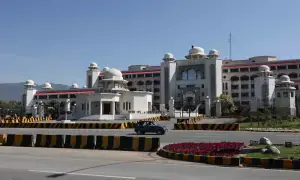
Once expensive grandeur has been overtaken by private indulgences. Huge homes fit for princes are again follies of the ultra rich. At their apex is the gleaming white step-pyramid — our Aiwan-i-Sadr. Commenced in 1970, it took 11 years to complete. Interestingly, only civilian presidents have occupied it. Both Gens Ziaul Haq and Musharraf preferred to remain in Army House (once PM House) in Rawalpindi.
The Aiwan-i-Sadr has a menagerie for deer and pigeons and a stable for about 100 horses. Its neighbour is the National Assembly building where debates are parroted. In that vast complex, birds, animals and public representatives — be they ever so humble — enjoy Blenheim-scale accommodation.
The writer is an author.
Published in Dawn, July 2nd, 2026