

IN Karachi, development is often imagined as an upgrade in scale — a quiet residential zone becomes commercial chaos, and an informal, difficult-to-maintain civic place is replaced by a larger, safer, more manageable and programmable space. On paper, this looks like progress. In urban life, the equation is complicated. Cities, particularly in South Asia, have a habit of mistaking expansion for continuity. The expansion of a building means that public mission has grown. When a facility offers more amenities, such as rooms, equipment, parking and programming, it is seen as advancement. But civic spaces do not live by square footage alone. They live through democratic access, repetition, informality, memory and the possibility of arrival.
This is where the debate between preservation and development in Karachi needs to be rethought. Preservation is not only about old buildings, stone façades, carved balconies or colonial-era elevations. It is also about the preservation of relationships: between a place and its street, between a room and its regulars, between a threshold and the people who feel they can cross it without permission, and without an agenda. Development, likewise, is not automatically the enemy. Cities must repair, rebuild, expand and adapt. But development turns destructive when it preserves the name while displacing the ecology that gave that name meaning. Karachi has already perfected the language of superficial preservation. We hold up façades while hollowing out interiors. We have seen this in Kanji Building, Duarte Mansion, and many more. We retain the front elevation but erase the spatial memory behind it. We allow history to remain as a surface while new commercial logic occupies the depth. This is not preservation. It is heritage as costume. The same danger exists with cultural and civic institutions. One can preserve a brand, a plaque, a founding story, even a commemorative wall, and still lose the urban life that made the institution matter.
The main characteristics between event-based large infrastructure arts councils, corporate institutions and informal community projects is that a neighbourhood-level cultural space depends on a delicate network of conditions. It needs public transport, walkability, evening life, mixed-use surroundings, casual visibility, porous thresholds, and a sense of familiarity. People must be able to drop in, not just arrive by invitation. Students, artists, writers, activists, young professionals, neighbours and strangers must feel that the space is part of their mental map of the city. Such spaces are not only attended; they are inhabited. Therefore, they are community projects and not corporate or state councils.
Karachi’s grassroot community institutions understood this instinctively. Mehr Ghar in Lyari, Rangoonwala Community Centre in Bahadurabad and Ghalib Library in Nazimabad are not only buildings with programmes. They are embedded in neighbourhood histories. Their value comes from the way they sit within communities that already have their own rhythms, languages, anxieties, memories and forms of gathering. They do not need to become monumental in order to matter. Their scale is part of their intelligence. Lyari, for example, cannot be understood in isolation. It is a dense urban world of cultural production, political memory, sport, music, migration and resilience. A community space there carries a different meaning from the same programme placed elsewhere. It is not simply ‘service delivery’; it is recognition. Similarly, a library in Nazimabad or a community centre near Bahadurabad belongs to a geography of everyday use. Its users are not only audiences. They are neighbours, students, families, passers-by and repeat visitors who build attachment over time.
Civic spaces live through democratic access, repetition, informality, memory and the possibility of arrival.
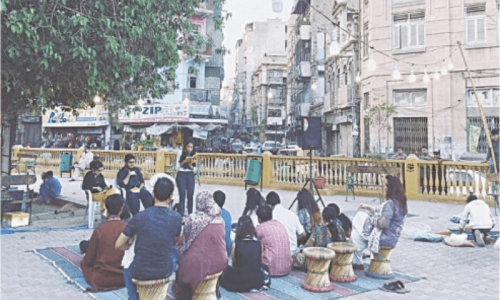
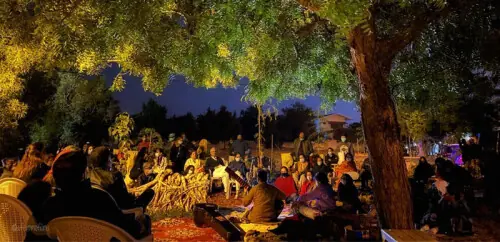
This is also visible in newer Karachi spaces that have emerged with modest means but strong civic imagination. The Centre For Art-based Methodologies and Well-being and Nani Ghar, Darham/ Marham, Kitab Ghar and Danish-o-Ramish represent a different model of public culture: smaller, intimate and community-facing. Once upon a time so was T2F. They are not trying to become grand cultural complexes. Their significance lies in creating rooms for reading, conversation, collective care, arts practice, learning, reflection and belonging. In a city where public space is scarce and often hostile, such areas become civic infrastructure on a neighbourhood level. They are not insulated from the city; they absorb it. They allow people to enter without the intimidation of institutional grandeur. They survive through trust, informality, shared labour, borrowed furniture, public generosity, uneven funding and the fragile ethics of care. They remind us that Karachi’s cultural future may not only lie in large master-planned facilities, but in a constellation of smaller spaces rooted in different localities.
An industrial or employment-dominated district works differently. Its rhythms are shaped by work-hour mobility, production, institutional destinations, transport corridors and commuting patterns. It may contain communities, mixed-use pockets and important public institutions, but its dominant urban logic is not the same as that of a porous civic neighbourhood. After working hours, many of these areas lose the everyday street continuity that sustains informal cultural life. A space placed there may still host events, but it risks becoming a destination rather than a commons. This distinction matters in Karachi, where access is already unequal. Arriving by car is not an accessibility argument in a city where many people do not move by car, where women calculate routes through safety, where students depend on affordability, where public transport remains fragmented, and where distance is measured not only in kilometres but in social permission.
Karachi needs development. But every form of progress need not be bigger, more centralised and more institutional. The future of Karachi’s cultural life cannot be measured through facilities alone. It must be measured through ecosystems. A city does not become progressive by uprooting its small civic rooms and rebuilding them as destination campuses. It becomes progressive when it understands that public culture grows through proximity, trust and place. Preservation, then, is not resistance to change. It is the discipline of asking what gives a place its life before deciding how to change it.
The writer is an architect.
X: @MarviMazhar
Published in Dawn, June 29th, 2026