Strange things began happening in the city of Karachi in 2020. The air grew lighter, almost transparent, as though the sea winds had quietly washed decades of dust from the sky. People claimed they could suddenly see farther than before.
Sailors returning from the mouth of Karachi harbour spoke of unbelievable numbers of dolphins, like messengers from another age. The roads, once choked with traffic, fell into long stretches of silence. For the first time in decades, Karachi could hear itself breathe.
And in that unsettling stillness — brought on by the outbreak of Covid-19 — people encountered another unfamiliar sensation: time.
Offices closed, commutes vanished and many experienced the strange, unhurried rhythm of an early retirement. Men and women who had spent their lives rushing between meetings, markets and obligations found themselves sitting on balconies at dusk, listening to birdsong that had long been drowned out by generators and traffic.
In a part of the city long resigned to apathy, isolation and institutional indifference, a small group of residents in Karachi’s upscale Defence area decided to stop complaining and start showing up. What followed was lessons in how the city can be transformed…
Neighbours, too, began discovering one another. People who had lived for years behind high walls and iron gates suddenly realised that old friends lived only a street away. Familiar names acquired faces; distant greetings turned into conversations.
In those suspended months, when the city seemed to hover between fear and introspection, a quiet community revolution began in one of Karachi’s elite neighbourhoods.
The MGB area — the khayabans [boulevards] of Momin, Ghazi and Badban in Phase 5 of the affluent Defence Housing Authority (DHA) — consisting of nearly 400 houses and six entry and exit points, became the unlikely focal point of this transformation.
THE WHATSAPP GROUP THAT STARTED IT ALL
Someone suggested that instead of endlessly complaining about the decay around them, residents should attempt a few small changes through collective effort and self help.
One thing led to another. Telephone numbers were exchanged. Those reluctant to participate were gently persuaded. Children unexpectedly emerged as the movement’s most enthusiastic ambassadors, going door to door, urging residents to join.
Soon, a WhatsApp group came into existence and, slowly, almost imperceptibly at first, the community began to grow in numbers, purpose and confidence.
The group’s value announced itself quickly. One night, smoke rising from a house was spotted by a neighbour, who alerted the community through a WhatsApp message. Within minutes, residents, the fire brigade and the police had mobilised, helping contain the fire before it spread further.
On another occasion, an attempt by land-grabbers to occupy an under-construction disputed property was quickly pre-empted after residents alerted the police. People began to recognise the extraordinary power of cooperation in a city where most citizens had long resigned themselves to institutional indifference.
As lockdowns deepened, new forms of local economy also began emerging. A few residents started home kitchens, delivering home-made meals within the neighbourhood. Others sold handicrafts and used furniture.
One woman, an artist, began painting giant sunflowers on boundary walls, adding bursts of colour to streets that had long surrendered themselves to monotony and dust.
CLEANING THE STREETS, CHANGING HABITS
The neighbours then started identifying problems that could be addressed immediately, and others for which the assistance of the Cantonment Board Clifton (CBC) and DHA would eventually be required. The movement’s first confrontation was with a habit everyone condemned but few were willing to change: garbage disposal.
Scattered across the area were eleven kachra kundis [trash dumps] — festering mounds of refuse that had become breeding grounds for flies, disease and neglect. Packs of stray cats and dogs gathered around them each evening to feed. Whenever municipal trucks arrived to collect the garbage, much of it spilled back on to the streets, as though the neighbourhood had been condemned to live permanently with its own waste.
Beyond these dumping sites, residents and domestic staff alike had fallen into the habit of throwing rubbish wherever it seemed convenient. Empty plots had become unofficial landfills, where construction debris, broken furniture, discarded household items and rotting waste accumulated beneath the unforgiving Karachi sun.
Cleaning the neighbourhood demanded far more than municipal action. The hardest task was changing habits. Residents had to convince not only themselves, but also their household staff, to wait for collection trucks instead of casually throwing garbage into open spaces.
Rather than publicly shaming offenders, activists quietly approached them, explaining the need for discipline and collective responsibility. Eventually, with the support of the CBC, all eleven kachra kundis were removed and regular waste collection introduced.
A handful of volunteers spent months persuading neighbours to separate organic and recyclable waste. Some listened politely and ignored the advice. Others resisted. A few embraced the idea and became examples for the rest. Animal lovers within the community launched another campaign: vaccinating and neutering stray dogs and cats.
Equally important was the relationship that developed between residents and the CBC. Instead of approaching civic institutions with suspicion and confrontation, community representatives chose engagement and collaboration. CBC officials responded with enthusiasm. Meetings followed. Relationships were built. Gradually trust was built on both sides. The experience reinforced a simple but often overlooked truth: when communities and public institutions work together, both become more effective.
SHADE AS RESISTANCE
Simultaneously, a group of residents began pushing for a greener neighbourhood. The volunteers set their sights on an empty plot that had become a dumping ground. Most residents saw an eyesore. A few imagined a park. They spent weekends clearing rubbish, debating designs and persuading sceptical neighbours that the effort was worth it.
People interested in urban forests, wild plantations and flowering plants came together with surprising energy and conviction. Within months, greenery emerged where refuse had once accumulated.
There were disagreements, of course. Residents argued passionately over which trees to plant, whether native species should take precedence over decorative ones, and how much of the area should remain wild. Ideas clashed. So did egos. But somehow, the collective effort survived these tensions.
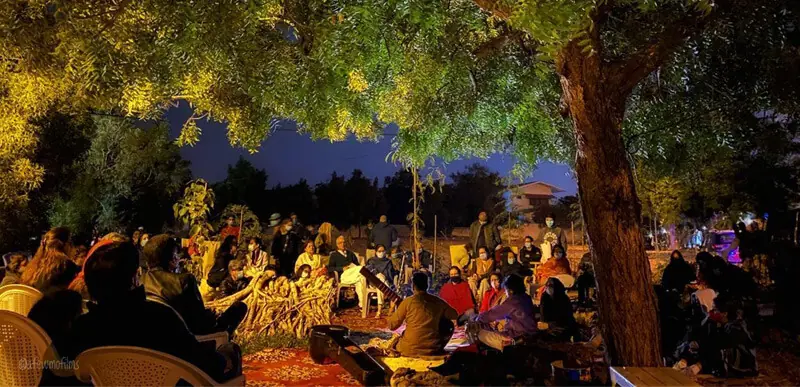
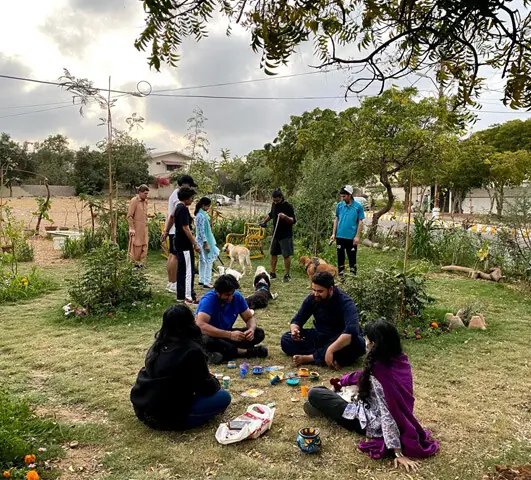
Soon the park acquired a life of its own. Informal baithaks [hang-outs] began taking place there in the evenings. Children played cricket nearby. Chess tournaments were organised under the shade of newly planted trees.
As the years passed, the park and surrounding streets became the setting for larger community celebrations. Residents gathered for Independence Day and Pakistan Day festivities, Eid gatherings, sports screenings and occasional musical evenings. These events transformed neighbours into friends and helped create something increasingly rare in upscale Karachi: a genuine sense of belonging.
To be fair, this sense of community and collective responsibility is far more visible in more middle class localities and in poorer neighbourhoods, where people coming together to solve problems is also a recipe for survival in the face of official neglect. In places such as Orangi Township, for example, neighbourhoods have even laid sewerage lines through collective action. But, remarkably, this sense of community has often been missing in the upscale neighbourhoods of Karachi.
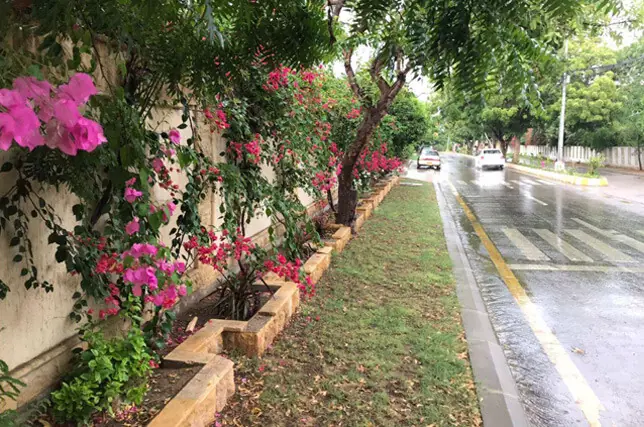
The enthusiasm proved contagious. Street corners and medians began attracting attention. Plantation drives spread through the neighbourhood. Residents started identifying neglected spaces where trees could be planted. In a city increasingly defined by concrete, shade itself became an act of civic resistance.
One of the most visible transformations involved the neglected strips of land between the roads and the boundary walls of houses. There were no pavements and these spaces were often left barren, dusty and uneven. Volunteers approached homeowners, requesting them either to pave the area or plant greenery to reduce dust and improve the aesthetics of the streets.
Once the process began, it spread rapidly. Nearly 150 houses eventually followed suit. Tree-lined streets and proper footpaths slowly emerged where neglect had once prevailed.
The community also assisted elderly residents and those unable to supervise construction work themselves, arranging contractors and coordinating labour on their behalf. In subtle ways, people had begun reclaiming not just their streets, but also the idea of shared responsibility.
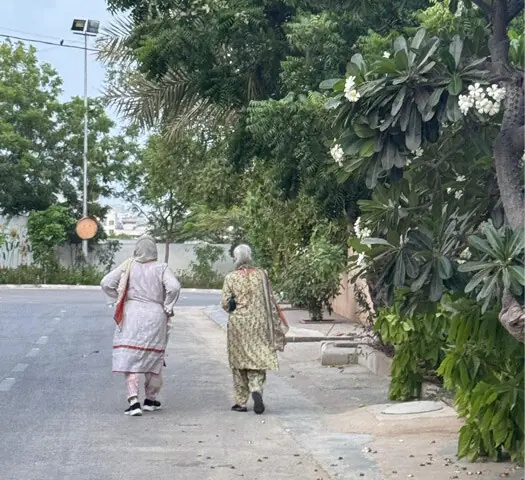
The cleaner, greener and safer streets also encouraged people to reclaim public space. Morning walkers, runners, cyclists, families and dog owners became familiar sights. During winter, when the neighbourhood’s petunias burst into bloom, visitors from other parts of the city began coming simply to walk beneath the flowers and trees.
BEYOND THE WALLS
Not surprisingly, security remained the concern that united almost everyone in the neighbourhood. Karachi has conditioned its residents to live with anxiety: hurried glances in rear-view mirrors, locked car doors, suspicious movements outside homes and the constant calculation of risk that shapes urban life in the city.
But the pandemic altered even this relationship with fear. As neighbours became more connected, they also became more watchful — not in the intrusive sense of surveillance, but through the quiet reassurance that someone, somewhere, was paying attention.
The residents approached the police, who responded positively by deputing personnel for the area. Individual streets pooled resources to arrange private guards for night patrols. CCTV cameras were installed at all six entry and exit points of the neighbourhood. Gradually, an informal but effective security network emerged, built as much on human presence and communication as on cameras and guards.
The results became visible within months. Incidents of robbery and petty street crime declined significantly. Suspicious activity was reported instantly through the community WhatsApp group. Strangers entering the area no longer passed unnoticed. Elderly residents living alone felt safer knowing neighbours were only a message away.
But perhaps the deeper transformation was psychological. In a part of the city where people had long retreated behind walls, generators and private security systems, residents rediscovered the older idea of collective vigilance — that security is not created by barriers alone, but by relationships, familiarity and shared responsibility.
The community’s wishlist remains a long one. Residents now speak of establishing a small dispensary for domestic workers and support staff in the area. Others want better water arrangements, more trees, safer streets, timely repair of roads and greater cooperation with civic agencies.
A small group of committed volunteers, who invested countless hours in mobilising residents, coordinating with civic agencies, raising funds and sustaining momentum were behind much of this transformation.
Their most important achievement was not planting trees or installing cameras, but earning the trust of their neighbours through visible action and tangible results. Over time, this trust evolved into an organised residents’ association that became the community’s collective voice.
The experience demonstrated an important lesson: communities are built not by complaints, but by a handful of people willing to consistently show up and do the work.
Yet perhaps the most important transformation cannot be measured in cleaner streets or falling crime statistics.
For a brief moment during the pandemic, people in upscale Karachi rediscovered an older truth that modern urban life had almost erased: that a neighbourhood is not merely a collection of houses separated by walls, but a living community held together by trust, cooperation and the stubborn belief that ordinary citizens, working together, can still repair small fragments of a broken city.
Nadeem Khalid is the president of WWF-Pakistan
Jaleel Akhtar is a television director and producer
Published in Dawn, EOS, June 28th, 2026