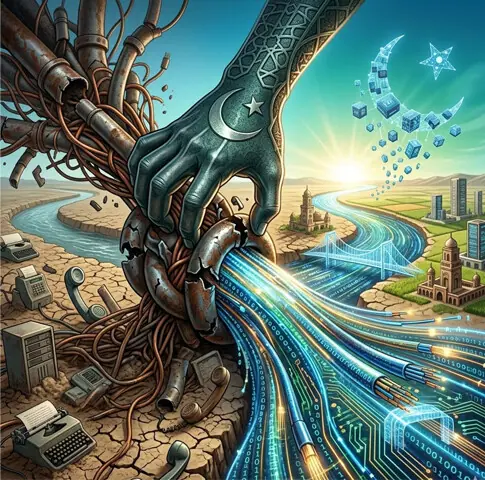
IN an era where digital economies are redefining global power, the question of whether Pakistan can emerge as the next digital leader in South Asia is both timely and critical. From artificial intelligence (AI) to e-commerce and freelancing, technology has become the backbone of modern economic growth. For Pakistan, the digital opportunity is immense. However, turning this potential into reality requires confronting structural challenges and leveraging existing gains with strategic clarity.
Pakistan’s digital transformation is already visible in key metrics. As of 2025, the country has 190 million mobile connections, covering more than 75 per cent of the population, and 116 million internet users, indicating a digital penetration of nearly 46pc. Broadband infrastructure has expanded rapidly, with 147 million broadband subscriptions and nearly 60pc penetration, showcasing substantial progress in connectivity. These figures reflect a strong digital foundation, particularly in a country where over half the population is young and increasingly tech-savvy.
The growth of Pakistan’s IT sector further strengthens its digital prospects. In the 2025 fiscal, Information technology (IT) and IT-enabled services exports reached approximately $2.8 billion, growing by nearly 24pc year on year, while generating the largest trade surplus among service sectors. The country now hosts more than 30,000 IT firms and produces a growing pool of freelancers, who alone contributed about $400 million in foreign exchange earnings. Additionally, initiatives such as DigiSkills have trained over 4.5 million individuals. These developments indicate that Pakistan is actively participating in the global digital economy, particularly in outsourcing and freelance services.
The start-up ecosystem also reflects promising, albeit uneven growth. Pakistan ranks third in South Asia for start-ups. More than 1,900 start-ups have been incubated through national programmes, and the country’s demographic provides a strong foundation for innovation. However, the decline in venture capital funding, from $355 million in 2022 to only $37 million in 2024, reveals structural fragility in the ecosystem.
Another critical challenge is the digital divide. While internet usage has expanded, nearly half of Pakistan’s population remains offline, particularly in rural areas. Factors such as low digital literacy, insufficient infrastructure in remote regions, and affordability constraints continue to limit inclusive digital growth.
Moreover, issues like inconsistent policies, regulatory un-certainty, and limited foreign investment hinder long-term sectoral development. Competition in South Asia further complicates matters. Countries like India and Bangladesh have aggressively pursued digital strategies. Pakistan stands at a critical crossroads. Becoming the next digital power in South Asia is not an unrealistic ambition, but it requires sustained reforms, targeted investments and a coherent long-term vision.
Muhammad Saeed
Chitral
Published in Dawn, June 28th, 2026