• Dozens of families displaced as homes, roads and farmland suffer extensive damage
• PMD issues Glof alert, while NEOC warns of landslide risk in mountainous and upper regions
GILGIT: Cloudburst-induced floods wreaked havoc in Thore Valley of Diamer district on Saturday, while rapidly melting glaciers continued to raise water levels in rivers and streams across Gilgit-Baltistan (GB), putting downstream communities at increasing risk.
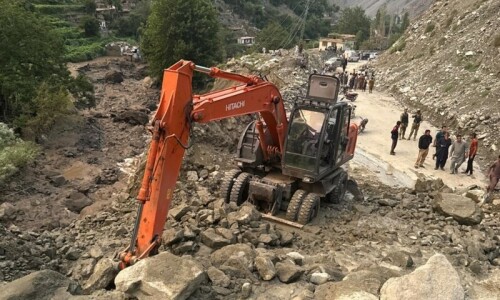
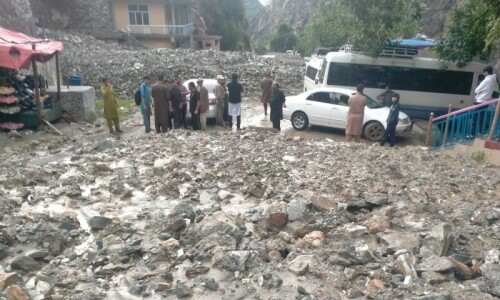
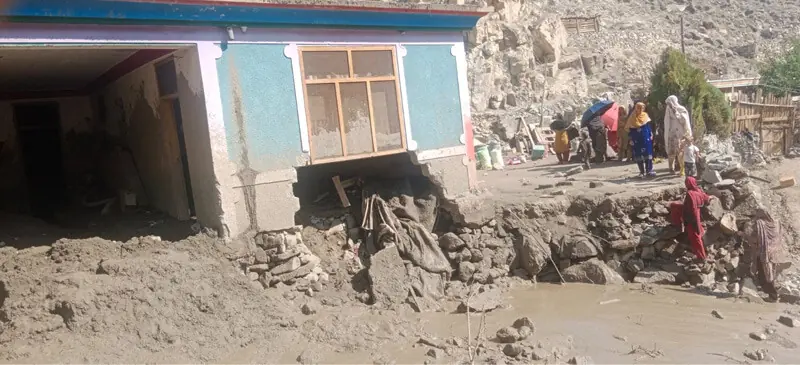
According to local police, flash floods triggered by a cloudburst over nearby mountains caused widespread devastation in Thore Valley. Several homes, hundreds of acres of farmland, orchards, trees, and both public and private property were damaged.
The floods also destroyed link roads and communication bridges, cutting off access to several villages. Dozens of families were left homeless, while electricity and water supply systems were disrupted.
Floodwaters swept away vehicles parked along roadsides and damaged standing crops. The water also entered the Wapda Colony built for employees working on the Diamer-Bhasha Dam project, as well as nearby villages, causing extensive destruction.
Assistant Director General of the Gilgit-Baltistan Disaster Management Authority (GBDMA), Imtiaz Ahmed, said the district administration responded immediately and intensified relief operations in the affected areas.
He said food supplies, tents, and other essential relief items were being distributed among flood-affected families. He added that the valley’s main road had been reopened and damage assessment was underway.
“Authorities are working to restore access and provide immediate assistance to families affected by the flooding,” he said.
Local residents appealed for urgent humanitarian assistance, including food, shelter, medical aid, and essential supplies for those who lost their homes and livelihoods.
Heatwave
Meanwhile, heatwave conditions continued across Gilgit-Baltistan on Sunday, accelerating glacier melt.
Authorities warned that rising water levels in rivers and streams had increased the risk of flooding and glacial lake outburst floods (Glofs). The swelling waterways have disconnected several roads and damaged crops and farmland in downstream areas.
Flooding in Sadpara Nallah blocked the Deosai Road, cutting off access to Deosai from Skardu. Police said several tourist vehicles were stranded in the area.
Water erosion also severed the link road to the Badswat area in Ghizer district. Similarly, rising water levels in Hopper Nallah damaged crops and farmland downstream and threatened roads, bridges, and other public and private infrastructure.
PMD issues Glof alert
In the meantime, the Pakistan Meteorological Department (PMD) issued an alert on Saturday warning of an increased risk of glacial lake outburst floods (Glofs) in Gilgit-Baltistan and Khyber Pakhtunkhwa, forecasting that high temperatures are likely to persist until the first week of July.
“This significant warming will substantially accelerate snow and ice melt in the glaciated valleys of these regions,” the PMD said in an advisory issued late Friday.
The department warned that river and stream flows are expected to remain unusually high. Existing glacial lakes may expand rapidly due to increased meltwater, while new glacial lakes may also form.
It cautioned that vulnerable downstream communities and low-lying areas adjacent to riverbeds face a heightened risk of sudden inundation and flash floods.
Separately, the National Disaster Management Authority (NDMA) also issued an alert warning of increased glacier melting in northern and mountainous regions from June 27 to July 3.
According to Radio Pakistan, the NDMA cautioned that rising temperatures, combined with expected rainfall, may accelerate glacier melt, increasing water flow in rivers and streams across Gilgit-Baltistan, KP, and AJK.
Landslide alert
The NDMA’s National Emergency Operations Centre (NEOC) also issued a landslide alert for mountainous and upper regions of the country.
The authority warned of an increased risk of landslides in Gilgit-Baltistan, upper Khyber Pakhtunkhwa, and Azad Jammu and Kashmir between June 27 and July 3 due to intermittent rainfall and accelerated glacier melt.
It also warned of possible rockfalls, debris flows, and landslides across mountainous areas.
Published in Dawn, June 28th, 2026