0
0

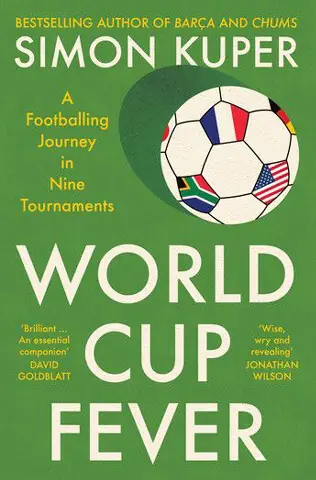
World Cup Fever
By Simon Kuper
Profile Books
ISBN: 9781805224112
352pp.
Do you remember the first football World Cup match you watched — perhaps in a crowded living room, in a stadium or even on a flickering television that made every goal seem larger than life? Simon Kuper remembers. More importantly, he understands why that memory matters.
In World Cup Fever, Kuper turns nine tournaments — from Italia 1990 to Qatar 2022 — into a personal history of modern football. He is among the rare writers who have attended every World Cup since 1990, and he uses that vantage point to trace the sport’s evolution from a comparatively intimate festival to a vast global spectacle intertwined with money, geopolitics and corporate power.
That doesn’t mean the book is limited to the game’s last 36 years — it is more than a chronicle of tournaments. Kuper repeatedly leaves the press box and the stadium to ask how the World Cup came to be. From discussing the organisational issues of the first World Cup in 1930 to taking readers along to his roots in South Africa, he does a remarkable job.
Through this book, you will learn how difficult it was to organise the inaugural tournament and why the then Fifa president, Jules Rimet, remains one of football’s foundational figures. It also tells you a lot about the hosts of the last nine events, which isn’t something you can read about online or hear on someone’s vlog, because only an experienced campaigner like Kuper can have an opinion on such matters.
The book is divided into two parts to make it easier for readers. The early chapters in ‘Part One: In Jules Rimet’s World’ remind readers that the competition was built through logistics, persuasion and idealism. The later chapters in ‘Part Two: New Worlds’ discuss the expansion of the mega-event and why it is considered the biggest sporting competition on the planet.
A recent book about nine football World Cups since 1990 is a compelling exploration of the international event as a global phenomenon where football, politics and national identity collide
The research doesn’t stop there. On a good note, the book also exposes the corrupt elements in Fifa, including the awarding of World Cup events to post-apartheid South Africa in 2010, the least-interested Brazil in 2014, Putin-dominated Russia in 2018 and oil-rich Qatar in 2022, where the mega event was held in winter. The umpiring errors during these mega events and the player errors that cost their teams a place in the next round, round it up.
For Kuper, the story of football’s biggest competition is also a story about globalisation. He recounts all nine World Cups he attended, both as a fan and as a journalist. His recollection is spot on, thanks to the journals he has kept. Although I have followed most of the World Cups since 1990, it was refreshing to read about them through the eyes of someone who was there, absorbing everything that happened on the field.
I must add that, had the author set aside his personal bias toward his native South Africa and focused more on the other mega events, I might have wholeheartedly recommended this book to readers. The South African pages deserve another book because, here, the author’s heart takes over, and he starts rambling about stuff from his white grandmother’s transformation to the bad state of affairs in the region before and during the tournament.
Of course, everyone wants to read about the organisation of a Fifa World Cup in a post-apartheid region, but not in a book about eight other World Cups. Another book would have been a good idea, because those chapters slow the flow for readers who want to know about the World Cup and the World Cup alone.
However, he does talk about the World Cups throughout most of the book, which is one reason to read it. Be it talking about Brazilian Ronaldo’s rare off day, Zinedine Zidane’s headbutt in a World Cup final, or Luis Suárez’s infamous incidents that made him the villain of the World Cup twice, you can find everything in these pages.
Not only does the author put his observations on paper, he also discusses his interactions with players, managers and fans around the globe. To keep his journalistic fire alive, he also goes to the horse’s mouth — namely, Fifa officials — to address his scepticism about the institution that governs global football.
The book’s highlight is Kuper’s depiction of the exhaustion, travel, hotel rooms, deadlines and banal routines behind the glamorous image of the World Cup correspondent. His reflections on fellow journalist Grant Wahl’s death during the 2022 tournament are especially unsettling, because they reveal how professional obligation and human emotion can collide during a live event.
These passages also chart the book’s emotional trajectory. Kuper begins as a fan intoxicated by the tournament’s possibilities and gradually becomes a reporter who sees the machinery behind the spectacle, highlighting the good, the bad and the ugly. He also shares with readers his kids’ interest in the game and regrets not watching a Fifa World Cup game with them live because, when they are watching, he is covering it!
For readers currently enjoying the 2026 World Cup, World Cup Fever works on several levels: history, memoir, political analysis and football writing. It is neither a tactical study nor a nostalgia trip, though it contains elements of both. It wouldn’t be incorrect to say that the World Cup remains a carnival because of the people’s love for the game and its popularity, where strangers mingle, national myths are rehearsed, and millions experience the same drama at the same moment.
World Cup Fever is therefore much more than a sports book. It is a compelling account of how football’s greatest tournament became one of the defining global rituals of the modern age — beautiful, maddening, compromised and impossible to ignore.
The reviewer is a broadcast journalist who also writes on sports, film, television and popular culture. X: @omair78
Published in Dawn, Books & Authors, June 28th, 2026