Govt urged to integrate climate strategies into budgetary planning
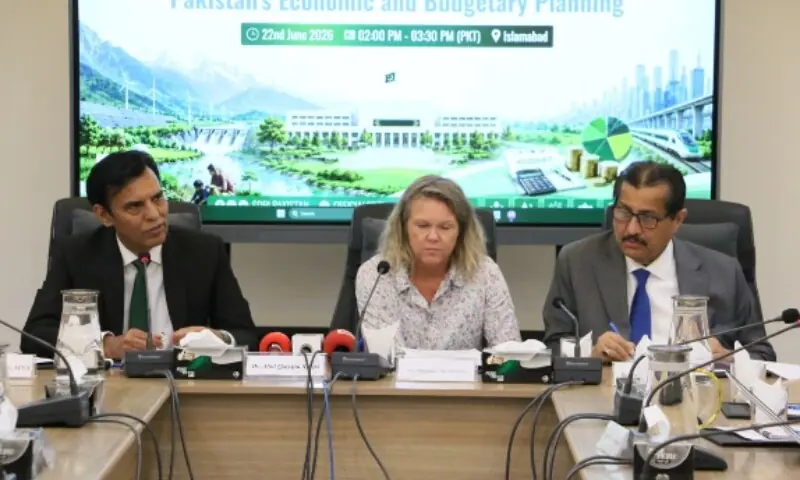
ISLAMABAD: Parliamentarians and policy experts on Monday urged the government to immediately integrate climate strategies into national budgetary planning to counter risks crippling Pakistan’s economic growth and food security.
Speaking at a parliamentary consultation on ‘Mainstreaming climate considerations in Pakistan’s economic and budgetary planning’, they warned that environmental shocks threaten to permanently erase development gains unless green budgeting tools are adopted.
The consultation was organised by Sustainable Development Policy Institute (SDPI) and the embassy of Denmark.
Danish Ambassador to Pakistan Maja Mortensen said climate and environmental concerns could no longer be addressed in isolation and must become part of mainstream economic and political decision-making.
“The diagnosis of the problem already exists; the challenge now is how to translate it into policy action,” she said, describing the consultation as timely in the wake of the federal budget process.
She said climate resilience and economic development are complementary rather than competing objectives.
She also offered Danish experience and technical cooperation in integrating climate priorities into development planning.
SDPI Executive Director Dr Abid Qaiyum Suleri said climate considerations must be reflected in both federal and provincial finance bills, as Pakistan’s budget framework is being shaped under the International Monetary Fund’s Extended Fund Facility (EFF) and Resilience and Sustainability Facility (RSF) programmes.
The IMF-supported reforms had encouraged greater allocations for disaster risk reduction, water conservation and renewable energy projects, he said, adding some of these commitments had already been reflected in federal and provincial budgets.
Dr Suleri, however, warned that climate finance was shrinking globally and nationally despite rising climate-related challenges.
PPP MNA Mirza Ikhtiar Baig said Pakistan remained among the countries most affected by climate change despite contributing minimally to global emissions.
Referring to the aftermath of the 2022 floods, he regretted that much of the international financial support pledged for reconstruction had not been materialised so far. He noted that Pakistan had secured access to climate-related financing under the IMF’s Resilience and Sustainability Facility.
PPP MNA Asad Alam Niazi said climate change had emerged as a national security challenge and there was still inadequate public awareness about its economic and social consequences.
He noted that erratic weather patterns and climate-induced disasters were affecting agriculture, livelihoods and economic productivity, while government allocations for climate action remained insufficient.
SDPI Deputy Executive Director (Research) Dr Sajid Amin Javed said climate change is causing annual losses equivalent to around 1.53 per cent of global GDP which could rise dramatically in coming decades if mitigation and adaptation measures were delayed.
“Climate change should not be treated as a separate budgetary tag; it must become a core pillar of fiscal and economic planning,” he said, adding that employment, poverty, inequality, food security and economic growth were now directly linked with climate resilience.
Head of SDPI’s Energy Unit Engineer Ubaidur Rehman Zia highlighted the importance of embedding climate considerations into fiscal and economic planning.
SDPI’s Head of Ecological Sustainability and Circular Economy Zainab Naeem said climate-related allocations in the federal budget 2026-27 had declined by around 70 per cent compared to the previous year.
She noted that while approximately Rs2,026 billion had been tagged as green-linked revenues, significant gaps remained in climate finance accountability and reporting mechanisms.
Former Managing Director of the Private Power and Infrastructure Board (PPIB) Shah Jahan Mirza observed that the petroleum development levy had increasingly become a tool for managing budget deficits. He urged regulators to formulate climate risk guidelines and called for a shift from reactive responses toward proactive planning and budgetary allocations for climate adaptation.
Published in Dawn, June 23rd, 2026