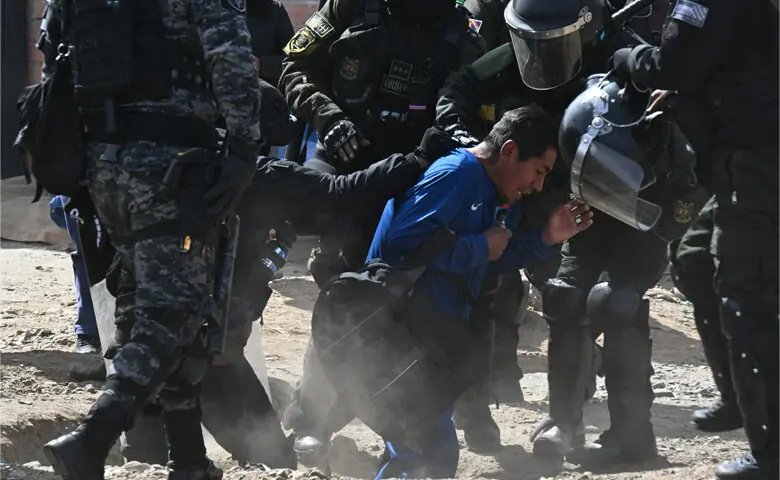
LA PAZ: Tensions soared in parts of Bolivia on Saturday as authorities began clearing roadblocks after President Rodrigo Paz declared a state of emergency amid protests that have paralysed the economy over the past 50 days and left at least 14 people dead.
Addressing the nation early, the centrist Paz said anti-government blockades were no longer a social protest but an organised attempt to destabilise Bolivia’s democracy.
“There comes a moment when failing to act ceases to be prudence and becomes irresponsibility. And that moment has arrived,” Paz said, promising the measure, which enables wider military deployment, would protect citizens and ensure the flow of essential goods.
He warned that those continuing disruptions would face legal consequences. Protesting groups, many allied to former leftist President Evo Morales, have cut off key roads, stranding trucks and choking supplies of food, fuel and medicines to many areas, particularly hurting Bolivia’s administrative capital La Paz and the neighboring city of El Alto.
Govt says ex-president Evo Morales must face the law
At least two dozen vehicles and trucks, multiple motorcycles and several tractors left police headquarters in El Alto on Saturday en route toward a main highway that has routinely been blockaded by protesting groups.
“We have suffered, and we want all of this cleaned up. It’s good; all of us neighbors are in agreement,” said Elvira de Mamani, 65, as she watched a massive tractor clear debris that had been blocking the highway in front of her neighborhood in El Alto.
At another roadblock down the road, a group of truck drivers who had been sleeping in line since Friday chanted, “We want gasoline!” as it was cleared.
Dozens of people lined up along a highway in an area of El Alto home to migrants from peasant highland communities, shouting support for the protests.
“We have the right to fight for our livelihoods, for our food ... We will fight for our children, so that everything isn’t privatized!” said Fortunata Perez, through tears.
Morales must face ‘the law’
The Bolivian government said that former president Evo Morales will have to face “the law” for fomenting crippling protests, fueling speculation that a law enforcement operation could be undertaken in the fugitive ex-leader’s stronghold.
“With Evo Morales, the law; with narco-terrorism, the law. We will carry out whatever operations are necessary at the appropriate time,” Interior Minister Marco Antonio Oviedo told Unitel television, referring to the the Chapere province where Morales is believed to be evading charges that he denies of trafficking a minor.
Emergency powers
Both government allies and opposition politicians have supported Paz’s state of emergency. Congress cleared a path for the declaration in May when it repealed a law that had set limits on the executive branch’s use of emergency orders and was seen as favoring labor unions and social organisations.
“We have seen that after 50 days of the blockade, it was necessary. We see it as somewhat late, because unfortunately, lives have been lost,” said Lissa Claros, a lawmaker from the right-wing opposition Alianza Libre party. “We hope that with this, order and peace can be restored throughout the national territory.” Some opposition lawmakers have warned the state of emergency could further ratchet up tensions, while analysts and legal experts have also said the emergency powers could deepen unrest if they lack public support and fail to address the underlying causes of the protests.
Published in Dawn, June 21st, 2026