PSX tumbles over 2,400 points on back of uncertainty over US-Iran talks
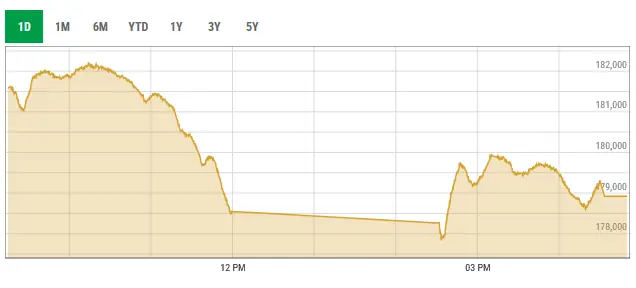


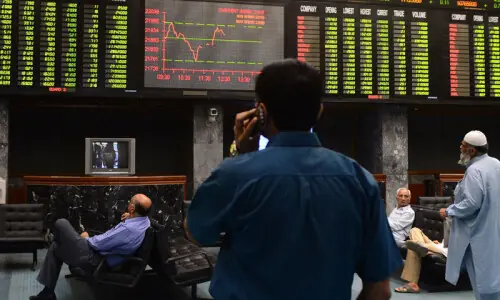
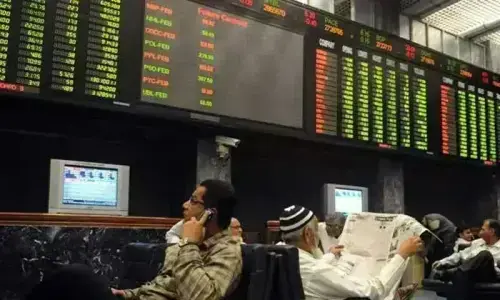
The Pakistan Stock Exchange (PSX) benchmark KSE-100 index tumbled by over 2,400 points on Friday, breaking its four-day bullish spree.
Falling oil prices following the signing of the ‘Islamabad MoU’ between the United States and Iran had fueled optimism, triggering buying interest across multiple sectors. As a result, the KSE-100 index had maintained its recovery for the fourth straight session on Thursday.
On Friday, initial positive momentum pushed KSE-100 to an intraday high of 182,185.87 points at 10:14am. However, the market declined almost steadily after 10:30am until it regained some points later.
The KSE-100 index declined by 2,858.75 points (1.58 per cent) to stand at 178,539.46 at 12:03pm.
After hitting an intraday low of 177,836.16 at 2:34pm, it reversed some of its losses but closed at 178,922.75, down by 2,475.46 (1.36pc) from the previous close of 181,398.21.
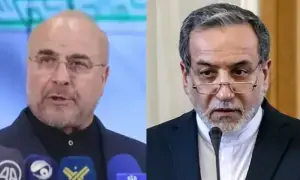
The downward trend followed the postponement of the planned US-Iran talks in Geneva, which were seen as a key step in the peace framework under the Islamabad MoU.
Topline Securities Limited noted that important developments during the week were a current account surplus of $459 million in May compared to a deficit of $276m in April; the Real Effective Exchange Rate (REER) increasing from 105.84 in April to 106.15 in May; and net Foreign Direct Investment (FDI) clocking in at $214m in May compared to $54m in April.
“On flows end during the week, insurance and individuals were major sellers in the market as they net sold equities worth $58m and $10m, as of yesterday’s close; whereas mutual funds and companies were major buyers in the market as they net purchased equities worth $65m and $7m, as of yesterday’s close,” Topline said.
Awais Ashraf, director of research at AKD Securities, noted that the cancellation of the meeting, which was scheduled to initiate technical discussions between US and Iranian delegations, has “shaken investor confidence”.
The decline comes in contrast to the expectations of analysts, who had anticipated that the market would likely sustain its positive momentum, buoyed by easing geopolitical tensions and stable monetary policy.