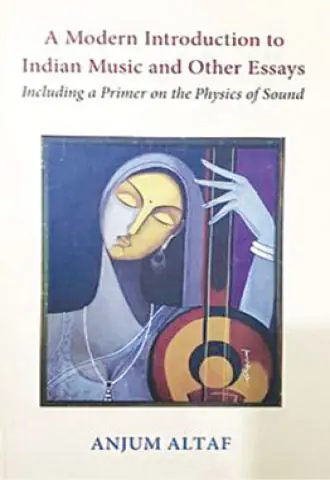
A Modern Introduction to Indian Music and Other Essays
By Anjum Altaf
Maktaba-e-Danyal
ISBN: 978-969-419-130-0
280pp.
Usually, books on music are written by practitioners of classical and light music, who try to explain the complexities of their own learning experience and the outcomes of consistent effort. These are mostly educated people who have not adopted singing as a profession but do so for pleasure.
Then there are compilers of books on music who don’t have an in-depth knowledge of it. Their work is often based on borrowed texts on contemporary popular music, comprising film songs by eminent singers.
According to Anjum Altaf, author of A Modern Introduction to Indian Music and Other Essays, which includes a primer on the physics of sound, the key purpose of his effort is to enhance the enjoyment of listening to music by fostering greater familiarity with its principles, vocabulary and grammar.
He cites chess or cricket as examples, which an individual can enjoy better after knowing the rules of both games. At the same time, he asserts that music is obviously much more powerful in its impact compared to chess or cricket, because it can still be enjoyed without any knowledge of its rules.
Part primer, part Socratic conversation and part cultural history, this engaging volume explores the theoretical foundations of Indian classical music
The book is unique and quite different from other Pakistani authors’ books on music, as it is interactive. It is the outcome of shared learning, in which a group learns from each other by pooling knowledge, and is more exciting and effective than passively being exposed to an expert’s views. In fact, the essays started off as blog posts that were then commented upon by readers. Those discussions are included in the book, almost like a Socratic dialogue.
There are vast audiences, mostly from India, who have taken part in debates in the essays on Indian and Western classical music, film music, and other genres especially prevalent in the Subcontinent. Some of them are not only practising vocalists but also run institutions that teach music to others. Most of the audience have been associated with music for a long time and have exhaustive knowledge, which is quite interesting and educational for the readers. The author refers to them as his sangeet parivar [musical family].
Although the author controls the debates, he expresses his ignorance about some aspects of the music at various points in the book. There are three chapters devoted to the physics of sound and partial reference to even the mathematics of music, which are quite difficult for the reader in general to understand.
In Indian classical music, seven swaras or sur [musical notes] — collectively called the sargam — constitute the saptak [an octave or a series of seven musical notes] and given the following names: Shadja, Rishab, Gandhar, Madhyam, Pancham, Dhaivat and Nishad. These seven swaras also have nicknames, which are more common than the original names — Sa, Re, Ga, Ma, Pa, Dha and Ni.
In Hindustani classical music, a ‘thaat’ signifies the parent scale from which the ragas in that family are derived. Pandit Bhatkhande had set the number of thaats at 10, which, in his judgement, included most of the popular ragas in Hindustani tradition. Each of the thaats has seven ascending and descending swaras (called sampurna), while the ragas in their respective families may have fewer. There is frequent reference to the characteristics of Indian and Western classical music, which provides valuable insight for readers. These are some of the comparisons:
(a) There is harmony in Western music vs melody in Indian music;
(b) Western classical music is based upon the equal tempered scale, and rests upon melody, harmony and counterpoint. Swaras and tala [rhythm] are the two basic components of Indian classical music;
(c) The ethos of Western and Indian music seems quite different, but both are inspirational at their best;
(d) Western classical music is largely based upon harmonic (two or more notes played at the same time) movement and counterpoint. The music is often rehearsed, very rarely improvised, hence the compositions are written in ink (or frozen in time) and are uniquely credited to the said composers. Indian classical music, on the other hand, is mostly improvised and spontaneous;
(e) The central figure in the Western concert is the conductor, but there is no conductor at an Indian music concert.
While lamenting the current state of classical music in Pakistan, the author believes it is dying in the country. The country has failed to produce the likes of Roshan Ara Begum and the stalwarts of the Patiala and Sham Churasi gharanas [schools of music], who migrated to Pakistan after Partition. This art form is not part of the sensibility of the new generation.
According to journalist Zubeida Mustafa, every society decides its attitude to music. “Bangladesh is predominantly Muslim but cherishes music. It is food for the soul and societies that enjoy music are happier,” she asserts while commenting on music in the book. She also writes that “Music would never flourish in Pakistan till this conflict between the yearning of the soul and the voices in the head is resolved.”
There is an interesting story in the book relating to the advent of the harmonium in India, which was invented in Paris in 1840. The harmonium was introduced from Europe to accompany choral music in smaller churches in India. It was adapted for Indian music by an Englishman named Moore.
The early adaptations had various tonal deficiencies and were rejected by the performers, who were mostly Muslims. However, they were accepted by pandits, who found them useful in teaching music. This controversy thus acquired a religious edge and Zulfiqar Ali Bokhari, who was the director of All India Radio (AIR), banned the harmonium from radio broadcasts on this basis. As a result of such powerful opposition, the harmonium remained banned on AIR until 1971.
In Indian culture, there is a persistent bias against anything produced by little or lesser effort. Therefore, the harmonium was resented. Bengali Nobel laureate Rabindranath Tagore seems to have crusaded very early against the harmonium. The philosopher of Indian art, Ananda Coomaraswamy also fulminated against the contraption. Jawaharlal Nehru, long before becoming the first prime minister of India in 1947, joined the chorus formed by Tagore, Coomaraswamy and others in condemning the harmonium.
Those who only wish to get theoretical knowledge of Indian classical music will find Anjum Altaf’s book an interesting read. However, those eager to learn classical singing should get training from an ustaad [maestro]. For instance, when the author explains how to sway from one swara to another and calls it ‘andolan’ or ‘sur jhulana’, the trainee vocalist will not be able to understand.
However, when the ustaad practically demonstrates to his trainee ‘the jhooltay huay sur’ or swinging swaras in various ragas, the latter will understand without any difficulty.
The reviewer is a consultant in human resources at the Aga Khan University Hospital, Karachi
Published in Dawn, Books & Authors, June 21st, 2026