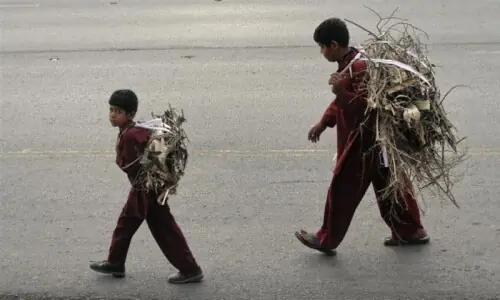
Over 6.6m children involved in hazardous labour in Pakistan: report
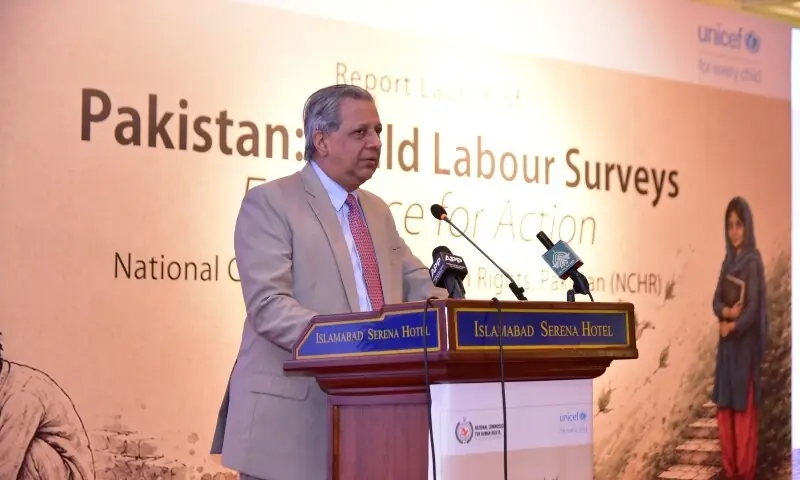
ISLAMABAD: Pakistan has 8.6 million children in child labour, with over 6.6 million engaged in hazardous labour that threatens their health, safety, and future, according to a national report launched by the National Commission for Human Rights (NCHR) in collaboration with Unicef on Thursday.
The report “Pakistan: Child Labour Surveys, Evidence for Action” was the first nationally representative child labour dataset in nearly three decades. It provided a comprehensive picture of the scale, distribution, sectors, risks, and drivers of child labour nationwide.
Speaking at the launch, NCHR Chairperson Rabiya Javeri Agha noted that Pakistan’s last comprehensive child labour survey was conducted in 1996, with policymakers and development partners relying on outdated or fragmented data for over 20 years. She emphasised that while prevalence varied across provinces, hazardous child labour remained a widespread concern affecting children in every region.
The report showed that Punjab bore the largest burden of children in child labour, with over six million in Punjab, followed by Sindh (1.6 million), Khyber Pakhtunkhwa (745, 155), Balochistan (201,352), and Islamabad Capital Territory (15, 180).
The report identified poverty as the strongest driver of child labour, with the highest prevalence among the poorest households and families with low parental education. Boys were significantly more likely than girls to be engaged in labour, including hazardous work. It showed that a significant share of child labour took place within families on family farms, in family workshops, and in family homes.
This made it largely invisible to conventional labour inspection.
The findings also highlight the severe impact on children’s well-being. Children involved in labour were more likely to be out of school, work longer hours, and suffer injuries, illness, fatigue, and poor mental health. Across provinces, between 32 and 58 per cent of working children reported work-related injuries or illness, while up to one third of older children in labour reported symptoms of depression.
Speaking on this occasion, Federal Minister for Human Rights, Senator Azam Nazeer Tarrar, said that the issue of child labour could not be solved by any one ministry or any single intervention.
He said that what the evidence increasingly confirmed was that child labour in Pakistan was far more widespread than many assumed.
Judge of Supreme Court of Pakistan Justice Ayesha Malik said that Pakistan had made clear legal commitments with respect to child labour.
She mentioned Article 11 of the Constitution, which prohibited the employment of children under 14 in hazardous occupations, and Article 25A, which guaranteed free and compulsory education.
Stressing the importance of including children’s voices in policymaking, she called for bringing their perspectives to the decision-making table to effectively address the challenge. “Child labour is closely linked to issues of education, family circumstances, health, nutrition, and social mindset. The real question is whether we are engaging children themselves in discussions about these issues and listening to their experiences and concerns,” she said.
In his opening remarks, Minister of State for Law and Justice Barrister Aqeel Malik said that child labour was not inevitable.
“It is driven by poverty, exclusion, and under-investment. Every child who stays in school instead of going to work is a measure of our success. That is the standard we should hold ourselves to,” he said.
Published in Dawn, June 19th, 2026