0
0

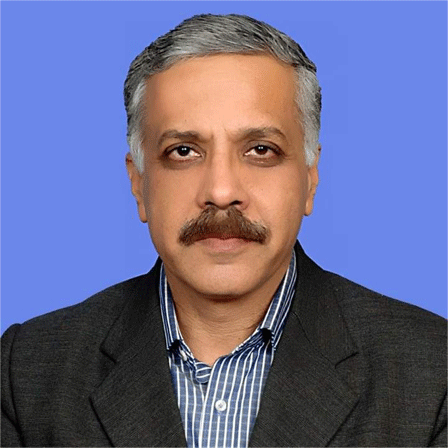
Miftah ismail
Former Finance Minister
Prime Minister Shehbaz Sharif’s tenure is the only four years in our history where growth hasn’t even touched 4pc Pakistanis are poorer than they were four years ago, paying more in direct and indirect taxes and suffering from 78pc inflation over the last four years.
As a nation, we exported less than last year, became more indebted, our unemployment is at a 20-year high, and poverty is higher today than 10 years ago. In short, our downward slide continued this year.
Does this budget recognise that Pakistan is on a downward slide? Hardly. Will this budget halt our economic slide by implementing major reforms on both the revenue and expenditure sides? No. This is a budget of Nero playing the fiddle while Rome was burning.
Yes, it has a little relief for salaried people and exporters. It reduced withholding taxes on property transfers. But it also adds a host of indirect taxes on manufacturers, distributors and wholesalers. This may increase the cost of many consumer goods. There is also relief for those flying in first or business class and for those using credit cards in foreign currency.
Some tax relief for the higher income brackets, some growth measures for the wider economy, some stimulus to the housing sector — that is the budget in a nutshell. Much of the budget’s hopes rest on successful tax collection by the FBR through tech-enabled yet untested methods. Whether it is the start of a sustainable growth trajectory, only time will tell.
Salim Raza
Former SBP Governor
With slight easing, stabilisation continues. Bearing diminishing linkage with growth frameworks, the budget becomes a one-year fiscal plan. Entrenched, rising expenses lead to high, cascading taxes. Revenue outcomes veer away mid-stream. Expenditures are — as a practical matter — inelastic. We end up with low Investment ratios (a third of our South Asia neighbours) and turgid GDP growth (about half our neighbours)The national budget is meant to leverage growth; its policy bias stimulates investment. Growth enables fiscal flexibility. Based on our own resources, sustainable growth could be led, illustratively, by a recurring focus on three areas: enhanced agricultural productivity; reinforced domestic industrial supply chains; and reducing cash outside banks, from 37pc of deposits to nearer the 17pc of our neighbours. Agriculture needs singly managed policies for galvanising mechanisation, storage and processing. Given pervasive reliance on imported intermediate goods across our industry, GDP growth becomes import-led, reversing as we cross 5pc; SMEs must progressively indigenise intermediate goods in identified sectors. Cash entering banks mobilises a multiplier impact on deposits. A broader deposit base will ameliorate the chokehold on banks’ ability to act as engines of private-sector growth, posed by the government’s present acquisition of three-quarters of ‘banks’ loanable assets.
Mushtaq Khan
Founder, Doctored Papers
To understand this budget, it is important to flush out the center-province standoff that delayed it: (1) the IMF wanted the government to expand the tax base to capture retailers, agriculture, and real estate; (2) these taxes are the responsibility of the provincial governments; (3) provincial governments were more interested in increasing their share of the NFC awards, and threatened the center with insufficient cash surpluses that are required for the Extended Fund Facility; (4) the National Economic Council meeting was postponed four times, hinting that the ruling coalition could break; (5) the Establishment stepped in and wanted a strategic allocation to fortify Pakistan’s security; and (6) the provinces agreed to reduce their development budgets, but not to tax their constituents.
The FY27 budget follows the IMF’s austerity roadmap, but without the necessary reforms. The FBR revenue target is now a quantitative performance criterion, which means a revenue shortfall next year will require additional intra-year tax collections. Institutional reforms have been put on the back burner, while new revenues will come from removing tax exemptions, stricter enforcement, settling tax cases in the government’s favour, fuel levies, and further squeezing captive payers. In other words, this is a status quo budget that will please few.
Published in Dawn, The Business and Finance Weekly, June 15th, 2026