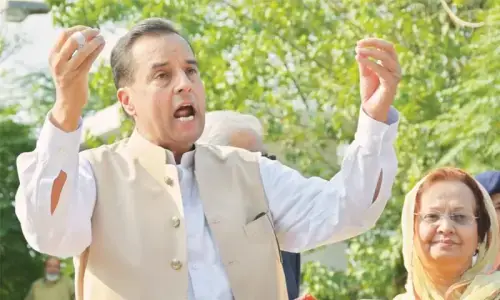
Izzat Majeed departs as one of those rare figures whose life cannot be contained within biography alone but must be read as a long, unfolding composition part raga, part jazz improvisation and part whispered Punjabi verse carried across time. With his passing, Lahore loses not merely a man but a certain way of listening to the world. His last few years were spent battling the Alzheimer’s disease. He fought bravely, but eventually succumbed to it.
Born into a household already tuned to the grammar of art, he was the son of Mian Abdul Majeed, a towering figure in Pakistan’s film industry during its golden age when cinema still believed it could sing the nation into coherence. His father’s home was not a residence but a rehearsal room of memory where classical maestros and film composers crossed paths and where the young Izzat first learned the intricacies of sound.
Izzat’s mother, Mrs Seeta Majeed, came from a prominent Indian family, and carried within her the quiet gravity of a life that had crossed borders both geographic and forbidden. Her union with Mian Abdul Majeed, an interfaith love that defied the cautious architecture of its time, became the first bridge for Izzat between faiths and cultures. The Seeta Majeed Building at the Beaconhouse National University stands as a testament to Izzat’s love for his mother. Built through his sponsorship, it was established to foster liberal arts education in Lahore and beyond.
Though trained as an economist and briefly folded into the rational architectures of finance and advisory work in the Middle East (Saudi Arabia), Izzat carried another curriculum within him—one written in scales, improvisations and the restless pulse of rhythm. Oxford sharpened his intellect but did not confine it as even there music leaked from his life like light through a closed door. The man who was expected to calculate returns instead kept returning to sound. It merits mention that Izzat achieved success as an economist that came to the very few but he made a conscious choice to devote his energies to promote art in Pakistan.
When he finally founded Sachal Studios in 2008, it did not feel like an enterprise so much as a recovery of something long exiled. Out of the quiet ruins of Pakistan’s fading film and classical music ecosystems, he gathered the musicians who had been made invisible. In doing so, he did not simply preserve talent; he restored dignity to it. The studio became less a building than a breathing archive—where forgotten hands learned again how to speak through instruments.
Under his guidance, Sachal became a rare meeting place between South Asian classical traditions and Western jazz, as though raag and improvisation had finally recognised each other as distant relatives. Izzat often understood these forms not as opposites but as twin grammars of longing, one disciplined by centuries, the other by spontaneity, both circling the same ineffable centre. With collaborations spanning artists such as Wynton Marsalis and performances from Lincoln Centre to Royal Albert Hall, Sachal’s sound traveled outward, but its emotional origin remained rooted in Lahore’s densely layered cultural soil.
Yet beneath the applause and international recognition lay a quieter, more essential work: the care of those whom history had nearly discarded. For many musicians who had once animated Pakistan’s film industry, Sachal was not merely employment but return to craft, respect and fragile certainty that their art still mattered. In this sense, Izzat’s legacy is less institutional than humane, an act of listening made permanent.
Those who knew him describe a man of deliberate economy in speech, often monosyllabic, sometimes misread as distant. Yet he was never absent from sound; rather, he seemed absorbed by it. He preferred studios to salons, rehearsal to rhetoric, the unfinished phrase to the polished declaration. Beneath that restraint lay a conviction both simple and radical: that music is not ornament to life but one of its deepest forms of understanding.
In his later years, Izzata often spoke of jazz and South Asian classical music as though they were two rivers that had long been searching for a shared delta. In that metaphor lies something of his own temperament, restless yet patient, analytical yet intuitive, always seeking convergence rather than division. He was, in a sense, a Punjabi and English poet not by publication but by sensibility: writing in two tonalities at once.
And yet, the final image is a sobering one. Despite a life that reached far beyond national boundaries, his funeral was marked by a modest turnout, a quietness that seemed almost disproportionate to the reach of his work. There is something instructive in that silence not as a judgment upon the man, but upon the fragile attention span of societies that often forget their own custodians of memory. The distance between his global recognition and his final farewell becomes, in itself, a kind of elegy.
Izzat Majeed is survived by the living continuation of his vision: the musicians of Sachal Studios, the recordings that continue to travel where he no longer can, and the audiences—known and unknown—who have found in his work a rare dialogue between East and West that does not erase either.
But more than institutions or recordings, he leaves behind a sensibility: that culture is not a possession but a responsibility; that forgotten voices do not disappear so much as wait to be heard again; and that music, when treated with sincerity, can still repair what history fractures. It is such individuals who help repair the ruptures within civilizations and, in a seamless manner, forge enduring cultural bonds that bring together disparate communities. Through their vision and efforts, they act as bridges across difference, fostering understanding, unity, and shared purpose among people who might otherwise remain divided.
Izzat Majeed’s life reads now like a long, unfinished composition, its themes introduced, developed, refracted and released into the wider world. What remains is not closure, but resonance.
May he rest in the music he spent his life restoring.
Published in Dawn, June 14th, 2026