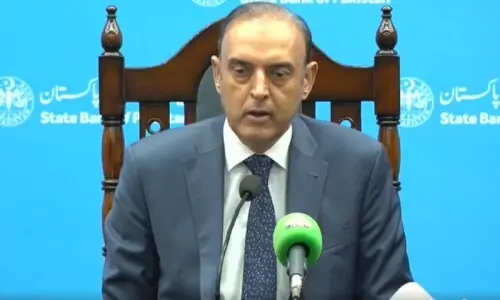
WHILE launching the Economic Survey 2026, Finance Minister Muhammad Aurangzeb told a hopeful story of economic recovery.
Indeed, the numbers support his words. Going from negative growth to 3.7pc is impressive as is reducing inflation levels. The current account surplus, albeit fragile, must also be lauded. The government deserves credit for stabilising an economy under pressure by floods, rising energy prices and trade uncertainty amid regional conflict.
However, there is another story behind these numbers, and it is a harder one. Stabilisation, though welcome, is not transformational. The distance between the two is precisely where Pakistan’s future hangs in the balance.
Growth may be at a four-year high, but investment as a share of GDP remains near multi-decade lows. An economy that does not invest cannot grow sustainably; it merely consumes existing capacity at a slightly higher rate. Some MNCS are reinvesting, but not out of confidence in the country’s economic potential; they are protecting existing positions in a market they cannot easily exit.
Behind closed doors, the same executives celebrating Pakistan’s ‘recovery’ describe an environment consumed by tax disputes, regulatory friction and bureaucratic attrition. That is not the profile of a country attracting transformative capital. Local investors, which the minister described as the true barometer of domestic confidence, are not investing at scale.
The reasons are structural and familiar: punishing energy costs, borrowing rates that make productive investment economically unattractive, a tax regime that rewards evasion over compliance, and a regulatory environment hostile to enterprise despite some improvement. Eleven stock exchange listings are welcome, but they are a drop in the ocean.
The survey takes pride in the breadth of this recovery, with agriculture, industry, services and large-scale manufacturing growing simultaneously. This is better than lopsided growth. But breadth without depth is a limited achievement. Growth driven by productivity gains compounds over time and builds lasting wealth.
Growth driven by consumption, favourable commodity cycles, or a low base simply marks time. Pakistan’s farm sector — among the region’s largest — continues to import food, cotton and basic inputs it should be producing competitively at home and exporting.
That paradox alone encapsulates the productivity crisis at the heart of the economy. LSM growth hitting a four-year high may be welcome but it largely reflects IMF-mandated demand recovery rather than genuine productivity or efficiency gains. The next external shock will expose the same vulnerabilities all over again.
Unless productivity becomes the dominant target of economic policy, Pakistan will continue to oscillate between crises and fragile recovery, never quite escaping the periodic IMF bailouts.
The Economic Survey tells the story of a country that has survived another difficult year. The more important story of whether Pakistan can finally break the cycle is waiting to be written.
Published in Dawn, June 12th, 2026