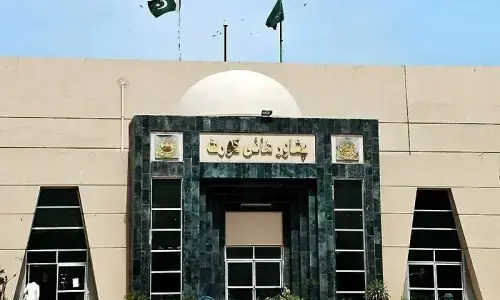
PESHAWAR: Peshawar High Court on Wednesday issued notices to the Khyber Pakhtunkhwa chief secretary and other officers to seek their response to a plea against ‘lack’ of health facilities in Upper South Waziristan tribal district and a request for setting up a fully functional district headquarters hospital (DHQ) there.
A bench consisting of Justice Ijaz Anwar and Justice Inamullah Khan directed that the respondents including the chief secretary, provincial health secretary and director general health services should submit their replies to a petition filed by several inhabitants of Upper South Waziristan.
The petition with multiple prayers was jointly filed by residents of Ladha tehsil of the district including Sherpao alias Paji, Asifur Rehman and others.
They sought declaration of the court that denial of adequate health facilities in Upper South Waziristan district was unconstitutional and a violation of fundamental rights of citizens there.
Petitioners call for functional DHQ hospital in Upper South Waziristan
The petitioners sought directives of the court for the respondents for ensuring availability of qualified and specialist doctors including female medics, essential medicines and necessary medical equipment.
They also sought directives of the court for respondents to make all the basic health units (BHUs), rural health centres (RHCs) and civil dispensaries fully functional particularly in remote areas including Karama.
Moreover, they requested for establishment of medico-legal units and postmortem facilities in the district on urgent basis.
Advocate Sajjad Ahmad Mehsud appeared for the petitioners and stated that before 2018, South Waziristan was a tribal agency included in the erstwhile Federally Administered Tribal Areas (Fata).
He said that after the merger of Fata into Khyber Pakhtunkhwa through Constitution (Twenty-fifth Amendment) Act, South Waziristan was granted the status of a settled district. He said that through a notification by the KP government in 2022, South Waziristan was bifurcated into Upper and Lower South Waziristan districts.
The counsel stated that upon creation of Upper South Waziristan district, the respondents became legally and constitutionally bound to provide essential infrastructure, including administrative offices, law enforcement system and most importantly a fully functional district headquarters hospital.
However, he said that despite lapse of considerable time since creation of the district, the respondents had failed to set up DHQ hospital, thereby leaving the entire population deprived of basic and essential healthcare services.
He claimed that the existing healthcare structure in the district was limited to a few BHUs and small health centres, which were either non-functional or grossly under-resourced, lacking qualified staff, medicines and essential equipment, thus rendering those ineffective for any meaningful medical assistance.
Mr Mehsud contended that there were no medico-legal facilities, postmortem units or medico-legal officers (MLOs) in the district, so people were compelled to transport bodies of deceased persons to other districts for postmortem examinations, leading to unnecessary delay, degradation of forensic evidence and serious impediments in the administration of justice.
He said that in cases of medical emergencies, people were forced to travel long distances often ranging from five to seven hours to Dera Ismail Khan and 14 to 15 hours to Peshawar, which frequently resulted in preventable fatalities during transit due to lack of timely medical intervention.
The respondents in the petition are KP government through its chief secretary, secretaries of health and planning and development departments, director general health services, district health officer and deputy commissioner of Upper South Waziristan and Independent Monitoring Unit Health through its director.
Published in Dawn, June 4th, 2026