Lawyers can’t be suspended for arguing cases during strike: FCC
• Criticises practice of frequent strike calls; terms them ‘illegal’ and violative of litigants’ rights
• Dismisses Peshawar bar appeal; holds that everyone has right to counsel of choice
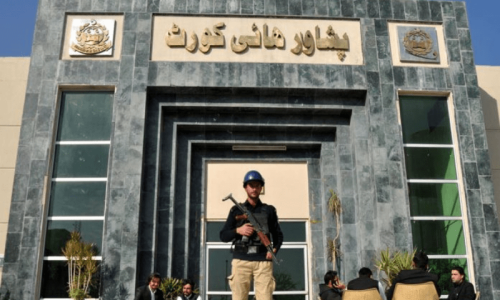
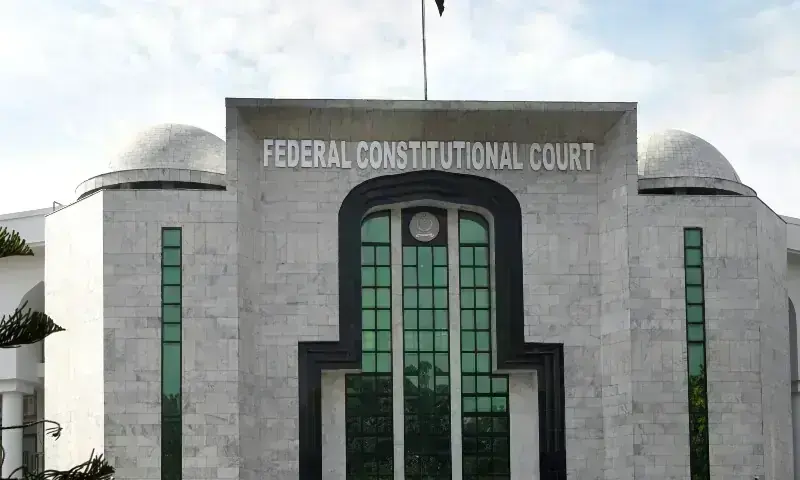
ISLAMABAD: In a landmark judgement on an appeal filed by the Peshawar High Court Bar Association, the Federal Constitutional Court (FCC) on Wednesday ruled that bar associations and bar councils cannot suspend a lawyer’s licence solely for representing a client or appearing in court during a strike.
Authored by Justice Aamer Farooq, the 20-page judgement also criticised the practice of frequent strike calls by bar associations and bar councils, observing that such strikes were not only illegal but also violated the constitutional right of access to justice of litigants and their counsel.
“When a strike call is made, the lawyer bodies restrict lawyers from appearing before the courts. Consequently, a litigant, on that day, is deprived of his legal practitioner’s representation, and proceedings in his case are adjourned without any progress,” Justice Farooq noted.
“This amounts to a denial of access to justice,” he asserted.
While deciding the challenge to the Oct 15, 2025 judgement of the Peshawar High Court (PHC), the two-member constitutional court, which also included Justice Rozi Khan Barrech, framed two questions for determination.
First, whether the jurisdiction of a high court under Article 199(1)(c) of the Constitution extends to issuing writs against “any person”, including regulatory bodies such as bar councils. Second, whether the suspension of the licences of two lawyers, one for representing a client and the other for appearing in court during a strike, infringed the fundamental right to practise a profession guaranteed under Article 18.
The FCC answered both questions in the affirmative.
The court held that preventing lawyers from representing litigants or from approaching and appearing before courts was wholly impermissible. It observed that such restrictions struck at the heart of the economic freedom guaranteed under Article 18, which was designed to protect the right to pursue a lawful profession.
The controversy arose after the murder of a young lawyer, in connection with which a station house officer (SHO) was implicated. The incident triggered protests demanding that the officer be brought to justice.
Subsequently, the officer surrendered before the relevant court and was taken into custody. He later engaged Advocate Shabbir Hussain Gigyani as his counsel. These developments prompted the Khyber Pakhtunkhwa Bar Council to pass a resolution prohibiting any advocate from representing the accused officer.
Meanwhile, Advocate Azim Afridi faced disciplinary action when the executive committee of the KP Bar Council suspended his licence during an emergency meeting on Oct 8, 2025. The suspension followed a communication from the Peshawar Bar Association, which described his appearance in court during a strike as an act of “indiscipline”.
Both lawyers challenged the suspension of their licences before the PHC, which ruled in their favour.
In the judgement, Justice Farooq observed that the legal system was already overburdened, with courts carrying lengthy cause lists and litigants often waiting years for hearings.
“In such circumstances, strike calls by lawyer bodies only add to the plight of litigants,” the judgement noted.
The court observed that regardless of how noble the cause behind a strike might be, it was neither an appropriate solution nor a legitimate means of expressing grievances, as it came at the expense of litigants seeking redress and justice.
Justice Farooq reiterated that denial of access to justice in any form constituted a violation of the Constitution, whether through non-appearance before courts or the closure of administrative and judicial functions.
The judgement held that the economic freedom clause under Article 18 was clearly attracted when Advocate Afridi, or any lawyer, was prevented from appearing before a court on behalf of a client.
The FCC explained that while a provincial bar council was empowered to suspend or cancel the licence of an advocate of the high court in cases of professional misconduct, no compelling reason existed in the present case to justify preventing lawyers from representing a person accused of murder.
Published in Dawn, June 4th, 2026