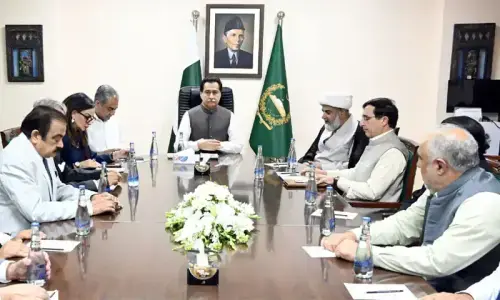
THEY are at it again. Politically powerful sugar mill owners are back with their demand seeking permission to export their ‘surplus’ stocks. The letter of the sugar mills’ representative PSMA to Deputy Prime Minister Ishaq Dar follows an all too familiar script. There is a surplus, it says. Stocks are piling up; mills are under financial strain; farmers are suffering, and export permission is the only logical solution. The millers are dangling $500m in potential foreign exchange earnings before a dollar-hungry government, arguing it would ease pressure on the current account. Pakistanis who have heard this story before know it never ends the way the millers predict. What the letter leaves out is the cartel’s long and well-documented history of inflating surplus claims when seeking export permission or subsidies.
For its part, the government will pretend to resist, form committees to ascertain the surplus claim, get ‘assurances’ from the millers to hold local prices steady, and eventually relent in the ‘larger interest’ of the farmers and the economy. What else can be expected from a government facing pressure from an industry whose owners include some of the country’s most influential politicians? Immediately, sugar will start disappearing from the markets, prices will climb and consumers will have to foot the bill. This is not speculation. As recently as last year, millers struck precisely such a bargain with Mr Dar, committing to sell local sugar at an agreed price in exchange for export clearance. That commitment was never honoured. The promises were quietly abandoned once the export window opened. There is a legitimate argument that a genuine surplus should be exported. But that argument only holds if two conditions are met: first, stock figures are independently verified; and second, domestic supply is legally protected through binding price and availability mechanisms with stringent enforcement, not the agreements that the mills sign and then toss aside. Neither condition has ever been reliably met in our sugar sector. The more structurally sound solution would be to fully deregulate the sugar trade in both directions, allowing free import and export simultaneously, so that global price signals discipline domestic producers and consumers are protected by competition rather than by the promises of an industry cartel. But that, too, requires a government willing to challenge the mills rather than accommodate them.
Published in Dawn, June 2nd, 2026