0
0

• Rubio says US in constant contact with Field Marshal Munir as the latter arrives in Iran
• Notes ‘some progress’ made but insists more work needed
• US considers ‘Plan B’ with willing Nato countries over Hormuz
• Iran rules out deal if US demands handover of enriched uranium
• Qatar joins mediation push in coordination with US
• UAE says Iran’s N-programme now top concern
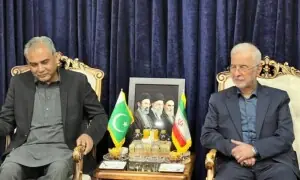
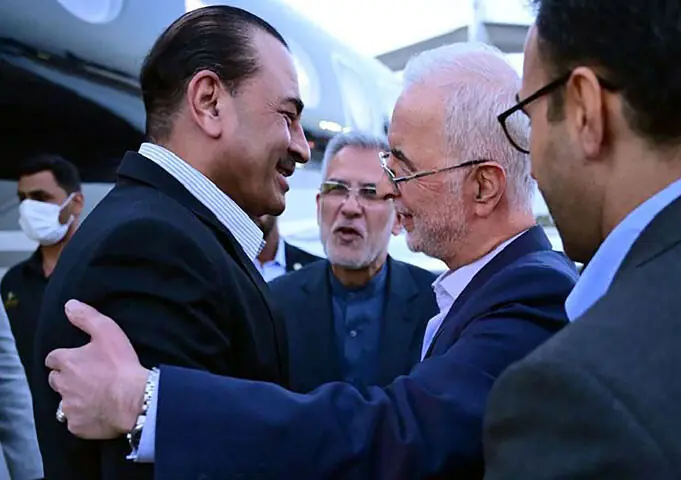
ISLAMABAD: Chief of Defence Forces Field Marshal Asim Munir reached Tehran on Friday as efforts to broker an interim understanding between the United States and Iran entered a decisive phase amid cautious hopes that a fragile ceasefire around the Persian Gulf could be stabilised before tensions spiral again.
The visit came at a time when negotiations appeared to have moved beyond political signalling into detailed bargaining over a narrow interim framework dealing with the Strait of Hormuz, Iran’s nuclear programme, sanctions relief and guarantees against renewed military action.
Inter-Services Public Relations (ISPR) said Field Marshal Munir had travelled to Tehran “as part of ongoing mediation efforts”.
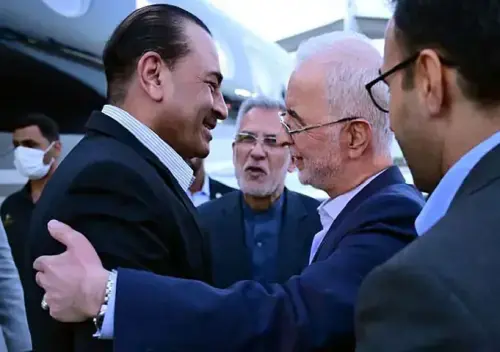
“On arrival, he was received and warmly welcomed by Iranian Minister for Interior Eskandar Momeni. Federal Minister for Interior Mohsin Naqvi was also present at the reception,” it said.
Mr Naqvi had remained in Tehran after earlier consultations with Iranian President Masoud Pezeshkian, Foreign Minister Abbas Araghchi and Interior Minister Momeni.
Diplomatic sources said Field Marshal Munir’s presence indicated movement from exploratory diplomacy towards strategic-level bargaining focused on escalation control, maritime security and possible guarantees linked to a phased arrangement.
The mediation process around Tehran has widened over the past 48 hours. Qatar also dispatched a negotiating team to the Iranian capital in coordination with the United States, while Saudi Interior Minister Abdulaziz bin Saud Al Saud spoke to Mr Naqvi in Tehran.
An Iranian diplomat in China also praised Beijing for presenting a peace initiative during the war “with the support of Pakistan”.
Regional diplomats also pointed to signs of softer Emirati messaging in favour of de-escalation and uninterrupted maritime trade.
Pakistan is also expected to remain in close touch with China, which analysts believe prefers indirect involvement through Islamabad rather than overt mediation.
‘Primary interlocutor’
US Secretary of State Marco Rubio also praised Pakistan’s mediation role, describing it as Washington’s “primary interlocutor” in the talks.
“The primary interlocutor on this has been Pakistan and continues to be, and they’ve done an admirable job,” Fox News quoted him as saying.
He also referred to Field Marshal Asim Munir’s Tehran visit, saying Washington was in “constant communication” with him at the highest levels.
“We’re in constant communication with him, and the highest levels of our government are constantly talking to him,” Rubio said.
Diplomats said the evolving process increasingly resembled a phased stabilisation effort rather than negotiations on a comprehensive settlement.
Current discussions are believed to revolve around an interim arrangement involving a formal ceasefire extension, phased sanctions relief, freedom of navigation guarantees in the Strait of Hormuz and a structured timeline for follow-on negotiations.
The hardest disputes, however, remain unresolved. Washington is pressing for immediate movement on Iran’s highly enriched uranium stockpile and wider nuclear restrictions, while Tehran is seeking a trust-building period before entering binding commitments. Iran, however, insisted that the uranium issue remained a major obstacle. Foreign Ministry spokesman Esmaeil Baghaei said any demand for Tehran to hand over its highly enriched uranium to the United States was a “non-starter”, Al Jazeera reported, citing IRNA.
“We cannot necessarily say that we have reached a point where an agreement is close,” he said, adding that gaps between Tehran and Washington remained “deep and significant”.
Baghaei said the focus of the current negotiations was ending the war and that nuclear details were not being discussed at this stage. He also confirmed that a Qatari delegation was holding talks with Foreign Minister Abbas Araghchi, while Pakistan remained the main mediator in the process.
Military signalling has continued alongside diplomacy. Regional security monitors reported ongoing US aerial refuelling operations near Saudi and Emirati airspace, indicating that Washington was maintaining visible operational readiness even as negotiations accelerated.
An Islamic Revolutionary Guard Corps commander said Iran’s armed forces were “more prepared than ever before” and warned that if “the enemy makes a mistake”, Iran would respond “more forcefully and decisively than before”, Tasnim reported.
Iranian officials have also continued to stress the need for guarantees against renewed attacks, pointing to deep mistrust despite active diplomatic engagement.
In another indication that Tehran was resuming the dialogue process, Iranian parliamentary speaker Bagher Ghalibaf was reappointed head of the negotiating team, while Foreign Ministry spokesman Baghaei was named spokesman for the talks.
Diplomatic sources said the overall picture suggested that while procedural gaps had narrowed considerably, strategic distrust between Tehran and Washington remained deep. “There is momentum and serious engagement,” one regional diplomat said. “But this is still crisis management under pressure, not reconciliation.”
Rubio earlier said there had been “some progress” in negotiations with Iran but added that “more work” was needed. He reiterated Washington’s priorities, including preventing Iran from acquiring a nuclear weapon, addressing its highly enriched uranium stockpile and settling the issue of future enrichment.
“We’d all love to see an agreement with Iran and wish the straits are open and they abandon their nuclear ambitions,” he said.
Reopening of Hormuz
Rubio also discussed reopening the Strait of Hormuz with Turkish Foreign Minister Hakan Fidan and raised the issue during a Nato-affiliated meeting in Sweden.
He said Washington preferred an agreement with Tehran but warned that a “Plan B” could involve Nato countries willing to contribute if Iran refused to reopen the waterway.
“I don’t know if that’ll be a Nato mission necessarily, but it will certainly be Nato countries that can contribute to it,” he told reporters.
Meanwhile, the European Union moved to expand its sanctions framework to target those it says have facilitated Iran in “threatening the freedom of navigation in the Middle East”, Al Jazeera reported.
“The EU will now be able to introduce further restrictive measures in response to Iran’s actions undermining the freedom of navigation in the Strait of Hormuz,” the European Council said, adding that the measures could include travel restrictions and asset freezes.
US Central Command said American forces had redirected 97 commercial vessels and disabled four since the start of a blockade against Iran.
A senior UAE official said the chances of a US-Iran agreement to reopen the Strait of Hormuz were “50-50”.
Presidential adviser Anwar Gargash urged Tehran not to overplay its hand during the fragile ceasefire, saying Iranian officials had “missed a lot of chances over the years because there’s a tendency to overestimate their cards”.
“I hope they don’t do that this time,” he told the GLOBSEC Forum in Prague. Gargash said the Strait of Hormuz, which carried around a fifth of global oil production before the disruptions, must return to normal and remain an international waterway.
“Negotiations just to reach a ceasefire and sow the seeds for further conflict in the future is not what we’re seeking,” he said.
He added that Iran’s nuclear programme had become the UAE’s top concern. “The Iranian nuclear programme was our second or third worry, now it’s our first worry,” he said.
With additional input from Agencies
Published in Dawn, May 23rd, 2026