0
0

IRAN wants an end to hostilities on all fronts and a simultaneous lifting of the blockade in the Strait of Hormuz before negotiations with the US can begin. However, this is a sticking point not only for the US but also for Israel, which insists that any preliminary dialogue without the nuclear issue as the centrepiece would be a nonstarter.
A senior Iranian official, not wishing to be named, explained what was keeping Tehran from negotiations. He said that after last year’s attacks, President Donald Trump claimed that all Iranian nuclear sites had been “obliterated”. “If that is true,” the official argued, “then the priority should be ending the war rather than negotiating over enrichment, which is no longer a threat.” Iran points out that it remains a signatory to the nuclear non-proliferation treaty (NPT), under which the IAEA has conducted 15 inspections through its safeguards system. Meanwhile, Trump’s administration wants zero uranium enrichment, insisting Tehran abandon all enrichment activities, even for civilian purposes, and halt its nuclear programme entirely to secure a deal. A recent report by Iran’s semi-official Fars news agency claimed Washington demanded Iran keep only one nuclear site operational and transfer the rest of its highly enriched uranium stockpile to the US.
Tehran sees these demands as detached from Iranian political realities. In June 2025, after Israel launched unprecedented strikes on Iranian nuclear and military facilities, Iranian officials threatened to withdraw from the NPT. Earlier this year, legislation was introduced proposing exactly that. Iranian officials ask what incentive remains to stay within the treaty if Iran is denied the right — protected under NPT and IAEA safeguards — to enrich uranium for civilian use.
Tehran sees US demands as detached from realities.
The official warned that parliament and the Guardian Council could approve withdrawal from the treaty, after which Iran would no longer be bound by IAEA oversight. In such a scenario, there would be less visibility regarding Iran’s nuclear activities, including a covert push to develop nuclear weapons. Therefore, the incentive for the West to engage with Iran is much more. Iran appears open to transferring its enriched uranium stockpiles to Russia, but insists that hostilities must end first. Tehran remains hopeful for a principal agreement followed by peace talks within a month, likely in Islamabad.
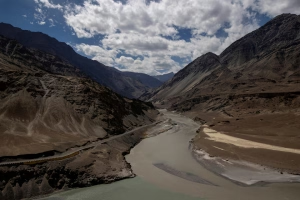
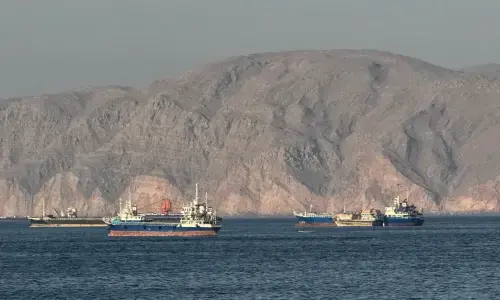
What Iran is willing to address first is the Strait of Hormuz, where it has restricted ship movement. But Tehran insists the Americans must simultaneously lift the blockade targeting Iranian vessels. “Under the threat of war we will not negotiate,” the official said. “If the Americans want war, then there will be war. Otherwise we are prepared for negotiations.”
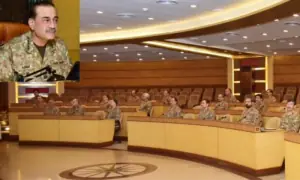
Iran has imposed what it calls a “toll booth” system in the Strait of Hormuz, allowing only vessels cleared by the IRGC to pass, arguing it fears passing vessels could be used to seize Iranian islands. During Field Marshal Asim Munir’s visit to Tehran in April, Foreign Minister Abbas Araghchi announced that the strait was “completely open for all commercial vessels” along coordinated routes. But after the US allegedly seized an Iranian cargo ship near the strait two days later, Tehran reversed course. The official said “other nations are scared of the Americans and therefore do not speak against the unfairness of their dealings with us”. He insisted Iran was imposing “service charges”, not a toll tax.
Last weekend, Pakistan’s Interior Minister Mohsin Naqvi travelled to Tehran in another effort to push for a diplomatic solution. Yet Iranian officials have remained sceptical of Washington. They explain that in the past after they struck an agreement in 2015 between Iran and the P5+ alongside the EU, President Trump withdrew from the Joint Comprehensive Plan of Action (JCPOA) and later had Gen Qasem Soleimani killed in 2020. They also note that last June the US attacked Iran even as another round of negotiations was scheduled in Muscat.
“The Omanis were astonished by the American attack,” the official said. He added that despite reservations, Tehran brought senior leaders to negotiations in Pakistan in April, including parliamentary speaker Mohammad Bagher Ghalibaf. The official claimed the Americans were not sincere because Special Envoy Steve Witkoff and Jared Kushner remained in contact with Israeli leaders. “At least twice Witkoff left the room to speak with the Israelis,” he said, “and soon after, the process was derailed.”
The Iranians seem to want to engage with the Americans provided they are recognised as victors, are compensated for the war through lifting of sanctions and the final agreement has the approval of the five countries that became the guarantors of the JCPOA.
The writer is an anchor and journalist, and co-chair of the HRCP.
Published in Dawn, May 23rd, 2026