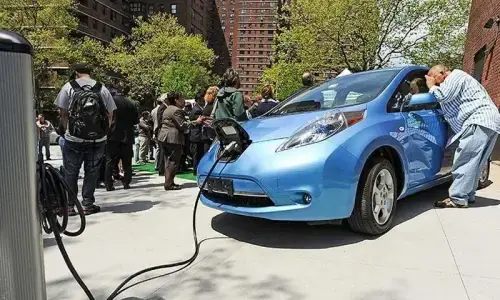
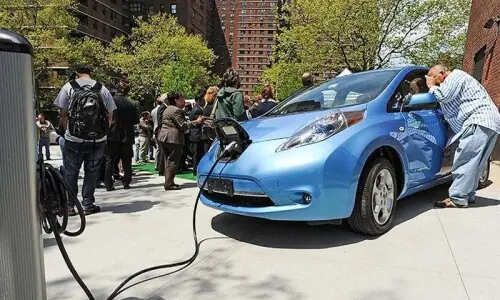
Lucky Motors is betting fuel-price shocks and rooftop solar adoption will speed up electric vehicle demand, as it launches EVs with Chinese state-owned automaker Guangzhou Automobile Group (GAC) and plans local assembly as early as the year-end, its CEO told Reuters.
The launch comes as local consumers face their sharpest fuel price increases in years, with prices double those of four years ago, as the US-Iran conflict disrupts supply through the Strait of Hormuz.
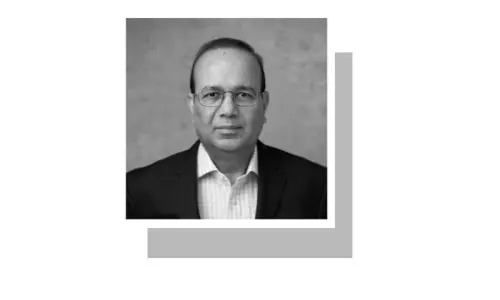
“Every crisis has an opportunity. This crisis has actually helped Pakistani consumers transition fast from conventional fuel vehicles to new energy vehicles,” said Muhammad Faisal, CEO of Lucky Motors.
Under an agreement with GAC, Lucky Motors began displaying four Aion and Hyptec models from GAC across Pakistan this week and plans to begin local manufacturing of its partner’s EVs as soon as December 2026, he said.
GAC is Lucky Motors’ third automotive brand after Kia and Peugeot, which are both assembled at its Karachi plant. It is a subsidiary of Lucky Cement, one of Pakistan’s largest conglomerates.
Faisal said he expected the initial imported stock of GAC cars, which he described only as a “sizeable order”, to sell out within two months.
EVs remain a small fraction of Pakistan’s annual car sales, dominated by Japanese and Korean brands.
The shift has been faster in two-wheelers, where EV sales nearly tripled to around five per cent of all bikes sold, according to consultancy Renewables First.
Solar revolution charges the case
Faisal said Pakistan’s solar revolution was accelerating the case for four-wheelers. Solar now supplies around a quarter of the country’s electricity, making home overnight charging viable for the urban buyers Lucky Motors is targeting.
“A lot of people buying these products have solar on the rooftop. It makes it easy to charge overnight and use the car during the day,” he said.
The firm is also eyeing battery swapping, a technology that lets drivers exchange a depleted pack for a charged one in minutes in what would be a first in Pakistan, with a rollout targeted for around the same time as local EV assembly begins, Faisal said.
Faisal also said that Lucky Motors and GAC were in early discussions about exporting Pakistani-assembled vehicles to other right-hand drive markets, where GAC has limited presence.
Beyond vehicles, Lucky Motors, which also assembles Samsung-branded smartphones at its Karachi plant, was studying local battery manufacturing, pending a government policy expected soon.
Islamabad has set a target of 30 per cent EV sales by 2030 and pledged $400 million for more than 3,000 public charging points.