Nigeria’s military on Tuesday said that joint airstrikes with the United States had killed 175 Islamic State (IS) fighters in the country’s northeast, including the militant group’s global second-in-command.
The remote region has been gripped by an extremist insurgency since 2009, first by Boko Haram, then its offshoot and rival, the Islamic State West Africa Province (ISWAP).
According to the United Nations, more than 40,000 people have been killed and two million others displaced.
US and Nigerian forces killed Abu Bilal al-Minuki, an IS leader described as the “most active terrorist” in the world, at a remote village in the northeast last weekend.
The Nigerian military said on Tuesday that 175 IS militants had so far been “eliminated from the battlefield”.
“The joint strikes have resulted in the destruction of ISIS checkpoints, weapons caches, logistical hubs, military equipment and financial networks used to sustain terrorist operations,” it added.
As director of global operations for IS, al-Minuki provided strategic guidance on media and financial operations and “the development and manufacturing of weapons, explosives and drones”, according to the Nigerian military and the US Africa Command (Africom).
After the announcement of al-Minuki’s death, Nigeria’s President Bola Ahmed Tinubu thanked his US counterpart, Donald Trump, for his “leadership and unwavering support”.
He said he looked forward to “more decisive strikes against all terrorist enclaves across the nation”.
Senior figures
According to Tuesday’s military statement, the operations in the last few days have killed other key IS figures.
They include Abdal Wahhab, said to be a “senior leader” of ISWAP, “responsible for coordinating attacks and distributing propaganda”.
Abu Musa al-Mangawi was said to be a high-ranking ISWAP member, while Abu al-Muthanna al-Muhajir was a “senior media production team manager and close confidant to al-Minuki”.
Boko Haram and ISWAP have recently stepped up their attacks on villages, police stations and workers such as loggers and fishermen, as well as military bases, causing the deaths of several civilians and senior army officers.
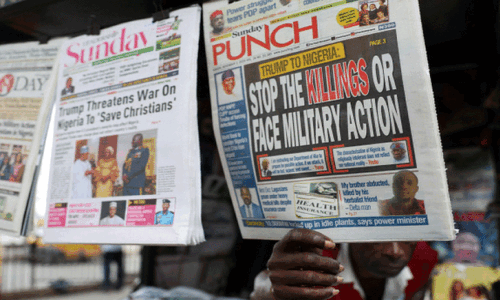
The upsurge in attacks prompted Tinubu to declare a nationwide state of emergency in 2025 and the US president to threaten Nigeria with military intervention.
Trump has claimed that Christians in Nigeria were being “persecuted” and victims of a “genocide” carried out by “terrorists”. The government in Abuja and most experts reject the claim and point out that the violence generally affects Christians and Muslims without distinction.
The US military, in coordination with the Nigerian authorities, carried out airstrikes on December 25 last year in the northwestern state of Sokoto, targeting what Washington called jihadists.
Northern Nigeria has been grappling with violence from criminal gangs known locally as bandits, who frequently carry out attacks on villages and mass kidnappings for ransom.
Africom has also taken action against IS and al-Shabaab militants in Somalia, intensifying airstrikes since the beginning of the year.