FCC upholds SHC ruling on Sepa DG’s appointment criteria
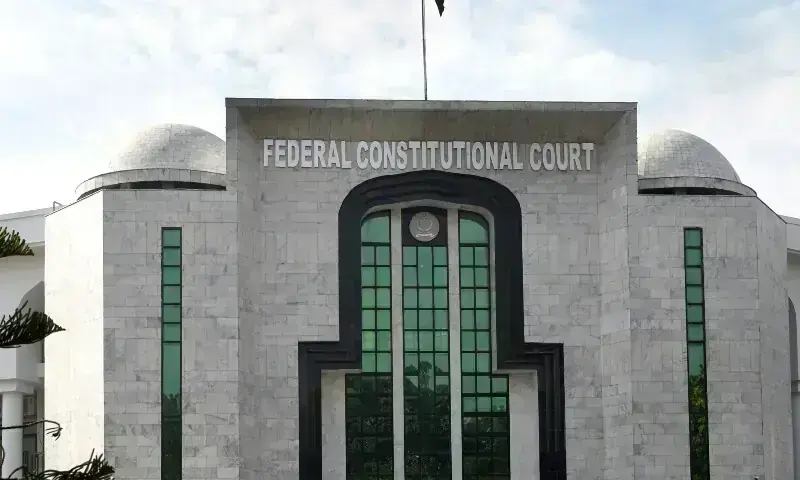
• Dismisses Sindh govt petitions; says agency plays crucial role in protecting rights under Articles 9 and 9-A
• Warns unqualified appointments could endanger public health, environment
ISLAMABAD: The Federal Constitutional Court (FCC) has ruled that the role of the Sindh Environmental Protection Agency (Sepa) is crucial in safeguarding the constitutional guarantees of the right to life and a clean and healthy environment, as envisaged under Articles 9 and 9-A of the Constitution, respectively.
The court observed that the appointment process for the post of Sepa director general must strictly comply with the established legal framework to ensure the protection and enforcement of citizens’ fundamental rights.
The FCC made these observations while dismissing multiple petitions filed by the Sindh government against a Sindh High Court ruling concerning the criteria and process for appointment to the position of Sepa DG.
The controversy arose from a notification issued by the Sindh government on July 21, 2025, stipulating that appointments to the post of Sepa DG could be made through transfer from among officers of the Pakistan Administrative Service, Provincial Management Service and allied services.
The FCC noted that the notification did not explicitly incorporate the technical qualifications mandated under the earlier Recruitment Rules of 2009.
In its Nov 12, 2025 judgement, the Sindh High Court had maintained that requisite technical qualifications and experience were necessary for appointments to the post.
Aggrieved by the SHC ruling, the provincial government approached the FCC under its constitutional jurisdiction.
Authored by Justice Rozi Khan Barrech, the four-page judgement observed that the insertion of Article 9-A through the 26th Constitution Amendment explicitly guaranteed every person the right to a clean, healthy and sustainable environment. Justice Barrech was a member of the two-judge FCC bench headed by Justice Aamer Farooq.
The judgement observed that the office of Sepa DG was a pivotal position within a statutory authority responsible for enforcing environmental laws, adding that the nature of the office inherently required not only administrative competence but also demonstrable technical expertise.
Any interpretation that permits appointments in derogation of these essential requirements would frustrate the object of the statute and undermine the constitutional guarantees of the right to life and the right to a clean and healthy environment under Articles 9 and 9-A of the Constitution, the judgement stated.
The court observed that the Sepa DG is responsible for enforcing environmental laws aimed at protecting the public from pollution and other environmental hazards. Therefore, it added, failure to adhere to the technical qualifications and experience required under the 2009 Rules could result in the appointment of individuals lacking the expertise necessary to effectively manage environmental issues.
“Such a scenario could lead to detrimental consequences for public health and safety, thereby infringing upon citizens’ rights to life and a clean environment as enshrined in Articles 9 and 9-A of the Constitution,” the verdict added.
“It is, therefore, essential that the appointment process for the Sepa DG strictly complies with the established legal framework to ensure that the fundamental rights of citizens are upheld and protected,” the court held.
The judgement noted that if the impugned notification was construed in isolation, it would effectively eliminate the essential qualifications mandated for a specialised technical office, thereby reducing the position to a purely administrative role.
Justice Barrech emphasised that such an interpretation would undermine both the statutory framework and the legislative intent.
The court also found no infirmity in the SHC directives for re-examining the appointment of the incumbent additional director general and for verification of academic credentials through the Higher Education Commission.
According to the judgement, these directives were consistent with the governing legal framework and aimed at promoting transparency, fairness and merit in the appointment process. Consequently, the FCC dismissed the petitions and upheld the SHC directives in their entirety.
Published in Dawn, May 16th, 2026