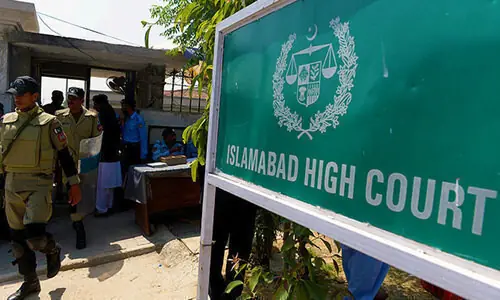
ISLAMABAD: The Islamabad High Court (IHC) on Wednesday set aside the supersession and deferment of top bureaucrats in promotion matters and ruled that high courts can assume jurisdiction in cases relating to assessment of “fitness” and “suitability” for promotion.
In a detailed judgment authored by Justice Raja Inaam Ameen Minhas, the court held that denial of fair consideration for promotion was amenable to judicial review and such disputes did not fall within the exclusive jurisdiction of the Federal Service Tribunal.
The judgment came on a series of petitions filed by BS-20 officers belonging to the Police Service of Pakistan (PSP), Pakistan Administrative Service (PAS), Inland Revenue Service (IRS), Pakistan Customs Service (PCS), and the health sector, which had challenged their supersession or deferment by the Central Selection Board (CSB) during meetings held in March 2025.
The court set aside the CSB’s decision and directed that the cases of the officers be considered afresh.
The court observed that although promotion to BS-20 and BS-21 was not a vested right and depended on fitness and merit, the process adopted by the authorities must conform to the “constitutional guarantees of fairness, transparency and due process”.
Justice Minhas ruled that the CSB proceedings and the subsequent communication of reasons suffered from procedural impropriety. He observed that the affected officers were informed about the adverse decisions months after the board meetings.
The court noted that while the board concluded its deliberations in March of last year, the reasons for supersession and deferment were communicated to some officers in September and to others in December.
The judgment observed that the Federation could not benefit from its own failure by withholding reasons and later claiming that the petitions were premature.
Among the prominent petitioners was Dr Mutahir Shah, a senior official of the Pakistan Institute of Medical Sciences (Pims), who challenged his deferment for promotion to BS-20 as the joint executive director of Pims.
According to the judgment, Shah had earlier approached the Federal Service Tribunal after authorities excluded his name from the promotion roster despite his being the senior-most eligible officer. The tribunal had directed the government to consider his case in the ensuing CSB meeting.
However, the CSB subsequently deferred his promotion, citing a “mixed reputation” regarding integrity and professional competence and recommending further performance watch.
The court also examined the cases of several PSP officers denied promotion to BS-21.
Dr Muhammad Akhtar Abbas, posted in Lahore in BS-20, was superseded after the CSB declared him an officer of “average competence and peccable integrity”.
Nisar Ahmed Khan, who serves as director general of the Coordination Unit for Implementation of Initiatives in Khyber Pakhtunkhwa, was denied promotion over allegations relating to integrity and professionalism, including concerns arising from an alleged voluntary return case.
Similarly, Mujahid Akbar Khan challenged his supersession after the board termed him professionally weak and referred to adverse additional information placed before it.
The petitions also included Sheikh Yaseen Farooq and Israr Ahmed Khan, both of whom were declared officers of average competence with questionable integrity.
In the case of Agha Muhammad Yousaf, the CSB cited “controversial financial integrity” while denying him promotion.
The lone PAS officer among the petitioners, Bilal Ahmed Butt, challenged his supersession after the CSB referred to his alleged “chequered history”, failure to attend mandatory training thrice and doubts regarding his financial integrity.
A large number of IRS officers also approached the court after being superseded or deferred for promotion to BS-20.
These included Iqbal Ahmad Sheikh, Karachi’s appeals commissioner; Shakeel Ahmed Shakeel, Islamabad’s director of internal audit; and Mirza Nasir Ali, Karachi’s law director. The CSB termed them officers of average competence with questionable integrity.
The board deferred the promotions of Muhammad Muti ur Rehman Mumtaz and Muhammad Zahid on “performance watch”, observing that they carried mixed reputations regarding financial integrity.
Other IRS officers who challenged the adverse recommendations included Wilayat Khan, Syed Ali Adnan Zaidi, Mumtaz Ali Bohio, Muhammad Amin Qureshi, Attiq ur Rehman Mughal, Muhammad Aslam Jamro and Dr Sajid Hussain Arain.
The court also reviewed petitions filed by PCS officers Arbab Qaiser Hamid and Dr Nasir Khan, who had repeatedly faced supersession in earlier CSB meetings as well.
During the proceedings, counsel for the petitioners argued that the CSB relied on “vague, cyclostyled and non-speaking reasons” without confronting the officers with any adverse material.
The petitioners maintained that many of the officers had never faced disciplinary proceedings, corruption references or show-cause notices during their careers. They contended that the board had abandoned the objective quantification mechanism envisaged under the Civil Servants Promotion Rules, 2019.
The Federation defended the process and argued that promotion to BS-20 and BS-21 involved comparative assessment by senior bureaucrats and that the CSB exercised structured discretion under the 2019 promotion rules.
However, the court held that while it would not act as an appellate forum over the merits of the CSB’s assessment, administrative actions remained subject to judicial review “on grounds of illegality, irrationality and procedural impropriety”.