0
0

KARACHI: The Pakistan Stock Exchange (PSX) staged a strong recovery during the outgoing week as improving prospects for a US-Iran understanding and the anticipation of International Monetary Fund’s executive board approval of $1.2 billion under its ongoing programmes kept investor in bullish frame of mind.
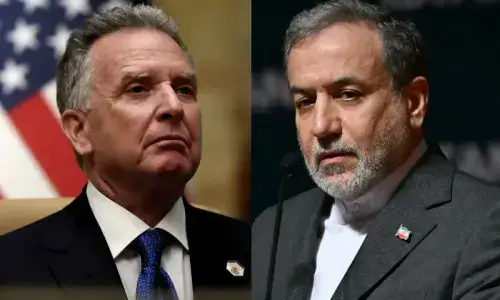
Barring the final trading session, the market maintained a bullish trajectory amid expectations that geopolitical tensions in the Middle East may ease. Investors also welcomed continued diplomatic efforts involving Pakistan aimed at encouraging dialogue between Washington and Tehran.
The benchmark KSE-100 index gained 8,122 points, or 5 per cent week-on-week, to close at 171,116 points.
Analysts said the rally was largely driven by optimism surrounding progress in negotiations between the US and Iran, which also led to a sharp decline in international oil prices.
Index surges past 171,000-barrier on value-hunting
Topline Securities Ltd noted that easing geopolitical concerns and lower crude prices encouraged aggressive buying across sectors.
The IMF Executive Board approved the release of $1.2bn under the Extended Fund Facility (EFF) and Resilience and Sustainability Facility (RSF), a development expected to strengthen the country’s external account and support foreign exchange reserves held by the State Bank of Pakistan (SBP).
Analysts expect the positive sentiment to continue next week as the IMF decision is likely to improve Pakistan’s economic outlook.
Pakistan’s trade deficit widened to $4.1bn in April, up 4pc year-on-year and 44pc month-on-month due to higher imports. Exports stood at $2.5bn, rising 14pc annually but declining 6.3pc from the previous month, while imports increased 17.1pc year-on-year to $6.6bn. The cumulative trade deficit during the first 10 months of FY26 rose 20.3pc to $31.99bn.
Large-Scale Manufacturing (LSM) output grew 11.1pc year-on-year in March, although it declined on a monthly basis. Overall LSM growth during 9MFY26 stood at 6.5pc.
AKD Securities Ltd said easing geoploitical tensions remained the dominant driver behind market performance during the week. International oil prices reportedly fell 18pc week-on-week.
The brokerage house said investors also tracked reports that US President Donald Trump had paused the “Project Freedom” naval operation in the Strait of Hormuz following mediation efforts by Pakistan and other countries. Despite intermittent exchanges near the strait during the week, hopes for a ceasefire and eventual agreement remained intact.
The SBP’s foreign exchange reserves rose by $23m week-on-week to $15.85bn as of April 30. SBP Governor Jameel Ahmad has projected reserves to reach $17bn by the end of June.
Other major developments during the week included plans to issue $250m Panda bonds, the government’s decision to phase out untargeted electricity subsidies, relief of Rs1.75 per unit for power consumers under quarterly tariff adjustments, restrictions on high-speed diesel imports by private oil marketing companies, and the rejection of the lowest spot LNG bids.
Sector-wise, cement, technology and investment companies were among the top gainers, rising 9.1pc, 8.2pc and 8pc, respectively. Textile weaving, leasing companies and synthetic and rayon sectors underperformed.
Cement despatches increased 11pc year-on-year to 3.89 million tonnes in April, supported by a 20pc rise in local sales, although exports fell 18pc. Total dispatches during 10MFY26 grew 10pc to 43.43m tonnes.
Fertiliser sales also remained strong, with urea offtake surging 85pc year-on-year to 463,000 tonnes in April, the second-highest level recorded for the month. Cumulative urea sales during the first four months of calendar year 2026 rose 11pc.
Refinery uplift recorded 12.7pc annual growth in April owing to strong demand for high-speed diesel and furnace oil. Oil and gas production also posted weekly gains.
Trading activity remained robust, with the average daily traded volume standing at around 1.1 billion shares. The average traded value during the week reached Rs42bn.
On the flows side, mutual funds emerged as major buyers, with net purchases of $6.3m, while insurance companies and individuals remained net sellers.
According to market analysts, the near-term direction of the PSX will continue to depend on geopolitical developments and the implementation of IMF-backed reforms.
They noted that the market continued to trade at attractive valuations, with the KSE-100 index currently offering a price-to-earnings ratio of around 7.5 to 8 times and a dividend yield exceeding 6pc.
Published in Dawn, May 10th, 2026