Style is a refinement in behaviour and the cultivation of poise. Style is expressed in the way a person walks or converses, by the cadence of language, by the spaces we choose to live in. Style shows confidence, presence and personal power, often communicated without the need for words.
Unlike brute force, style cannot be fought with or overcome. It is a quiet challenge that does not seek a reaction. While it can be mocked, it cannot be destroyed. It is the result of a cultivated intentionality that becomes part of a personality. Style is like the softest notes of a piano or violin that the listener knows can build up to a powerful intensity that will make hearts tremble.
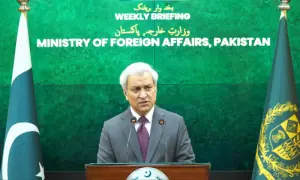
The former Supreme Leader of Iran, Ayatollah Ali Khamenei, killed in February this year, and the Minister of Foreign Affairs of Iran, Abbas Araghchi, through all the warmongering rhetoric, impressed the world with their soft-spoken manner and the slight smile of the wise dealing with the foolish. No angry fist shaking. Instead, we witnessed the Persian tradition of taarof, a complex, ritualised politeness, and zerangi or shrewdness.
Persian influences in the Subcontinent date back to the sixth century, first becoming the official language of Punjab in the 11th century, and then across the whole region with the rise of the Mughals. Classical Urdu, while absorbing Sanskrit, Arabic and Turkish vocabulary, retained greater Persian influences, in both language and cultural expression.
Although the modern world is increasingly taken over by speed and standardisation, there are still faint glimmers of style serving as a culturally embedded mode of expression
Etiquette required khush-asloobi, husn-i-amal and andaaz-i-bayan, terms that reflect the preference to behave and speak with elegance and grace. Even anger is ideally expressed as shikwa, a gentle reproach often couched in poetic terms, rather than shikayat, a direct accusation. Muhammad Iqbal wrote. “Andaaz-i-bayaan garche bohat shokh nahin hai/ Shayad ke utar jaye tiray dil mein miri baat [Although I am not a master of rhetoric/ Perhaps my words may still enter your heart].”
Despite the dilution of cultural traditions across the world by colonial influences and migration, the real deflection of style came from industrialisation and the economics of mass production. With its accompanying tools of marketing and incentivising, the space for unique self-expression was reduced, instead offering carefully curated identities, whose needs could be profitably manufactured.
The cult of individualism, which sounded like personal liberty, was offered to deflect attention from the loss of individuality, resulting in isolation and anonymity, severing ties to community.
Resistance came mainly from art, including the Arts and Crafts movement and Romanticism, which were soon marginalised as elitism — pretentious, privileged and exclusionary. The impact was felt across the board, from reproducible city planning and architectural styles, to supplanting traditional localised entertainment with worldwide release cinema and sports federations that could be monetised.
Yet, while systems have changed, people have not. Researchers have found by documenting the eye-tracking of subjects, that there was a preference for decorated building facades over modern buildings with bland facades. The exquisite muqarna ceilings of Spain’s Alhambra attract 2.6 million visitors annually.
Aesthetic pleasure is felt not just by artists but is experienced by everyone. It could be a beautiful sunset, the formation of starlings flying in large groups, the satisfaction of arranging furniture or folding a paan [betel leaf] into a neat gilori.
Countries where industrialisation has not taken over remain connected to the gracefulness of traditional styles: a village woman walking across parched earth with the movement of a flowing river, a man folding a turning 20 yards of muslin into an elegant turban. A young boy in a roadside tea shop has made an art of ‘meter chai’ — pouring tea from a great height. It is not just about what you do, but how you do it — with confidence, care and a style that makes it your own.
Increasingly, the homogenising aim of modernity is rejected, charged with the crime of a divided world, horrific wars, the plunder of the earth’s resources and disrupting climate balance. Across the world, there is renewed interest in mudbrick houses, organic food and slow movement. In Pakistan, literary and cultural traditions have been largely maintained at a community level, but they are now finding a place in the national narrative.
As the Persian poet Hafiz Shirazi reminds us, “The words you speak become the house you live in.”
Durriya Kazi is a Karachi-based artist.
She may be reached at
durriyakazi1918@gmail.com
Published in Dawn, EOS, May 10th, 2026