0
0

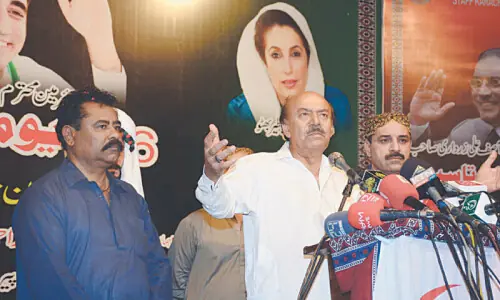
KARACHI, July 3: More than 41,000 bank employees have been rendered jobless due to the closure of 1,800 branches of different banks in the country since 1998. This was observed by Dr Shahid Hassan Siddiqui, Chairman of the Research Institute of Islamic Banking and Finance, while speaking at the weekly lecture programme at the PPP Secretariat. This was the fourth lecture of its series. The sitting was presided over by Aftab Shabaan Mirani.
Terming the retrenchment unjustified, he remarked that if at all some people deserved to be sacked, they were not at all the employees, but the senior decision-makers in the banking sector who, in collusion with influential defaulters, had constantly been causing heavy losses to the banks and were responsible for more than Rs100 billion debts hence accumulated.
Hailing the policy under which banks had been nationalised in Zulfikar Ali Bhutto’s tenure, he said the policy had proved very successful till 1982 but Gen Ziaul Haq started using the nationalised banks for political gains in violation of all norms and practices of prudential banking.
The 12 private banks that had been on the verge of closure in Bhutto’s government had been merged with major banks for safeguarding the depositors’ interests, he observed while advocating the nationalisation of banks in 1974.
More than 4, 000 new bank branches had been opened, many of them in the remote areas of the country and about 45, 000 new jobs had thus been created till 1982.
Dr Siddiqui said that banks were now being privatised through shady deals and the new owners had already closed down several branches, rendering many people jobless and depriving depositors of their savings.
He recalled that Gen Pervez Musharraf, in his first speech, had warned bank loan defaulters to clear their dues within four weeks but the ultimatum period had never ended.
The government and the State Bank had rather started writing off the bank loans with an accelerated pace, he wondered.
The beneficiaries of such ‘economic measures’ were billionaires and those who had acquired huge loans many a times but never paid them off.
The figure of loan recovery and rescheduled loans given by the NAB appeared to be 135 billion and but a State Bank report put the amount of total recovery and rescheduled loans through NAB at just Rs17 billion.
Quoting extensively from the figures given by the State Bank in its various reports, Dr Siddiqui claimed that there had been an unbridled loot and exploitation of millions of bank depositors since 1998.
The figures showed that besides financing the black-marketing, property accumulation in the hands of the elite, windfall gains by speculators in the stock exchange, etc., the banks had transferred more than 700 billion of their depositors’ money to the exploiters.
The depositors who were receiving at least three per cent in interest above the inflation rate in 1998, were now receiving six per cent below the declared rate of inflation in spite of the fact that the State Bank had directed that the return on deposits should be maintained at a minimum level of 1 per cent above the declared inflation rate.
“If 90 per cent of the saving deposits are on profit- and loss-sharing basis, why the Rs93 billion profit earned by the banks this year and the profit earned earlier had not been shared with the depositors?
“If the directives of the State Bank to pay a minimum of 1per cent above the inflation rate were followed, the banks would have paid an additional Rs100 billion to the depositors, evaporating the ‘spectacular profits and progress’ shown by them in thin air,” Dr. Siddiqui argued.
In his concluding remarks, Aftab Shaaban Mirani said that Dr Shahid Hassan’s lecture appeared to be ‘timely’ since it would not take too long now that an elected government would take corrective measures in the banking sector on a large scale.
He pointed out that professionalism and application of prudential banking practices were a pre-requisite both in the public and the private sector banks.
Advocating extension of credits to the agriculture sector and small farmers, he said that the two deserving fields stood completely excluded from the network of these financial services at present.