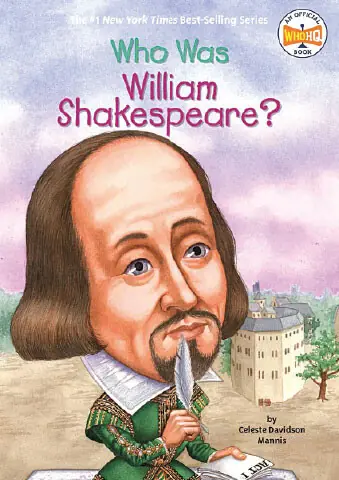
Ever wondered what made William Shakespeare so great that his work speaks even today, 400 years after his death? Celeste Davidson Mannis’ Who Was William Shakespeare? not only takes you into the era of the English language’s greatest playwright, but also explains the reasons behind what he did.
The book discusses every important aspect of Shakespeare’s life in simple, engaging language. Illustrations by John O’Brien add extra interest by providing a visual for what is mentioned on each page, such as the original home where the Shakespeare family lived, London’s condition when young Will decided to try his luck in the big city and the many theatres where he worked.
Not just that, according to this book, what Shakespeare became was influenced greatly by his family. Had his once-influential father not been in a position to facilitate the many acting troupes in his area, Shakespeare might not have been exposed to them. His decision to go to the city for a better life for his wife and children also played an important role in his development as a writer.
The book is divided into nine chapters: the first three cover his early life, and one is dedicated to his lost years, when he was away from his family and the public eye. It is in those ‘lost’ years that he is believed to have developed an interest in theatre. While he borrowed elements from earlier writers, the flavour he added made works like The Taming of the Shrew, Romeo and Juliet, Henry VI, Richard III, King Lear, Macbeth, Othello, The Tempest and many other plays widely popular.
And if you had no clue that there was a plague that claimed hundreds of lives in England, or that Shakespeare and his team were among the first to have their own theatre to perform in, then this book will certainly be useful to you.
The latter half of the book examines how his foray into poetry made him wealthy in that era, how the reigning monarch helped him develop his out-of-the-box ideas and why he veered towards tragedy in his final years. He could not complete his studies like his contemporaries, but his observations were so sharp that even after five centuries, his work speaks louder than that of others.
Shakespeare’s work defined him as an artist far ahead of his time, and this book is a tribute to the great thespian.
Published in Dawn, Young World, May 9th, 2026