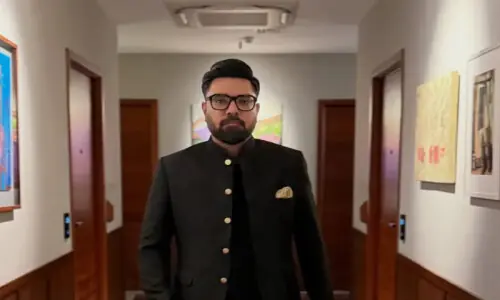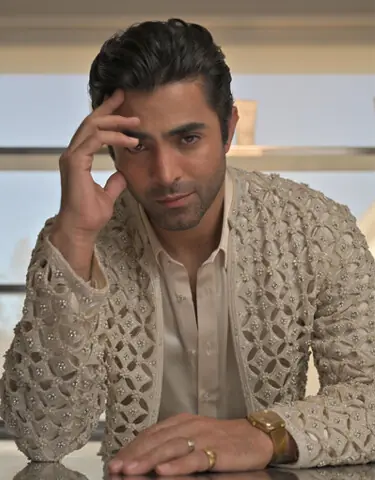
It is a hot afternoon when I arrive at Sheheryar Munawar’s office at Three’s Entertainment, his production house. As I wait for him, I get a chance to take in his office.
The walls are painted purple and film posters hang around the room. A chandelier fashioned out of green wine bottles hangs above. A floor lamp with a stand that resembles a gun is in a corner. The room has clearly been curated by someone who cares about aesthetics.
When Sheheryar enters, he matches the image in my mind: slightly long hair, stubble, shirt buttons casually undone. Before we even settle into conversation, he says that he is someone who is honest but controversy-averse, remarking that people often have “huge egos and small hearts.”
As the conversation progresses, it becomes clear that Sheheryar is brimming with opinions, although he believes not every thought is meant for the public.
Actor, writer, producer and director Sheheryar Munawar is revelling in his ‘second innings’ on television. But he has strong opinions on art versus commercialism, on what he wants to engage with personally, on human nature and on constantly improving himself. How does he do it all while also playing cricket, savouring food, learning music and building Lego worlds?
FROM A-LEVELS TO ADS
Sheheryar’s entry into the industry did not begin with acting as one might expect. He started modelling soon after his A-levels and later studied at the Institute of Business Administration (IBA), where he pursued a degree in finance with a minor in advertising.
While studying advertising, he was also starring in TV commercials which gave him the chance to see how they were made. “It was almost like I was getting on-the-job training without having graduated. In my advertising classes, I wouldn’t say I showed off, but I would mention that I worked in ads for various brands… I had bragging rights,” he remembers with a laugh.
He briefly worked at Engro Foods and later joined Rocket Internet, the venture capital firm that launched Daraz in Pakistan. By his own account, he was doing well and had a stable career trajectory ahead of him. But life had other plans.
While he was studying at IBA, he had also worked in a number of TV dramas, including Meray Dard Ko Jo Zuban Miley and Zindagi Gulzar Hai. And, as more acting offers came his way, he decided to chuck it all and pursue a career in acting full time.
THE ACCIDENTAL ACTOR
“I started getting a lot of calls for acting assignments and, although I was enjoying my job, I decided to quit and pursue acting. I tend to give 150 percent to whatever I do, I’m a bit of a workaholic that way. I felt acting would be an interesting experience — something new to explore.”
Surprisingly, however, acting didn’t captivate him too much at first. After collaborating with director Asim Raza on an ad, he was drawn to the world behind the camera, and eager to uncover the “method behind the madness.” Starting as an intern, he rose to assistant director (AD), then helmed commercials himself.
Together, Sheheryar and Raza launched Vision Factory Films and co-produced movies such as Ho Mann Jahan and Parey Hatt Love, in which Sheheryar wore the hats of both actor and producer.
Then came what he calls his “second innings” in television in the 2020s. And this time, he enjoyed acting more than the first time.
“I’ve enjoyed this phase much more, largely because working behind the camera gave me a very different kind of understanding of the work. I’m able to enjoy my characters more now. When I take on a role — I usually do just one project a year — I go in fully prepared.” As he talks, he gets up to show me some of his scripts with his notes in the margins. Clearly, he is a thinking actor.
Curious, I ask what makes this “second innings” so enjoyable — has his time in production and direction changed the way he approaches acting?
He pauses, considering the question. “I think it’s a combination of all those things,” he replies. “When I was working as an AD and spending time behind the camera, I was constantly learning. I was also reading a lot of books on acting and its different schools of thought, including An Actor Prepares.”
THE APPEAL OF IMPERFECTION
I remark that his recent roles are shaded in grey, and are far more complex than the straightforward heroes of his early days. He nods in agreement.
“It’s a conscious effort, but it’s also about the depth of the characters I’m playing now,” he says. “A human being is never perfect. Nobody is. We’re not meant to be. So, even if a writer gives me a seemingly perfect character, my job is to find the imperfections within him.
“I don’t just enjoy playing the virtues — I’m far more interested in the flaws. Machine-made things can be perfect, but there’s more beauty in something handmade — in its irregularities, in the marks of the craft.”
He gives the example of his character in Ae Ishq-i-Junoon. “On paper, Rahim was the ideal brother — dependable and loving. But I played him in a way that kept the audience slightly uneasy, as if something wasn’t quite right and they kept wondering if he was hiding something.”
He adds: “As Winston Churchill once said about a man he despised, ‘He has all the virtues I dislike and none of the vices I admire.’” That, in many ways, captures the essence of building a character for him. “It’s about deciding which virtues or vices and imperfections will make them likeable.”
FILM VERSUS TELEVISION
Given that he has worked in films and TV, I ask him which medium he prefers.
“I’d say both have their own strengths,” he says with practised ease. “In films, everything is larger than life — not just the characters, but the entire scale of production. From the sets to the supporting cast, from elaborate sequences to dances and costumes. Even the promotions are larger-than-life. That’s what makes it exciting.”
Television, on the other hand, is a very different challenge, as a narrative can span 35 episodes — sometimes even longer. “As a lead in a 35-episode drama, you’re looking at roughly 70 to 80 days of work, often with 12-hour shoots,” he points out.
“But what television demands — and offers — is having to sustain a character over a long arc, and it really polishes you as an actor. I enjoy both the processes, but they’re very different.”
ON PRIVILEGE AND PERCEPTION
Given that he is the nephew of producer and the founder of the Hum TV Network Sultana Siddiqui and that his father was also on the board of directors of Hum, I ask him whether people thought things came to him easily or if he was ever labelled a “nepo baby”?
He responds with ease without the slightest hesitation or irritation: “My first proper lead role and hit came very early in my career — in Aasmanon Pe Likha — which was with Geo. That was one of my first substantial roles. That came from a network I had no familial connection with.
“After that, I worked primarily with ARY. And there’s no blood relation there either — ARY is simply one of the leading networks in the country. Naturally, if you’re doing one project a year, your chances of success are higher when you’re working with a channel that has strong reach and viewership.”
He also points out that he has worked with Hum briefly and that too early in his career in dramas in which he had smaller roles. “There could be many assumptions or gossip around that, but the reality is quite straightforward. I can honestly say that whatever I’ve achieved has been through my own work. I produced my first film at 26. Nobody had anything to do with that except my own efforts.”
MESSAGING OR ENTERTAINMENT?
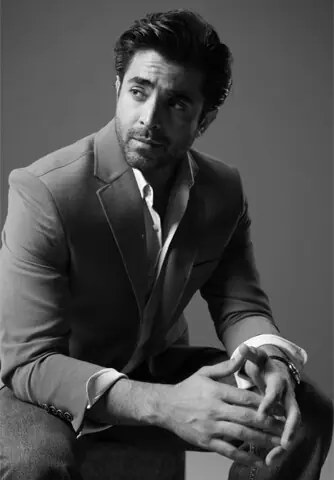
Calling Sheheryar simply an actor hardly does justice to his range — he is also a writer, director and producer. He’s penned and directed two short films, Prince Charming and Budhi Ghorri Laal Lagaam, and he urges me to watch them.
When I bring up the lack of diversity in dramas, he gently pushes back.
“If you watch Prince Charming, you won’t even realise I’m talking about postpartum marital depression,” he says. “I start off with a woman, and it appears as if she’s cheating on her husband in her own house.”
That, he explains, was deliberate: “I wanted to grab you. I spoke in a language I know will make you tick. In the end, I left you with a message about postpartum marital depression. And you become more empathetic towards women as a result. I gave you a message, but I also entertained you at the same time.”
He sees polarisation as a major issue in the television industry. “Some filmmakers are very commercial while others sermonise.”
He is blunt about content that doesn’t connect with audiences: “You call it art. I’m sorry, if people don’t watch it, it’s not art. If an expression is not creating an impression then, logically, it’s not an expression. It becomes a self-indulgent rant.”
He is also critical of filmmakers who say that they don’t care about ratings. “Then why are you in this business? Write a diary instead. Maybe someone will publish your memoirs.”
FINDING THE MIDDLE GROUND
For him, the solution lies in finding a middle ground. “You need to say something important, but in an entertaining manner — so people actually want to watch it and don’t feel that they are being preached to.”
He explains further. “Even a hakeem [traditional healer] gives meethi dawa [sweet medicine] — you need to sugarcoat medicine to make it work. The hardest thing is finding that middle ground between art and commercial storytelling. And that’s exactly what we’re trying to do at Three’s Entertainment.”
He cites the recent Fahad Mustafa and Mahira Khan-starrer Aag Lagay Basti Mein as an example of positive messaging delivered through entertainment.
“I loved the film. It was entertaining. But it also touched on something very interesting — the golden paint that the beggars are made to wear. Through the film, they entertained you, but also showed the plight of such beggars. At the end of the day, that was something you took away — that this is wrong and we need to do something about it.”
THREE’S COMPANY, ONE VISION
As the conversation moves towards the production house, he calls in Sonya Khan, his partner in the company (the third partner is Salman Iqbal, her husband who heads ARY). She echoes Sheheryar’s views and adds that, at the end of the day, TV is a consumer-driven business.
“When you’re in this business, you can’t just produce what you personally like. You also have to consider what the audience is ready to watch. It is about balance — you want to educate and evolve their taste, but you can’t impose it all at once. It has to happen gradually,” she says.
THE MANY PASSIONS OF SHEHERYAR
Curious about how he juggles so much, I ask if he ever finds time for anything beyond work. To my surprise, his list of hobbies is long.
“I’m a very sporty man,” he responds. “I play a lot of cricket as well as padel and squash. I’m also a voracious reader and a film enthusiast, with a long list of comfort movies I revisit. Documentaries, true crime and history [genres], fascinate me.
“My passion for history also runs deep — I love reading, watching and discussing it. Politics and political theory intrigue me too — Niccolo Machiavelli’s The Prince is a favourite. I love philosophy and psychology.”
Some might call some of his interests dry, but he finds them fascinating, especially the ones related to understanding human behaviour. “I love studying human behaviour because I feel like, when I write, it allows me to get into my characters. Even when I act, it really helps me to understand how people think and what makes them tick. Something that really excites me is trying to understand how people think.”
Music is another love. “My wife also sings, and we even have a ustaad who gives us lessons. I’m also a Lego enthusiast, building massive, intricate sets meant for adults with 16,000 or so pieces. I was also into aeromodelling and remote-controlled planes. I’ve always been a bit of a nerd. I have a very active mind, so I need to keep it occupied with things that allow me to create constructively, as opposed to being destructive and think about people.”
He also calls himself a foodie — he loves to eat and sometimes even travels to pursue his love for cuisine. “Last year, my wife and I spent a week in Thailand simply to savour the food. For me, food is a major factor in choosing travel destinations. I also adore Turkish food.”
A STUDENT OF THE CRAFT
With so much on his plate (no pun intended), it’s impressive he manages it all, I tell him. But can he be pinned down?
“If I had to describe myself, I’d say I’m a student of the performing arts. Acting, directing, producing — they’re all interconnected. Directing sharpened my acting, and both helped me become a better producer. They are really just different roles within the same creative machine.”
He adds: “These days, acting feels like a luxury — a chance to have fun without stress. Producing is the toughest job, while directing and acting together is still manageable.”
So, what’s next for Sheheryar Munawar?
He says he’s looking forward to his role in the forthcoming play Dar-i-Nijaat that Three’s Entertainment is currently making in addition to other serials. Though he keeps details under wraps, he shares that the role is challenging, and he’s working to add layers to it and his face lights up as he talks about it.
As the conversation winds down, I ask Sheheryar if there’s any particular character he has played that he most identifies with. “Rahim [from Ae Ishq-i-Junoon],” he shoots back immediately. “He had an inherent need to be good, but he also had to face his own demons — and I think that’s my journey too. At the core, I believe everyone needs to ask themselves what their purpose is. For me, it’s simple: keep improving at everything I do. That’s why I think I’ve been sent into this world.”
This sense of purpose — to keep improving and to keep searching for and bringing out imperfections — seems to be what defines and drives him.
The writer is a member of staff. Instagram: @mamunadil
Published in Dawn, ICON, May 10th, 2026