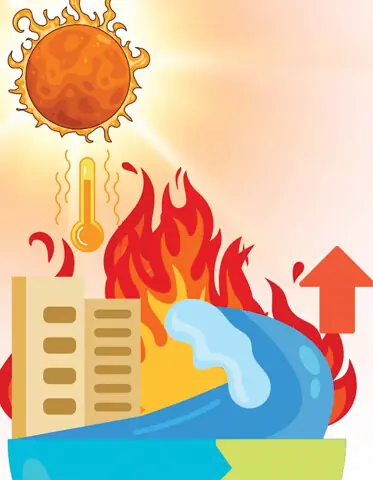
It’s obvious that as time passes, the weather is changing very rapidly and the intensity of the heat keeps increasing. The earth is the same, the sun is the same, but what has changed that the temperature has increased to such an extent that heatwaves are almost constant occurrences in summer?
Zubair was standing by his room’s window, looking at the scorching sun and the deserted roads outside, thinking about all of this. These same questions were running through his mind, and he was completely lost in his thoughts.
He went and sat beside his mother and shared his concerns with her.
His mother replied, “Son, all of this isn’t happening on its own. We humans have caused this. We have increased pollution on Earth to such an extent that we have become the reason for these changes. We cut down trees, pollute the air with vehicle emissions and factory smoke, and contaminate the oceans by dumping garbage, oil and chemicals into them. Climate change is the result of our own actions, and now we have to face the consequences.”
She further explained, “When I was your age, summer was hot too, but it wasn’t as intense as it is today. People didn’t fall ill so often or suffer from heatstrokes like they do now. Even in summer, there was a freshness in the air. People were not afraid to step outside. Daily life went on normally. But now, summers have become nothing less than a test for people.”
These words deeply affected Zubair. He realised that the rising heat was not just a normal change, but a serious warning. He quickly went to his room, opened his laptop and started researching further.
The more he read, the more shocked he became. He discovered that this was not just a seasonal issue, but a serious global problem called climate change. Ice in the North and South Poles is melting rapidly, causing sea levels to rise. Floods are occurring in many parts of the world, or there is a growing risk of them. This is not just Pakistan’s problem, but a global one. And the reasons are the same — deforestation, smoke from factories and vehicles, and pollution of all kinds.
Zubair wondered that if people knew about this, then why there were not enough efforts or actions taking place to improve the situation? It seemed that neither people nor governments were taking it seriously. But Zubair decided that even if he was young, he would not sit idle. He would do his part.
He went back to his mother, shared everything he had learned and told her that he wanted to bring a positive change. He asked if he could plant trees in the courtyard of their house.
His mother was very happy. She realised that, despite being young, her son was aware and concerned.
She smiled and said, “Yes, of course. You can plant as many trees as you like, not just in our garden, but in the neighbourhood too.”
Zubair also decided that he would spread awareness. He would talk to his family, relatives and friends, and even give a speech at school so that more people could understand the issue.
Soon, Zubair not only planted trees in his own house, but also in his neighbourhood with the help of his family and friends.
This is also a message for all of us. Together, through small steps, we can bring about a big change. It is our responsibility. If we keep thinking, “What difference will one person’s effort make?” nothing will change.
Published in Dawn, Young World, May 9th, 2026