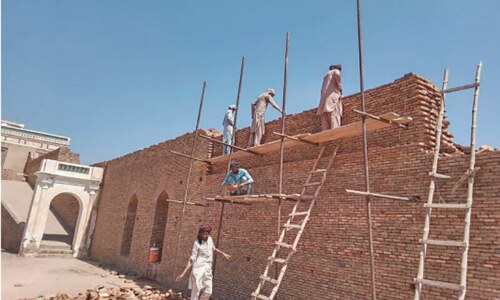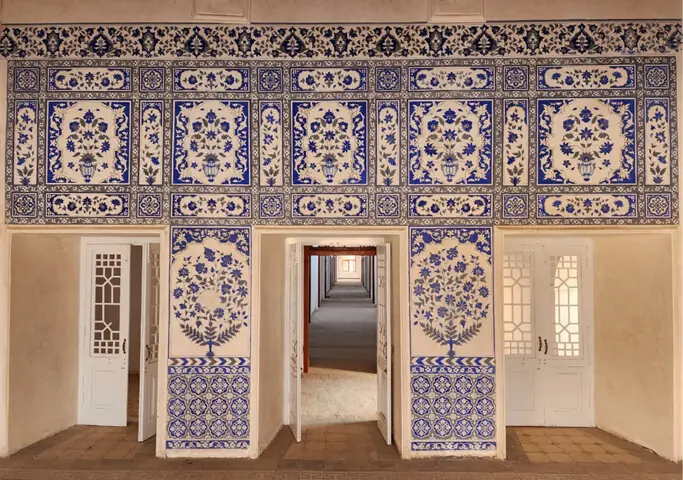
BAHAWALLPUR: The Punjab archaeology department claimed to have completed its over Rs120 million project for the conservation and restoration of some parts of the late Nawab of Bahawalpur Sadiq Muhammad Khan Abbasi V’s secretariat and residential portion inside the historic Derawar Fort, located in Cholistan desert, about 70kms from here.
The work on the project, which also included the restoration of a fortification wall close to the late Nawab’s civil buildings, was taken in hand during 2022-23.
Archaeology department Sub-Divisional Officer (SDO) Sajjad Ahmed told Dawn on Wednesday that the renovated portions of these historic buildings are ready and may be opened to the visitors in due course of time.
He says that both buildings have been decorated with modern tiles and material, while preserving their original architectural designs.
He says the department had earlier completed the restoration of the fort’s eastern side bastions, fortification wall, a platform, Baradari, main gate, godown and the historic mosque, costing a sum of Rs141.895m under the project.
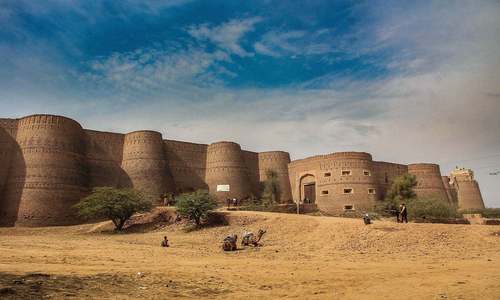
Derawar Fort, which attracts a large number of tourists and visitors annually, is a landmark of Cholistan desert and a masterpiece of architecture, said to be built by Rai Jajja Bhatti of Jaisalmir in 9th century A.D.
According to historical accounts, the present fort was built by the Nawab of Bahawalpur, Sadiq Muhammad Khan-1, in 1733 A.D, and it remained under the control of the ruler of now defunct Bahawalpur State till 1966.
The fort, having a massive structure, was built almost in a square plan, visually. The walls, along with 39 lofty bastions, were raised using small-size burnt bricks on both interior and exterior facades, while using sun-dried small bricks of the same size in the central core of the structure. However, mud mortar was used in the entire masonry work as binding material.
Due to its historical and architectural significance, it was declared protected in 2005 by archaeology department under the Antiquities Act 1975, and later on it was included in the Tentative Word Heritage List of Unesco in 2016.
After the death of Nawab Sadiq Muhammad Khan Abbasi V in 1966, the fort’s structure started deteriorating for lack of maintenance, but during the previous years, the archaeology department and Bahawalpur divisional administration had been allocating funds, from time to time, for the preservation and restoration of its decaying portions.
Published in Dawn, May 7th, 2026