Sindh High Court moved for devolution of solid waste management to towns, union committees
KARACHI: The opposition Jamaat-i-Islami has moved the Sindh High Court against the Sindh Solid Waste Management Board (SSWMB) Act, seeking devolution of all waste management functions and funds to town municipal corporations (TMCs) and union committees (UCs).
Nine TMC chairmen belonging to the JI and the leader of the opposition in the City Council filed a petition on Wednesday, citing the local government secretary, SSWMB and Karachi mayor as respondents.
They stated in the petition that waste management fell within the exclusive jurisdiction of local governments and sanitation, removal of waste, collection and disposal of refuse were listed in the relevant law as compulsory functions of TMCs and UCs.
However, they said, the Sindh government had established the SSWMB through a legislation in 2014 and its framework had effectively overridden the role of local governments and was fundamentally inconsistent with the constitutional mandate as well as the spirit of the local government system.
Jamaat’s elected LG representatives ask court to declare SSWMB Act contravenes Article 140-A of Constitution
The petitioners submitted that under the current system, the SSWMB operated at the provincial/divisional level and outsourced waste management services to private companies, which were contractually responsible for door-to-door collection, street sweeping, transportation of garbage to transfer stations and onward disposal at landfill sites.
However, they maintained that UCs and TMCs, the primary grassroots institutions of governance, had been completely excluded from this process while the performance of the private companies engaged by the board had been grossly unsatisfactory.
The petitioners also argued that in numerous instances, these companies delegated their work to smaller sub-contractors, who employ unskilled, untrained labourers, including children, women and elderly persons, often at meagre daily wages.
They contended that Article 140-A of the Constitution imposed a mandatory obligation upon provincial governments to devolve political, administrative and financial responsibility and authority to elected local governments.
But by vesting exclusive control over a core municipal function of solid waste management in a provincial/divisional body and stripping elected town administrations and UCs of their compulsory statutory functions, the SSWMB Act was directly in conflict with Article 140-A of the Constitution, they added.
Referring to a 2022 judgement of the Supreme Court that struck down Sections 74 and 75 of the Sindh Local Government Act, 2013 as unconstitutional, they maintained that the provincial government cannot launch any project or carry out any function that came within the purview of local governments.
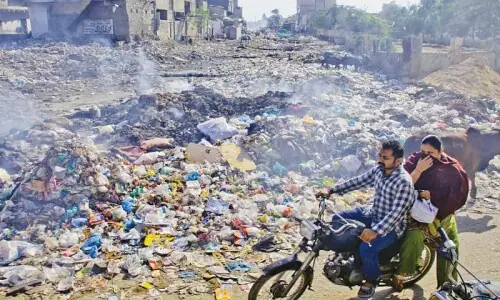
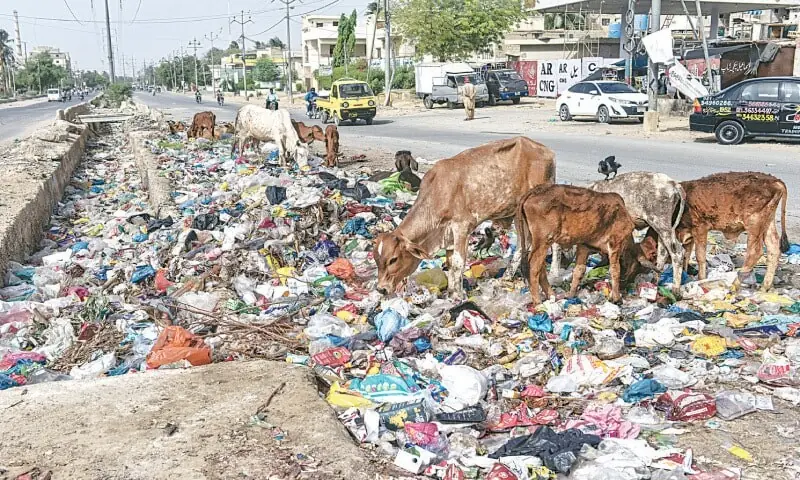
The petitioners also argued that owing to the poor and inadequate performance of private companies, there was strong and reasonable presumption of financial impropriety and corruption within the system while citizens were suffering acutely as garbage was neither regularly collected from households nor properly swept from streets and public spaces.
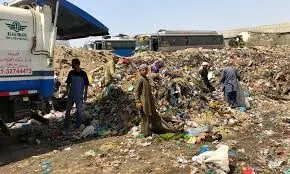
They further stated that garbage transfer stations, originally conceived as temporary holding points, had effectively been converted into permanent and open-air dumping grounds within residential areas posing severe public health hazards.
They contended that as a further consequence of the failure of the system, streets and public thoroughfares remain uncleaned for extended periods and accumulation of dust and particulate matter was exacerbated by vehicular traffic, which continuously dispersed pollutants into the atmosphere further deteriorating the air quality in the city.
The petitioners pleaded to declare the SSWMB Act inconsistent with and repugnant to Article 140-A of the Constitution to the extent that it strips elected TMCs and UCs of their compulsory statutory and constitutional functions relating to solid waste management.
They also asked the SHC to issue directives to respondents to forthwith devolve all waste management functions, funds, resources, machinery and personnel to the respective town and UC administrations and to restrict the role of SSWMB solely to the management of waste disposal operations at landfill sites located outside the city limits.
They further sought directives for respondents to ensure, on an interim basis and until appropriate legislative amendments are made, that all waste management operations including door-to-door collection, street sweeping and transportation of waste to landfill sites are carried out under the direct supervision, monitoring and control of TMCs and UCs.
Published in Dawn, May 7th, 2026