Call for urgent action, equitable climate finance, stronger global-local coordination


 0
0


ISLAMABAD: Policymakers, experts and stakeholders on the second day of the Breathe Pakistan Climate Change Conference 2026 highlighted that despite contributing minimally to global emissions, Pakistan remains among the most climate-vulnerable countries, underscoring the need for coordinated, locally grounded and globally informed responses.
The two-day event was organised by DawnMedia.
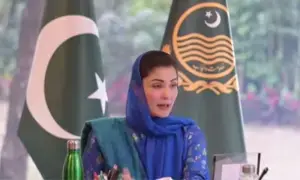
Speaking at the event, Senator Sherry Rehman said that global frameworks overlook the environmental impact of conflicts, while Pakistan continues to bear disproportionate climate risks despite minimal emissions.
“The Kyoto Protocol did not include any conflict or war spending or even a military movement footprint. Neither did the Paris Agreement. This has been the great silence, and now it’s time to talk about it,” she said.
Policymakers, experts and stakeholders say Pakistan continues to bear disproportionate climate risks
She warned that these gaps would have direct consequences for Pakistan. “It will impact our coastline. It will impact the air we breathe, which is already among the most toxic in the world at certain times of the year. We have over 140,000 fatalities due to air pollution alone, and that number is going up,” said Ms Rehman, who also chairs the Senate Standing Committee on Climate Change.
Rehman warned of a widening gap between global climate ambition and actual action, citing fragmentation within the international movement and rising geopolitical tensions. She noted that climate efforts remained divided across governments, grassroots groups and indigenous communities, weakening the collective response at a critical time.
While climate targets are based on carbon budgets, she said, real-world impacts are intensifying, with Pakistan already facing extreme heat and environmental stress. She reiterated that global agreements such as the Paris Agreement had overlooked the environmental consequences of conflicts.
Raising concerns over climate finance, Rehman said most funding for countries like Pakistan comes in the form of loans, adding to debt burdens instead of addressing vulnerabilities. She called for urgent reforms in global financial institutions to ensure accessible and equitable support.
Emphasising local priorities, she urged immediate action on water security, air pollution and sustainable urban planning. She also warned against unchecked development in green areas, stressing that environmental degradation carries long-term economic and public health costs.
The senator called for integrated global and local responses, saying climate change, conflict and economic challenges are deeply interconnected and require coordinated solutions.
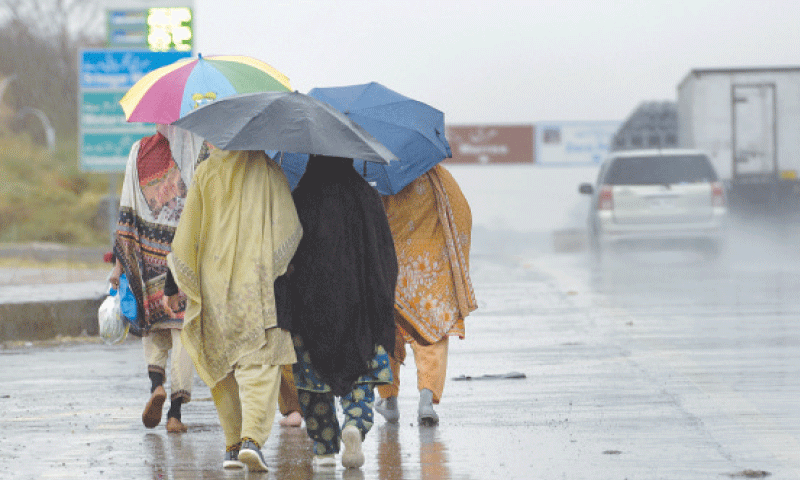
Speaking on the impact of air pollution on life expectancy, Climate Change Minister Musadik Malik said Pakistan contributes less than one per cent to global carbon dioxide emissions, yet in some parts of the country, children are exposed to air that is up to 100 times more toxic.
He noted that around ten countries produce about 78 per cent of global emissions, questioning the fairness of the situation.
“Those facing the impact of climate change in Gilgit-Baltistan are not the ones responsible for it, nor is the farmer in Sindh responsible for rising sea temperatures,” he said.
“Is this about rights, justice or political will and even our own political will, not just international?” he asked.
Mohamed Yahya, the UN resident and humanitarian coordinator in Pakistan, said the cost of building climate resilience was rising while financing remained insufficient.
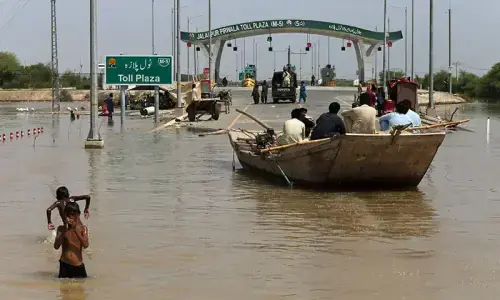
“Pakistan has witnessed repeated floods that have cost billions of dollars,” he said, adding that annual losses were comparable to the country’s IMF programme. “The constraints and the challenges overall are of execution. We are seeing very little implementation,” he said.
S Adeel Abbas, regional climate lead at the World Bank Group, acknowledged the government’s policy commitment to tackling climate change.
Earlier, in her welcome remarks at the inaugural session, Dawn CEO Nazafreen Saigol Lakhani said climate change was no longer a distant threat but a lived reality for Pakistan. She pointed to recurring floods, heatwaves, water stress and air pollution as pressing challenges.
She noted that recent disasters, including the 2022 floods and extreme weather events in 2025, had caused widespread loss of life and economic damage.
Emphasising collaboration, she called for stronger alignment between the government, private sector and communities, alongside greater focus on adaptation, climate finance, energy transition and accountability to build resilience and safeguard Pakistan’s future.
Published in Dawn, May 7th, 2026