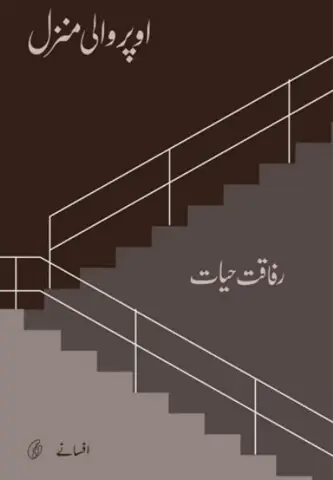
Upar Wali Manzil
By Rafaqat Hayat
Ilqa Publications
ISBN: 978-969-640-364-7
178pp.
After his magnum opus, Rolaak [Vagabond], Rafaqat Hayat has come up with a volume of short stories. However, his affinity for the longer form remains evident in this collection, where his best pieces may be described as long short stories. Most of these depict life in the small towns of rural Sindh, where Hayat spent most of his childhood and where most of his lively characters originate.
The volume opens with the story ‘Raat’ [Night]. On the very first page, we encounter two truckers. Poor yet full of life, these truckers are reminiscing about their sexual exploits, whether real or imagined. The truck and the night in which they travel become characters in their own right. The prose animates everything in and around the truck: its trembling light, its half-broken frame and its screeching and shrieking sounds cutting through the stillness of the night.
The interplay of sights and sounds is engrossing and leaves you thoroughly immersed in the ambience. The junior trucker is brimming with unspent energy, which he needs to expend on his wife at the earliest opportunity. The wife, meanwhile, is pregnant.
We encounter several colourful characters in this collection. A landowner, escaping from his thankless family to a big city, runs into an old friend, eats a hearty meal and leaves his suitcase with his friend’s family. An old man reminisces about his youth, when he met a girl — first as a lover and later as a murderer. A 10-year-old boy waits to be circumcised while the whole world watches as a spectator. These are ordinary people, living ordinary lives — worried in their own way, happy in their own way.
A collection of Urdu short stories gathers a cast of lively characters from rural Sindh, shaping stories that blur the line between the ordinary and the profound
It is in the longer form that Hayat’s art really comes to fruition. In ‘Nizam Din Chowkidar’ [Nizam Din, The Guard], a watchman suffers from impaired vision. He is old and lives with his wife and a granddaughter who guides him through his dimming world. He works in a department awaiting the arrival of an inspector who might discover his impairment and have his job terminated.
Yet, there is another layer: the world is presented through two contrasting perspectives. Nizam Din watches a dimly lit world gradually closing in on him while his granddaughter, little Surayya, discovers a world unfolding before her. Surayya’s new world is exuberant but also fraught with traps. One such trap is sexual harassment. The scene depicting this is described with masterly circumspection, suggesting that sexual harassment is a routine reality in the poorer segments of society.
‘Kudaal Ki Awaz Aur Aik Nazm’ [The Sound of a Pickaxe and a Poem] is my personal favourite among these stories. It has the allure of a smoothly flowing poem. A young supervisor of a telecom company, who happens to be a poet, hires labourers to dig up a road to lay down a cable line. While the labourers toil in the scorching heat, he indulges himself in romanticising and composing a poem about an elusive woman who appears on the balcony of a nearby building.
But this balcony is not the only object of our Romeo’s fixation. He is required by his employers to ensure that the day’s work is completed and to be stern with the labourers. This tension between duty and desire constitutes the core of his dilemma. The fuss of the labourers gradually dissolves into the rhythm of the pickaxe and, after a few false starts, he is able to complete his poem.
Two longer short stories deserve a special mention: ‘Curfew’ and ‘Upar Wali Manzil’ [The Upper Storey]. ‘Curfew’ is a story about Karachi in the 1980s, when curfews used to be imposed because of the deteriorating law-and-order situation in the city. The atmosphere of fear that engulfed certain areas is depicted through the eyes of a young child who is a newcomer to the city and is fond of spy fiction.
‘Upar Wali Manzil’ is a psychological study of two sisters, afraid of going beyond the marriageable age, vying for the same man who happens to be their tenant. It is a slow-moving story, where the tension between the characters builds up gradually and the stakes get higher and higher. It is a detail-encrusted story that will always remain etched in your memory.
‘Pushtbaan’ [The Protector] stands apart from the other stories in this collection because of its layered style, in which a realistic narrative runs parallel to a symbolic one. A pushtbaan is someone you can always fall back on in times of need; yet in such moments, one often turns inward and seeks answers within oneself.
This is the story of a man and his seemingly intangible cousin. The cousin has a habit of disappearing for long stretches of time and his ageing father relies on the protagonist to find him. However, the search for the cousin can also be interpreted as the protagonist’s search for his own soul. The cousin is, in fact, the protagonist’s doppelgänger. Thus, the outward journey becomes an inward quest. The style of the story recalls ancient tales such as ‘Aaraish-i-Mehfil’, where Hatim Tai sets out in search of answers to seven questions.
One quality that defines Rafaqat Hayat’s style is the way he mingles his characters with the atmosphere around them. This art was perfected by Thomas Hardy in his novels. In Urdu literature, we see a similar quality in Rajinder Singh Bedi’s novel Aik Chadar Maili Si [The Dirtied Cloak]. Hayat’s characters do not exist in a void. He plants them firmly in soil fertile enough for their luxuriant growth.
His characters possess a certain Chekhovian geniality. They offer you food, tea or an occasional puff of a cigarette or hash. They are sociable and invite you to tell your story and warm you up to listening to theirs. Hayat is never in a hurry. He offers you to mingle with his characters, dispels any hesitation you may feel about entering their world and gradually makes them your companions.
There is a thing or two that fiction writers can learn from this volume, such as how one should start a story and how to carry it through and sustain it with assurance. When these two elements are handled satisfactorily, there is little need to contrive an artificial twist at the end. This small collection of 178 pages is a treat to read and re-read.
The reviewer is a poet, fiction writer and translator.
His latest Urdu poetry collection Gul-i-Dogana, published by Maktaba-i-Daniyal, was short-listed for KLF poetry prize this year. He can be reached at kashifsyedraza@gmail.com
Published in Dawn, Books & Authors, May 3rd, 2026