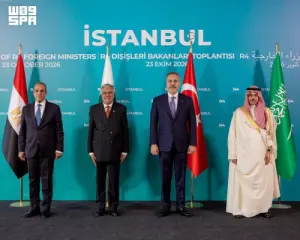
PAKISTAN is navigating one of its most delicate balancing acts in years. Not only did its leadership manage to secure a ceasefire at the height of the Middle East tension, its capital also became the venue for talks between the US and Iran — a rare direct engagement between the two in decades. This high-stakes role signals Pakistan’s growing relevance in a fragmented global order but also raises a critical question: can a country with a fragile economy and complex geopolitical constraints maintain its position without its neutrality being compromised?
Thus far, Islamabad has managed a careful equilibrium by engaging competing sides in the conflict without overt alignment with one. This posture has been enabled by two key dynamics. The current American administration has avoided issuing explicit ultimatums of the kind seen in the post-9/11 era — terms such as “either you are with us, or you are with the terrorists”. At the same time, Pakistan’s hybrid governance regime has allowed a calibrated and cautious policy stance, without external legitimacy pressures. However, this space is rapidly narrowing as the conflict elongates.
There should be little ambiguity about the drivers of this war: beyond publicly stated regional security narrative and concerns over Iran’s nuclear capability, it appears to be a fight for control over critical resources. This makes an early resolution highly unlikely, despite the current de-escalation. On top of Pakistan’s mediation efforts, war fatigue and mounting economic and energy market pressures have called for a temporary pause. Yet such breaks appear tactical, and not structural in nature.
If the war prolongs, Pakistan may come under pressure to align — through logistic support or intelligence, raising the risk of another Afghanistan-like situation for the country. In this context, Pakistan faces two core challenges. The first is navigating between two brotherly countries. On one side stands Iran, which not only shares a long border but also enjoys strong association from Pakistan’s Shia community. On the other is Saudi Arabia, which shares a profound spiritual affinity with the majority of the population and has also recently signed a Strategic Mutual Defence Agreement. This dual alignment renders any clear-cut policy choice inherently sensitive and consequential.
Survival will not depend on choosing sides.
Second, is maintaining deep ties with China without compromising economic and strategic links with the US. Although the US still dominates military power, advanced technology and global finance, China is rapidly emerging as an economic superpower. Consequently, countries across Europe, East Asia and the Global South are gravitating towards Beijing’s economic pull. In this evolving landscape, Pakistan faces a core dilemma: balancing its long-standing relationship with Washington while staying aligned with China.
In such a multipolar world, survival will not depend on choosing sides but on maintaining the capacity to choose. That capacity ultimately rests on two imperatives. First, strengthening the economy, which is a key constraint on an independent foreign policy. At the heart of Pakistan’s strategic dilemma lies its economic fragility. Persistent balance-of-payments pressures with low exports and limited foreign exchange reserves, high external debt and structural fiscal weaknesses constrain autonomy.
A prolonged conflict would intensify these pressures through energy price shocks, trade disruptions, capital outflows and tighter external financing conditions. Pakistan must accelerate structural economic reforms, move beyond an elitist policy focus, and create a more conducive environment for busin-esses that are currently overtaxed and overregulated. Most critically, the country needs to shift its growth paradigm away from remittance-driven consumption towards technology-led productivity and innovation — an approach long emphasised in endogenous growth theory.
Second, institutionalising neutrality. A neutral Pakistan must not only be balanced but also be predictable and credible. When a state’s actions consistently align with its declared principles, it reduces uncertainty, builds trust across rival blocs, and transforms neutrality from a tactical stance into a durable long-term strategy.
Fortunately, being a declared nuclear power, Pakistan possesses a credible deterrent that significantly reduces the likelihood of direct military coercion. This capability, coupled with restraint and a consistent commitment to responsible state behaviour, strengthens Pakistan’s ability to remain neutral.
As the current truce ends, Pakistan’s real test begins. With economic resilience and institutional consistency, neutrality can be a strategic asset for Pakistan that will help navigate safely through the Middle East conflict.
The writer is an economist.
Published in Dawn, May 3rd, 2026