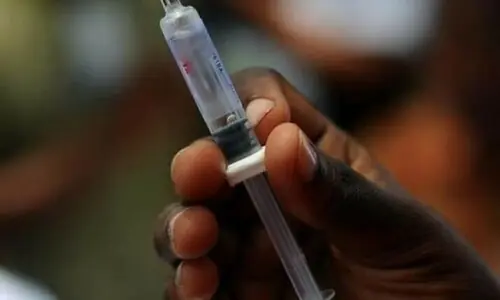
Govt urged to declare national health emergency over rising HIV cases


KARACHI: Raising an alarm over the recurring human immunodeficiency virus (HIV) outbreaks at healthcare facilities in the country, experts at a press conference held on Saturday demanded that the government declare a national health emergency over the “dangerous spread” of the disease, now affecting children in large numbers.
They also called for the strict implementation of basic infection control measures and the law on single-use syringes. They further pressed for setting up a national dashboard with credible information on the status of major infectious diseases, including HIV, hepatitis B, C and mpox.
Such an initiative, the experts emphasised, would help develop an evidence-based strategy to address the multiple health challenges the country faces.
Organised by the Pakistan Islamic Medical Association (Pima), the briefing on the rising HIV cases brought together experts from the Pakistan Paediatric Association-Sindh (PPA-Sindh), Pakistan Society of Physicians (PSP), Medical Microbiology and Infectious Diseases Society of Pakistan (MMIDSP) and Pakistan Medical Association (PMA).
Experts say Pakistan’s weak health infrastructure and low funding are fuelling preventable HIV infections, especially among children; urge strict enforcement of infection control measures
There was a consensus among the experts that a critical responsibility of disease prevention is completely missing from the mandates of provincial health bodies tasked to provide free diagnosis and treatment for HIV or other infectious diseases.
They also agreed upon the need to have enhanced health funding that could help ensure adequate medical supplies and infection control protocols.
“How could you implement these protocols in a country where the total health allocation remains critically low, consistently under one per cent of the GDP? Where hospitals operate either without or minimum supplies of basic infection control tools such as disinfectants, gloves or even clean water,” asked Dr Atif Hafeez Siddiqui, senior professor associated with Dow University of Health Sciences (DUHS).
The alarming increase in HIV cases, specifically, among children and low-risk groups in Pakistan in recent months, he stressed, clearly pointed to serious flaws within the healthcare system that a country, already burdened with multiple public health challenges, could not afford to ignore.
‘Internal reports lost in dust’
Dr Fatima Mir, heading the paediatric infectious disease section at the Aga Khan University Hospital, said a significantly large number of children from Sindh as well as other parts of the country were reporting with severe illness at the hospital’s HIV facility.
“Poor parents are being forced to travel to Karachi as the treatment of children with complex infections is not available in rural areas,” she said, adding that managing a child with HIV was 10 times harder than treating an adult with the same infection.
The spread of HIV among children in Sindh, she said, occurred mostly due to contaminated injections and unsafe medical practices, which was entirely preventable.
Dr Mir emphasised that the time had come for the country to shift from establishing more units to providing quality care.
“We should ask why only one to two hospitals in the country are internationally accredited? We have programmes to provide free HIV diagnosis and treatment, but there is no policy and action in place to protect the lives of millions of people in the country who are still non-infected,” she said.
Replying to concerns over the scale of the HIV challenge and lack of access to government data, Dr Mir said mere collection of data had no value unless it was interpreted by relevant experts and led to developing an evidence-based strategy to tackle the challenge at hand.
“Government departments carry out investigations in disease outbreaks, but these internal reports are lost in the dust. All stakeholders, including the general public, have the right to know how the outbreak occurred and who is responsible.”
She urged the medical societies to come forward to develop a cost-efficient infection control protocol that should be shared with all healthcare providers
In her remarks, Dr Samreen Sarfaraz, Chair of Infection Control Services and senior consultant at the Indus Hospital, said that unlike several countries where HIV cases and mortalities had seen a significant decline, Pakistan was seeing a rapid increase.
“A serious health crisis was recently identified in November 2025 among children as young as one year in Karachi, where more than 15 children attending a health facility in the Site town were diagnosed with HIV, with at least two fatalities,” she said, adding that the number of the affected children was still rising as screening efforts continued.
This revelation, she said, could only be the tip of the iceberg, with other public and private facilities providing unsafe healthcare contributing to a hidden, brewing HIV epidemic linked to healthcare.
The healthcare-associated HIV outbreaks had been reported in several cities in the country, including Taunsa, Multan and Larkana.
The speakers included Dr Syed Ahmer Hamid, heading PIMA Karachi, Dr Waseem Jamalvi, heading PPA Sindh, Dr Qaiser Jamal, heading PSP-Sindh, and Dr Asma Naseem of Sindh Institute of Urology and Transplantation.
Published in Dawn, May 3rd, 2026